
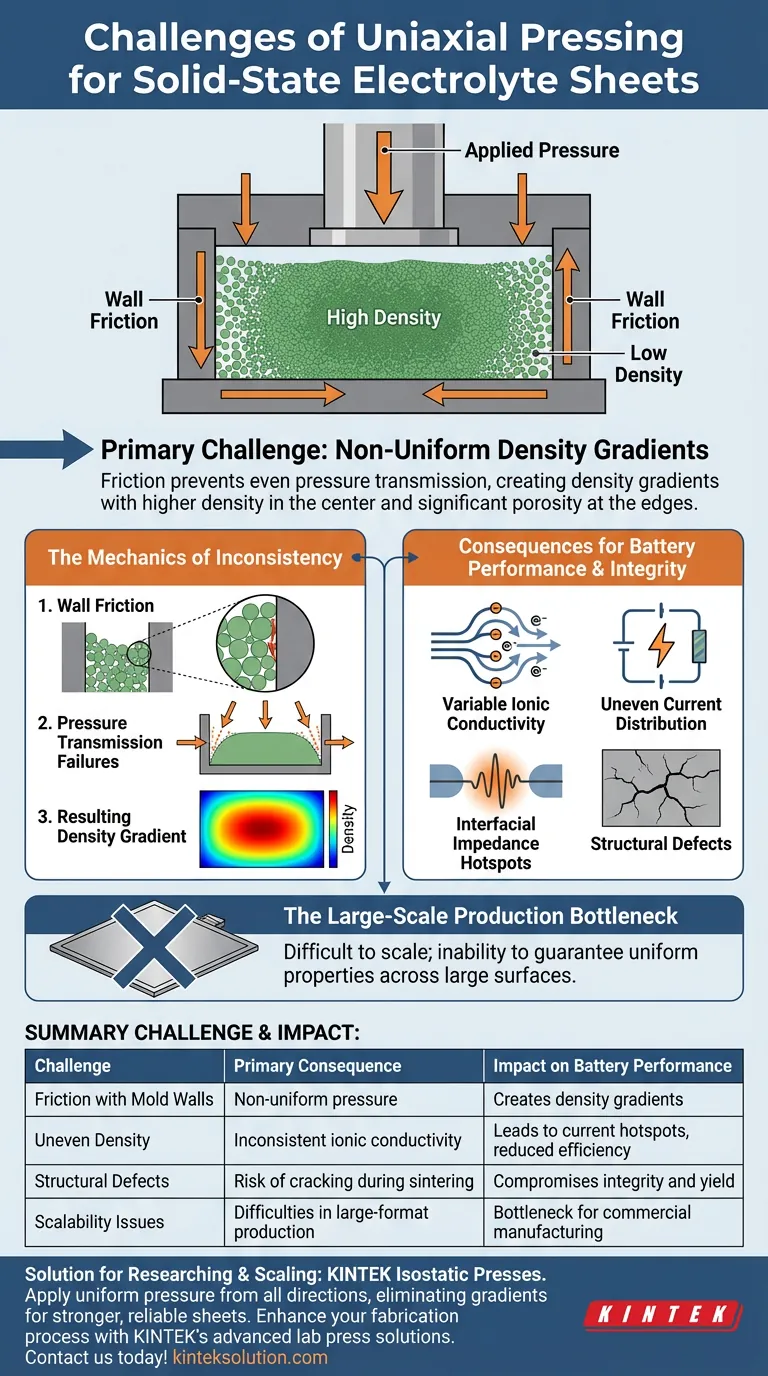
The primary challenge of using a uniaxial press for solid-state electrolytes is the creation of non-uniform density gradients. Friction generated between the powder and the mold walls prevents pressure from being transmitted evenly throughout the material. This results in a "green body" (the pressed powder before sintering) that typically has higher density in the center and significantly lower density at the edges, compromising the structural and electrochemical integrity of the final sheet.
While uniaxial pressing is essential for densifying powders to reduce porosity, the inherent uneven pressure distribution leads to inconsistent ionic conductivity and mechanical weakness, creating a significant bottleneck for scaling up production.
The Mechanics of Inconsistency
The Role of Wall Friction
When you apply pressure in a single direction (uniaxial), the powder does not flow perfectly like a fluid.
Friction immediately develops between the powder particles and the inner walls of the mold. This friction acts as a resistance force, absorbing some of the applied energy.
Pressure Transmission Failures
Because of this friction, the pressure applied by the ram is not transmitted uniformly through the depth and width of the sample.
The material closest to the moving punch receives the most force, while areas near the mold walls and further from the punch receive less effective pressure.
The Resulting Density Gradient
This physical limitation leads to a distinct microstructural defect: a density gradient.
The center of the electrolyte sheet typically achieves high density, while the edges remain more porous and less compacted. This inhomogeneity is not easily corrected during subsequent processing steps.
Consequences for Battery Performance
Variation in Ionic Conductivity
A solid-state electrolyte relies on dense, intimate particle-to-particle contact to transport ions.
Areas with lower density (such as the edges) have fewer contact points and higher internal porosity. This causes ionic conductivity to vary across the surface of the sheet, leading to uneven current distribution during battery operation.
Impact on Interfacial Impedance
High-pressure compaction (often ranging from 40 to 600 MPa) is intended to maximize ion conduction pathways.
However, if the pressure is uneven, the interfacial impedance will be inconsistent. Higher impedance in low-density zones creates resistance "hotspots" that can degrade overall cell performance.
Structural Integrity and Scalability
Defects in Green Pellets
Achieving a defect-free "green pellet" is a critical prerequisite for the high-temperature sintering stage.
If the green body has uneven density, it will shrink unevenly when heated. This significantly increases the risk of cracking and deformation during sintering, rendering the electrolyte sheet unusable.
The Large-Scale Production Bottleneck
While useful for small, standardized lab pellets, these issues become magnified as the size of the sheet increases.
The inability to guarantee uniform properties across a larger surface area makes uniaxial pressing a difficult technique to scale for commercial manufacturing of large-format solid-state batteries.
Understanding the Trade-offs
Simplicity vs. Uniformity
Uniaxial presses are standard laboratory equipment because they are cost-effective and capable of delivering extremely high pressures (up to 600 MPa) to create dense pellets.
However, you trade homogeneity for this simplicity. For small test cells where isolating intrinsic material properties is the goal, this trade-off is often acceptable.
Green Strength vs. Sintering Risks
Applying high pressure (e.g., 127 MPa) increases the "green strength" of the pellet, making it easier to handle before firing.
Yet, if that pressure is applied unevenly, you introduce internal stresses. You gain handleability in the short term but risk catastrophic failure during the final sintering phase due to differential shrinkage.
Making the Right Choice for Your Goal
To navigate these challenges effectively, you must align your fabrication method with your specific project objectives:
- If your primary focus is basic material characterization: Use uniaxial pressing to create small, dense pellets to quickly evaluate intrinsic electrochemical performance and cathode compatibility.
- If your primary focus is maximizing ionic conductivity: Ensure you apply sufficient pressure to minimize porosity, but be aware that conductivity measurements may vary slightly between the center and edge of the sample.
- If your primary focus is large-scale sheet fabrication: Recognize that uniaxial pressing likely has a hard ceiling; you may need to explore alternative compaction methods (like isostatic pressing) to achieve the necessary uniformity.
By acknowledging the friction-induced limitations of uniaxial pressing, you can better interpret your performance data and refine your manufacturing protocols.
Summary Table:
| Challenge | Primary Consequence | Impact on Battery Performance |
|---|---|---|
| Friction with Mold Walls | Non-uniform pressure distribution | Creates density gradients (high center, low edges) |
| Uneven Density | Inconsistent ionic conductivity | Leads to current hotspots and reduced efficiency |
| Structural Defects | Risk of cracking during sintering | Compromises mechanical integrity and yield |
| Scalability Issues | Difficulties in large-format sheet production | Bottleneck for commercial manufacturing |
Struggling with uniform density in your solid-state electrolyte research? The limitations of standard uniaxial presses are clear. For lab-scale production that demands superior homogeneity and consistent performance, KINTEK's advanced isostatic presses apply uniform pressure from all directions, eliminating friction-induced density gradients. This results in stronger, more reliable electrolyte sheets with even ionic conductivity.
Ready to enhance your fabrication process and accelerate your battery development? Contact our experts today to discuss how our specialized lab press solutions can meet your specific research and scaling challenges.
Visual Guide
Related Products
- Lab Round Bidirectional Press Mold
- Lab Polygon Press Mold
- Lab Cylindrical Press Mold with Scale
- Split Automatic Heated Hydraulic Press Machine with Heated Plates
- Lab Cylindrical Press Mold for Laboratory Use
People Also Ask
- What is the purpose of incorporating cartridge heaters into a lab press mold for MLCC block compression? Optimize Results
- Why is precise cooling management of the lab press mold necessary? Protect Core Integrity in Thermoforming
- What is the function of a pressing tool in thermoplastic panels? Master Precision Shaping & Fusion Bonding
- Why is a high-performance laboratory molding press critical for in-situ electrolyte formation? Unlock Battery Success
- How do the design and geometric precision of pressing molds and mandrels affect the quality of PTFE composite samples?



















