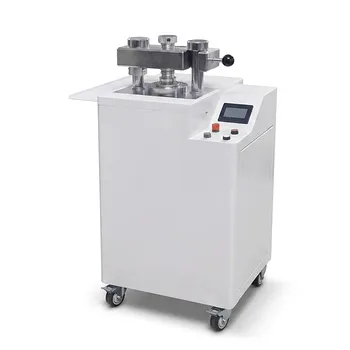
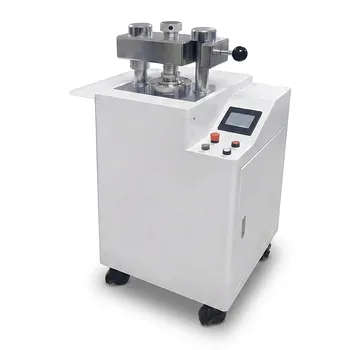
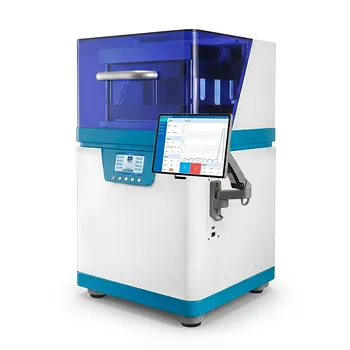
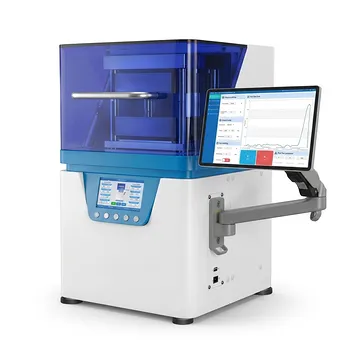
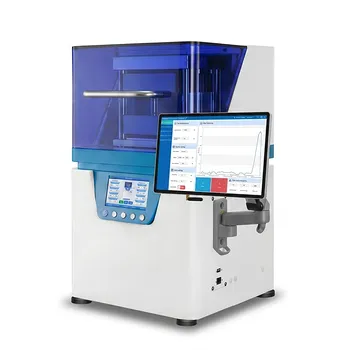
The choice between manual and power-operated hydraulic presses centers on the trade-off between initial cost and operational consistency. Manual presses rely on a hand-operated lever and physical exertion to generate load, making them a budget-friendly option for infrequent use. Conversely, power-operated presses utilize electric motors to drive the pump, offering automated, programmable control that ensures high precision and eliminates physical strain.
Core Takeaway While manual presses provide a cost-effective solution for laboratories with limited space or low sample volume, power-operated presses are the superior choice for high-throughput environments where data repeatability and operator workflow are critical.
Operational Mechanics and Physical Demand
The Source of Power
Manual hydraulic presses function via a simple hand-operated lever. This lever controls a piston moving within a cylinder filled with hydraulic oil to generate force.
Power-operated presses replace this manual leverage with an electric motor. This motor drives the pump and utilizes electric switches to control relief valves, automating the pressure application.
Operator Effort and Ergonomics
Using a manual press requires significant physical effort from the user. While these units can achieve loads up to 25 tons, reaching the higher end of this range is physically demanding and labor-intensive.
Power presses operate autonomously once programmed. This eliminates the physical burden on laboratory technicians, allowing them to focus on other tasks while the press cycle completes.
Precision and Data Quality
The Challenge of Consistency
In manual operations, the pressure applied can vary slightly based on the operator's technique. This variance introduces a variable that can negatively affect the repeatability of your XRF results.
Automated Repeatability
Power-operated presses are designed specifically for superior consistency. Basic power models allow users to set exact load ranges, ensuring that every sample is subjected to identical conditions.
By removing the human variable, power presses provide a more controlled and reliable pressing process. This is essential for laboratories requiring rigorous accuracy across large datasets.
Throughput and Efficiency
Workflow Suitability
Manual presses are most cost-effective for laboratories that use the press infrequently. Their simplicity makes them easy to deploy for occasional sample preparation without a complex setup.
Power presses are engineered for high-throughput environments. Because they operate autonomously and cycle faster without operator fatigue, they significantly improve overall laboratory workflow efficiency.
Footprint and Portability
Manual presses offer versatility in size, ranging from full-size benchtop units to handheld portable options. This makes them ideal for facilities with limited space or field applications.
Power presses generally require a dedicated benchtop space and a power source. They are fixed assets designed for stationary, high-volume production.
Understanding the Trade-offs
The Cost vs. Labor Equation
The primary trade-off is between capital expenditure and labor efficiency. Manual presses are the lowest cost option upfront but incur a "hidden cost" in the form of operator time and fatigue.
Simplicity vs. Control
Manual presses are mechanically straightforward but offer limited control over the rate of pressure application. Power presses introduce complexity but offer the ability to program specific ramp-up and hold times, which can be critical for difficult samples.
Making the Right Choice for Your Goal
To select the correct press, you must evaluate your daily sample volume and your tolerance for data variance.
- If your primary focus is Budget or Portability: Choose a manual press for its low entry cost and ability to fit into small or mobile workspaces for occasional use.
- If your primary focus is Data Consistency: Choose a power-operated press to eliminate operator error and ensure identical density across all prepared samples.
- If your primary focus is High Throughput: Choose a power-operated press to automate the workflow, reduce cycle times, and prevent operator fatigue.
Select the tool that aligns not just with your budget, but with the quality of data your application demands.
Summary Table:
| Feature | Manual Hydraulic Press | Power-Operated (Electric) Press |
|---|---|---|
| Power Source | Hand-operated lever (Physical labor) | Electric motor-driven pump |
| Consistency | Variable (Operator-dependent) | High (Programmable & repeatable) |
| Typical Throughput | Low (Infrequent use) | High (Continuous lab workflow) |
| Physical Strain | High (Especially at 20+ tons) | None (Automated cycle) |
| Footprint | Compact / Portable options | Fixed benchtop installation |
| Best Use Case | Budget-conscious or field research | Quality control & high-volume data |
Optimize Your Sample Preparation with KINTEK
Ready to elevate your lab's data precision? KINTEK specializes in comprehensive laboratory pressing solutions designed for every research need. Whether you require a budget-friendly manual unit or a high-performance, programmable automatic model, our expertise ensures you get the perfect density for your XRF samples every time.
Our value to you:
- Versatile Range: Manual, automatic, heated, and multifunctional presses.
- Specialized Tech: Glovebox-compatible models and advanced cold/warm isostatic presses for battery research.
- Expert Guidance: We help you balance throughput requirements with capital expenditure.
Contact KINTEK Today to Find Your Perfect Press
Related Products
- Automatic XRF Pellet Press for Laboratory Spectrometry Sample Preparation
- Automatic Fluorescence Sample Preparation Press 40 Ton Lab Pellet Press for XRF Analysis
- Automatic Laboratory Hydraulic Press for XRF and KBR Pellet Pressing
- Laboratory Hydraulic Pellet Press for XRF KBR FTIR Lab Press
- Manual Heated Hydraulic Lab Press with Integrated Hot Plates Hydraulic Press Machine
People Also Ask
- How can contamination occur during the preparation of pressed pellets for XRF analysis? Expert Prevention Guide
- How does the sample material influence the required pressing load for making an XRF pellet? Find the Optimal Pressure
- What are the different methods for preparing a sample pellet for XRF analysis? Expert Guide to Superior XRF Results
- What are the advantages of preparing a sample as a dense pellet for XRF? Unlock High-Precision Trace Element Analysis
- What is the primary purpose of using an automatic pellet press? Achieve Precise Geopolymer Analysis Results