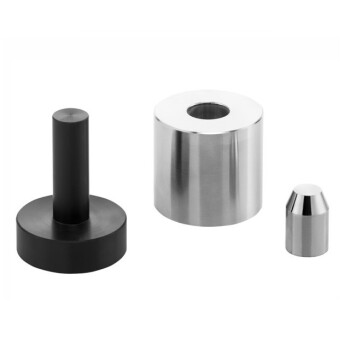
The primary functions of a precision laboratory press or sealing machine in solid-state battery packaging are to establish a hermetic seal and, more critically, to apply precise, controlled vertical pressure to the internal components. This mechanical force drives the solid-state electrolyte membrane into intimate physical contact with the lithium metal anode and the composite cathode. This process, often referred to as "interfacial wetting," eliminates physical gaps between layers to ensure the battery functions electrically.
Core Takeaway: In solid-state battery production, the press is not merely a packaging tool but an active instrument of electrochemical assembly. Its defining role is to mechanically force solid materials into atomic-level contact, which is the only way to lower interfacial impedance and establish functional ion transport channels in the absence of liquid electrolytes.
The Core Challenge: The Solid-Solid Interface
Overcoming Physical Gaps
Unlike traditional batteries that use liquid electrolytes to fill voids, solid-state batteries rely on solid-to-solid contact.
Without sufficient pressure, microscopic gaps remain between the electrode and electrolyte particles.
The laboratory press applies vertical pressure to close these voids, ensuring the electrolyte membrane "wets" the anode and cathode surfaces physically.
Reducing Interfacial Impedance
The primary obstacle in solid-state battery performance is high interfacial impedance (resistance).
If the layers merely touch loosely, the resistance is too high for efficient operation.
By forcing the components together, the press maximizes the active contact area, significantly reducing impedance and allowing lithium ions to transport smoothly across the interface.
Critical Functions in Production
Densification of Electrolyte Structures
Before final assembly, presses (often cold presses) are used to compact solid-state electrolyte powders.
Pressures can reach as high as 380 MPa to transform loose powder into a dense, pore-free pellet.
This densification creates a continuous path for ions, which is impossible to achieve with loose or porous material structures.
Establishing Ion Transport Channels
For a battery to cycle effectively, lithium ions must move from the anode to the cathode through the electrolyte.
The press ensures atomic-level contact between these layers, effectively building the "highway" for ion movement.
This continuous contact is a physical prerequisite for the battery to charge and discharge without significant degradation.
Hermetic Sealing and Protection
Beyond internal mechanics, the machine performs the vital function of sealing the battery casing (e.g., crimping a coin cell).
This creates an airtight barrier that prevents the ingress of moisture and oxygen, which are lethal to lithium metal anodes and many solid electrolytes.
A high-precision seal ensures capacity retention over long-term cycling by maintaining the internal chemical stability.
Understanding the Trade-offs
Pressure Uniformity vs. Component Damage
Applying pressure is a delicate balancing act.
Insufficient pressure leads to high resistance and "dead spots" where ions cannot flow, causing the battery to fail.
Excessive pressure, however, can crack the brittle solid electrolyte ceramic or puncture the separator, leading to short circuits.
Hot Pressing vs. Cold Pressing
Some processes utilize hot pressing, which combines heat with pressure to soften materials and improve atomic bonding.
While this ensures superior contact and eliminates gaps more effectively than cold pressing, it introduces thermal stress.
Operators must carefully manage temperature limits to avoid chemically degrading the sensitive electrode materials or the solid electrolyte itself.
Making the Right Choice for Your Goal
To maximize the effectiveness of your laboratory press or sealing machine, align your equipment settings with your specific research or production objectives:
- If your primary focus is lowering internal resistance: Prioritize a press capable of delivering high, uniform vertical pressure to maximize "interfacial wetting" between the anode and electrolyte.
- If your primary focus is cycle life and longevity: Ensure your equipment provides a high-precision, hermetic seal to completely eliminate moisture ingress, which causes long-term chemical degradation.
- If your primary focus is material density: Utilize a high-pressure cold press (up to hundreds of MPa) to compact electrolyte powders into dense, pore-free pellets before assembly.
Success in solid-state battery assembly is ultimately defined by the ability to use mechanical force to bridge the gap between solid materials, creating a unified electrochemical system.
Summary Table:
| Function | Key Role | Impact on Battery Performance |
|---|---|---|
| Interfacial Wetting | Eliminates physical gaps between solid layers | Enables functional ion transport channels |
| Densification | Compacts electrolyte powders (up to 380 MPa) | Creates a dense, pore-free continuous path |
| Impedance Reduction | Maximizes active contact area | Lowers resistance for efficient operation |
| Hermetic Sealing | Airtight casing closure | Prevents moisture/oxygen ingress and degradation |
| Mechanical Force | Provides uniform vertical pressure | Prevents short circuits and internal 'dead spots' |
Elevate Your Battery Research with KINTEK Precision
Achieving the perfect solid-to-solid interface requires more than just force—it requires precision. KINTEK specializes in comprehensive laboratory pressing solutions designed specifically for the rigorous demands of battery research. From manual and automatic presses to heated, multifunctional, and glovebox-compatible models, our equipment ensures uniform pressure distribution and superior hermetic sealing.
Whether you are working on cold or warm isostatic pressing or need high-pressure densification for electrolyte pellets, KINTEK provides the reliability your innovations deserve.
Ready to lower your interfacial impedance? Contact our laboratory experts today to find the ideal pressing solution for your solid-state battery production.
References
- Chun Huang, Chu Lun Alex Leung. Li<sup>+</sup> concentration and morphological changes at the anode and cathode interphases inside solid-state lithium metal batteries. DOI: 10.1088/2515-7655/adafda
This article is also based on technical information from Kintek Solution Knowledge Base .
Related Products
- Warm Isostatic Press for Solid State Battery Research Warm Isostatic Press
- Lab Infrared Press Mold for Laboratory Applications
- Laboratory Hydraulic Press Lab Pellet Press Button Battery Press
- Carbide Lab Press Mold for Laboratory Sample Preparation
- Button Battery Sealing Press Machine for Lab
People Also Ask
- Why must composite cathodes be sealed in vacuum lamination bags for WIP? Ensure Battery Stability and Density
- How do sacrificial volume materials (SVM) maintain microchannels in isostatic pressing? Ensure Structural Integrity
- What is the function of elastic molds in warm isostatic pressing? Achieve Uniform Density in Composite Particles
- What is the function of hydraulic pressure in warm isostatic pressing? Achieve Uniform Material Density
- What is the role of the flexible material in warm isostatic pressing? Key to Uniform Density & Precision