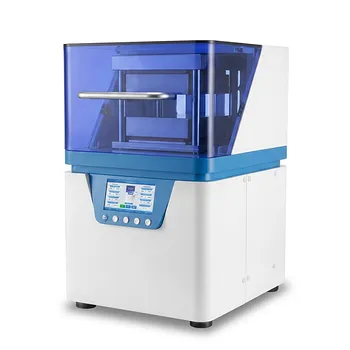
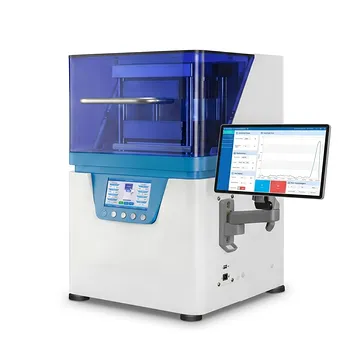
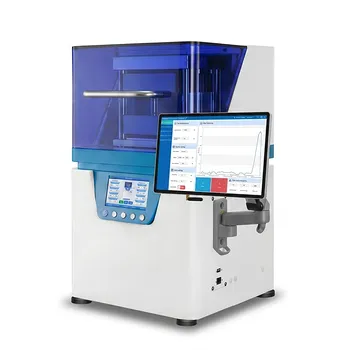
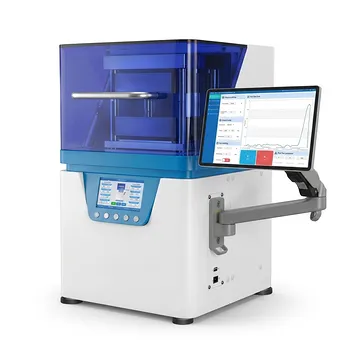
In the laboratory, a hydraulic press functions as a high-precision instrument utilized primarily for sample preparation and material characterization. It applies controlled fluid pressure to generate substantial force, enabling researchers to create pellets for spectroscopic analysis, test material strength, and investigate how substances behave under extreme compression.
Core Takeaway: A laboratory hydraulic press is essential for ensuring data accuracy. It standardizes samples by compressing them into uniform pellets for analysis and provides the force necessary to empirically measure the durability and deformation limits of new materials.
Sample Preparation for Spectroscopy
One of the most frequent uses of a hydraulic press in a lab is creating high-quality samples for analytical techniques.
Creating Pellets for FTIR and XRF
Spectroscopic techniques like FTIR (Fourier Transform Infrared Spectroscopy) and XRF (X-Ray Fluorescence) require samples to be solid, flat, and uniform.
A hydraulic press compresses mixtures of sample powder and a matrix (such as Potassium Bromide) into thin, transparent pellets.
Ensuring Sample Homogeneity
Loose powders often yield inconsistent results due to air gaps or uneven distribution.
By applying significant pressure, the press compacts the material into a homogeneous solid, reducing scattering and ensuring light or x-rays interact evenly with the sample.
Material Testing and Characterization
Beyond preparation, the press is a critical tool for direct experimentation on material properties.
Evaluating Strength and Durability
Engineers use hydraulic presses to assess the compressive strength of composites, ceramics, and metals.
The machine applies force until the material yields or fractures, providing concrete data on its durability limits.
Studying Deformation and Stress-Strain
Material science laboratories use these presses to observe how materials deform under sustained load.
This allows researchers to plot stress-strain behavior, revealing how a material will perform structurally before it actually breaks.
Investigating High-Pressure Effects
Researchers use the press to simulate deep-earth or high-stress environments.
This helps in understanding phase changes and chemical reactions that only occur when substances are subjected to extreme pressure.
Specialized Research Applications
While testing and prep are the primary uses, the versatility of the press allows for niche R&D applications.
Pharmaceutical Research and Development
In pharmaceutical labs, presses are used to test powder compaction.
This is vital for validating drug formulations and ensuring that pills will hold their shape during manufacturing and transport.
Prototyping Microfluidic Devices
Hydraulic presses are increasingly used to bond layers of materials together.
This is particularly useful in prototyping microfluidic chips, where precise pressure is needed to seal channels without damaging delicate structures.
Understanding the Trade-offs
While powerful, a hydraulic press is not a universal solution for all force applications.
Precision vs. Volume
Laboratory presses are designed for precision and control, not speed or high-volume production.
They are excellent for creating a single, perfect sample, but are inefficient for mass-manufacturing tasks compared to industrial stamping presses.
Sample Size Constraints
The distinct advantage of a lab press is its small footprint and ability to handle minute sample quantities.
However, this limits the geometry of the sample; large structural components cannot be tested in standard laboratory units.
Making the Right Choice for Your Goal
To maximize the utility of a hydraulic press, align its application with your specific data requirements.
- If your primary focus is Spectroscopy: Prioritize a press with programmable pressure cycles to ensure repeatable, transparent pellets for FTIR or XRF.
- If your primary focus is Material Science: Ensure your press has precise force measurement gauges to accurately record stress-strain data and deformation points.
- If your primary focus is Pharmaceutical R&D: Focus on the press's ability to apply low, consistent pressure to simulate tablet manufacturing conditions without over-compressing.
A hydraulic press transforms raw force into analytical precision, bridging the gap between a loose substance and a measurable result.
Summary Table:
| Application Category | Primary Laboratory Use | Key Benefit |
|---|---|---|
| Spectroscopy | Creating FTIR/XRF pellets | Ensures sample homogeneity and data accuracy |
| Material Science | Compressive strength & stress testing | Determines durability and deformation limits |
| Pharmaceuticals | Tablet formulation & powder compaction | Validates pill structural integrity |
| R&D | High-pressure simulation & bonding | Facilitates phase change studies and microfluidics |
Maximize Your Research Precision with KINTEK
Unlock the full potential of your laboratory with KINTEK’s industry-leading pressing solutions. Whether you are conducting cutting-edge battery research or routine spectroscopic analysis, our comprehensive range includes:
- Manual & Automatic Presses for effortless sample preparation.
- Heated & Multifunctional Models for complex material characterization.
- Glovebox-Compatible & Isostatic Presses (CIP/WIP) for specialized environments.
Don't settle for inconsistent data. Partner with KINTEK to achieve the high-precision results your research demands.
Contact Our Experts Today to Find Your Perfect Solution
Related Products
- Automatic Hydraulic Hot Press with Large Plate and Precision Temperature Control for Advanced Material Sample Preparation and Industrial Research
- Automatic Hydraulic Heat Press Machine with Multi Stage Programmable Control and Integrated Water Cooling Plate Size 180x180mm
- Automatic High Temperature Heated Hydraulic Press Machine with Heated Plates for Lab
- Automatic Heated Hydraulic Lab Press with Programmable Touch Screen Controls and Precision Temperature Regulation
- Manual Heated Hydraulic Lab Press with Integrated Hot Plates Hydraulic Press Machine
People Also Ask
- What are the specific features and applications of hydraulic hot press machines? Precision Solutions for Modern Labs
- How does an automatic hydraulic press operate? Achieve Precision and Consistency in Lab Pelleting
- What are the advantages and common applications of an automatic hydraulic press? Elevate Your Lab's Precision
- What is the technical significance of setting a precise dwell time? Achieve Peak Material Density and Stability
- When is an automatic hydraulic press more suitable than a manual press? Scale Your Lab with Precision & Speed