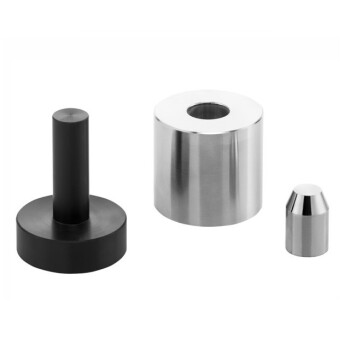
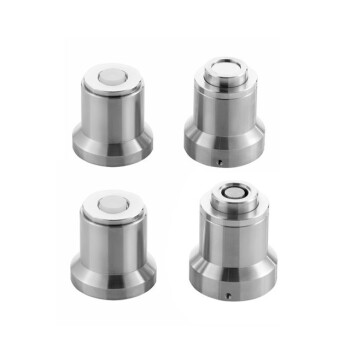
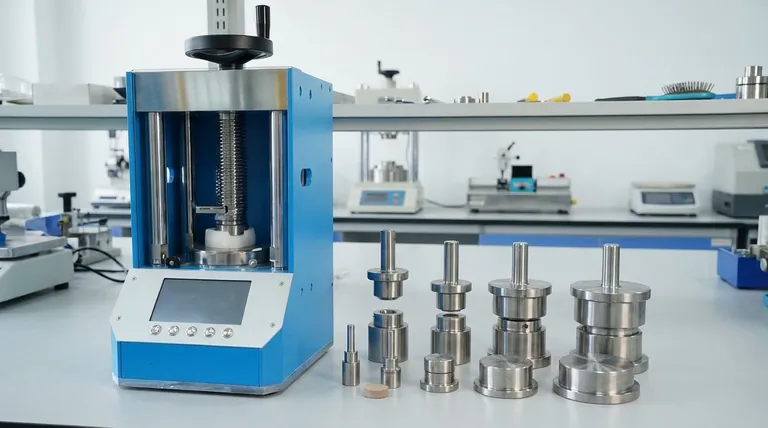
For any given hydraulic press, the recommended die set diameter is determined by the need to achieve sufficient compaction pressure without exceeding the press's maximum force capacity. A smaller diameter concentrates the force to create higher pressure, while a larger diameter spreads the same force, resulting in lower pressure. The goal is to match the press, die, and material requirements.
The selection of a die set is not just about physical fit; it's a critical calculation of pressure. The correct diameter ensures the press's force is effectively translated into the pressure required to properly form your sample.
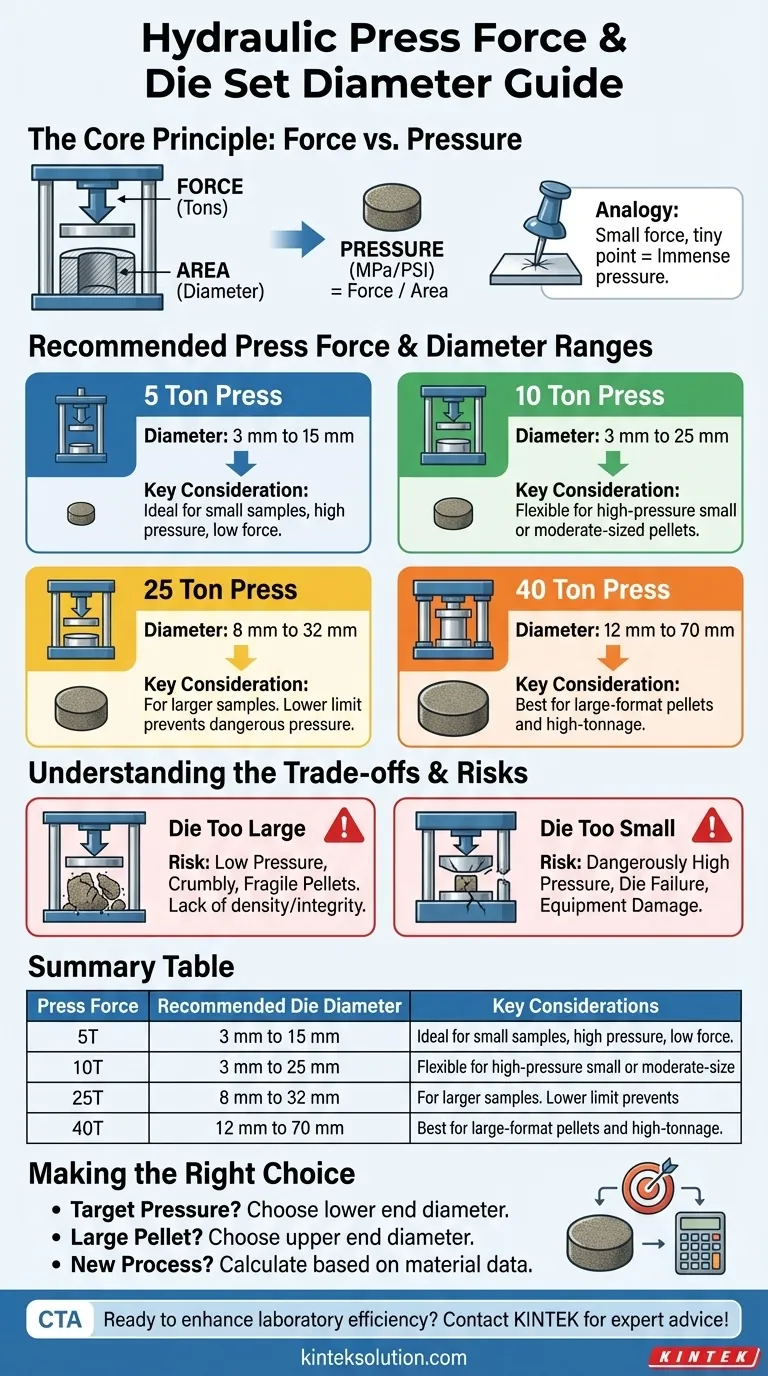
Recommended Press Force and Diameter Ranges
Based on standard equipment guidelines, here are the direct recommendations for matching press force to an appropriate die set diameter.
5 Ton Press
This press is recommended for die sets with a diameter of 3 mm to 15 mm. It is ideal for smaller samples where high pressure can be achieved with relatively low force.
10 Ton Press
The 10 Ton press can accommodate a wider range, suitable for die sets from 3 mm to 25 mm in diameter. This provides flexibility for both high-pressure small samples and moderately sized pellets.
25 Ton Press
For larger samples or materials requiring significant force, the 25 Ton press is recommended for die sets from 8 mm to 32 mm in diameter. The lower limit (8 mm) prevents generating dangerously high, uncontrolled pressures.
40 Ton Press
The most powerful of this group, the 40 Ton press, is designed for large-format pellets. It is best matched with die sets ranging from 12 mm to 70 mm in diameter.
The Core Principle: Force vs. Pressure
To make an informed choice, you must understand the relationship between the force you apply and the pressure your sample experiences. They are not the same thing.
Force: The "Push"
Force is the total load applied by the press, measured in tons. This value is constant, set by the press itself (e.g., 5 tons).
Area: The "Footprint"
Area is the cross-sectional surface of your die, calculated from its diameter. A small diameter die has a small area; a large diameter die has a large area.
Pressure: The Result That Matters
Pressure is the force distributed over that area (Pressure = Force / Area). This is what actually compacts your material, typically measured in Megapascals (MPa) or Pounds per Square Inch (PSI). Think of a thumbtack: a small force from your thumb creates immense pressure at the tiny point, allowing it to pierce a board.
Understanding the Trade-offs
Choosing a diameter outside the recommended range introduces significant risks and compromises the quality of your results.
The Risk of a Die That Is Too Large
This is the most common mistake. If the die diameter is too large for the press, you will be unable to generate the necessary pressure for proper compaction.
The press may apply its full 10 tons of force, but spread over a large area, the resulting pressure will be too low. This leads to crumbly, fragile pellets that lack the required density or integrity.
The Risk of a Die That Is Too Small
Using a die that is too small for a high-tonnage press can create dangerously high pressure. This can exceed the material strength of the die set itself, leading to catastrophic failure and equipment damage.
It also concentrates the entire load onto a tiny point on the press platens, potentially causing indentation or damage over time. The recommended lower limits are in place for both safety and equipment longevity.
Making the Right Choice for Your Goal
To select the correct combination, always start with the needs of your material.
- If your primary focus is achieving very high pressure for a hard-to-press material: Select a diameter at the lower end of your press's recommended range.
- If your primary focus is creating a large-diameter pellet from an easy-to-press material: Select a diameter at the upper end of the range, ensuring your press has enough tonnage to reach the target pressure.
- If you are starting a new process: Begin with your material's known compaction pressure (from scientific literature or supplier data) and use it to calculate the ideal die diameter for your press.
Ultimately, mastering pellet pressing comes from understanding that you are matching the tool not just to the sample size, but to the required pressure.
Summary Table:
| Press Force | Recommended Die Set Diameter Range | Key Considerations |
|---|---|---|
| 5 Ton | 3 mm to 15 mm | Ideal for small samples requiring high pressure with low force. |
| 10 Ton | 3 mm to 25 mm | Flexible for high-pressure small samples or moderate-sized pellets. |
| 25 Ton | 8 mm to 32 mm | Suitable for larger samples; lower limit prevents excessive pressure. |
| 40 Ton | 12 mm to 70 mm | Best for large-format pellets and high-tonnage applications. |
Ready to enhance your laboratory efficiency with the right die set and press? KINTEK specializes in lab press machines, including automatic lab presses, isostatic presses, and heated lab presses, designed to meet your precise compaction needs. Our experts can help you select the perfect equipment to achieve optimal pressure and sample integrity. Contact us today to discuss your requirements and discover how our solutions can benefit your lab!
Visual Guide
Related Products
- Lab Infrared Press Mold for No Demolding
- XRF KBR Steel Ring Lab Powder Pellet Pressing Mold for FTIR
- Lab Ring Press Mold for Sample Preparation
- Lab Button Battery Tablet Press Sealing Mold
- Square Bidirectional Pressure Mold for Lab
People Also Ask
- What is the purpose of incorporating cartridge heaters into a lab press mold for MLCC block compression? Optimize Results
- What is the function of a pressing tool in thermoplastic panels? Master Precision Shaping & Fusion Bonding
- Why is precise cooling management of the lab press mold necessary? Protect Core Integrity in Thermoforming
- What role do precision positioning and pressure molds play in single-lap joints? Ensure 100% Data Integrity
- Why is a lab press used for KBr pellet preparation in polyurethane FTIR? Achieve High-Resolution Spectral Data