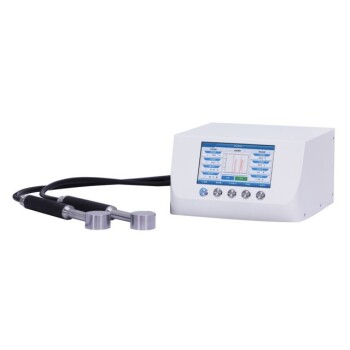
The primary technical advantage of preheating hydrofluoric acid is the substantial increase in chemical reactivity. By using laboratory heating equipment to raise the temperature to 70°C, you can achieve a more aggressive dissolution of the ceramic glass matrix, which enhances surface texture quality while permitting the use of lower acid concentrations.
Increasing the temperature of the etching solution fundamentally alters the efficiency of the process. It allows for the creation of superior microscopic retention structures without the need to extend processing time or rely on heavily concentrated, hazardous chemical solutions.
The Impact on Chemical Reactivity
Accelerating the Etching Kinetics
Heating the solution directly energizes the hydrofluoric acid. This increased thermal energy accelerates the chemical reaction between the acid and the ceramic material.
Consequently, the acid attacks the glass matrix more vigorously than it would at room temperature.
Refining Surface Morphology
The enhanced reactivity leads to a specific physical change in the ceramic surface. It refines the microscopic geometric morphology of the material.
This results in more pronounced microscopic porous retention structures, which are critical for effective bonding and adhesion in subsequent steps.
Efficiency and Concentration Benefits
Reducing Chemical Concentration
One of the most significant advantages of preheating is the ability to reduce the strength of the acid.
Because the heated solution is more reactive, you can achieve the desired etching depth using lower concentrations of hydrofluoric acid. This reduces the reliance on highly potent chemical mixtures to achieve the same physical result.
Improving Processing Efficiency
The preheating process streamlines the overall workflow.
By increasing the acid's aggressiveness through heat, you improve the processing efficiency of the surface treatment.
Maintaining Process Speed
Critically, this method improves quality without becoming a bottleneck.
The reference notes that you can achieve these refined surface structures without needing to extend the acid etching duration. You gain superior morphology without sacrificing throughput.
Understanding the Process Variables
The Concentration vs. Temperature Trade-off
It is important to view temperature as a lever that counterbalances chemical concentration.
While heating improves reactivity, it serves primarily as a substitute for raw chemical strength. If you cannot heat the solution, you would typically be forced to use higher concentrations of acid to achieve similar retention structures.
The Role of Precision
Using laboratory heating equipment provides the necessary control to maintain 70°C constantly.
Inconsistent heating would likely lead to uneven etching or variable retention structures. Therefore, the "advantage" is heavily dependent on the precision of the equipment used to maintain this specific thermal set point.
Making the Right Choice for Your Goal
To maximize the benefits of preheated hydrofluoric acid, consider your primary processing objectives:
- If your primary focus is Surface Quality: Rely on the elevated temperature to produce more pronounced microscopic porous structures for better retention.
- If your primary focus is Chemical Safety: Utilize the increased reactivity of the heated solution to transition to lower, safer concentrations of hydrofluoric acid.
- If your primary focus is Throughput: Leverage the preheating method to refine surface morphology without adding time to your etching cycles.
By substituting thermal energy for chemical concentration, you achieve a safer, more efficient process with superior structural results.
Summary Table:
| Advantage Category | Technical Benefit | Impact on Process |
|---|---|---|
| Chemical Reactivity | Accelerated Etching Kinetics | More aggressive dissolution of the glass matrix |
| Surface Quality | Refined Microscopic Morphology | Enhanced porous structures for superior bonding |
| Safety & Cost | Reduced Chemical Concentration | Achieve high-quality results with lower acid strengths |
| Operational Speed | Optimized Workflow Efficiency | Superior etching results without extending cycle times |
| Process Control | Thermal Precision | Consistent results through stable temperature management |
Elevate Your Material Research with KINTEK Precision
Unlock superior surface treatment results and laboratory efficiency with KINTEK. As specialists in comprehensive laboratory pressing and thermal solutions, we provide the precision equipment necessary to maintain critical temperatures for sensitive chemical processes.
Whether you are focusing on battery research or advanced ceramic engineering, our diverse range of manual, automatic, and multifunctional laboratory solutions—including isostatic presses—ensure your workflow is safe, efficient, and highly repeatable.
Ready to optimize your etching and pressing processes? Contact KINTEK today to discover how our high-performance equipment can transform your research outcomes.
References
- Gustavo Belmiro Casaburi, Rafael Leonardo Xediek Consani. Preheated acid associated with silane and electric current in the adhesion of the resin cement to ceramic. DOI: 10.1590/0103-6440202405641
This article is also based on technical information from Kintek Solution Knowledge Base .
Related Products
- Automatic Heated Hydraulic Press Machine with Hot Plates for Laboratory
- Laboratory Split Manual Heated Hydraulic Press Machine with Hot Plates
- Automatic Heated Hydraulic Press Machine with Heated Plates for Laboratory
- Cylindrical Lab Electric Heating Press Mold for Laboratory Use
- 24T 30T 60T Heated Hydraulic Lab Press Machine with Hot Plates for Laboratory
People Also Ask
- Function of a Laboratory Hydraulic Press with Heated Platens in SSE? Enhance Battery Density & Conductivity
- Why is a laboratory hydraulic press with heating plates required for PLA/TEC films? Achieve Precise Sample Integrity
- What are the requirements for electrode pressing with high-viscosity ionic liquids like EMIM TFSI? Optimize Performance
- How does a laboratory heated hydraulic press facilitate PBN sample prep for WAXS? Achieve Precise X-Ray Scattering
- What are the industrial applications of heated hydraulic presses? Master Heat & Force for Precision Manufacturing