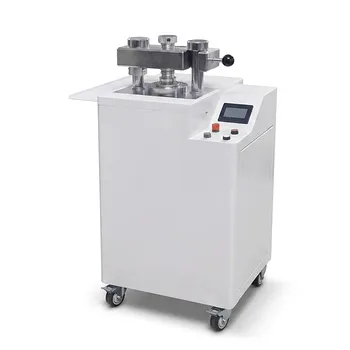
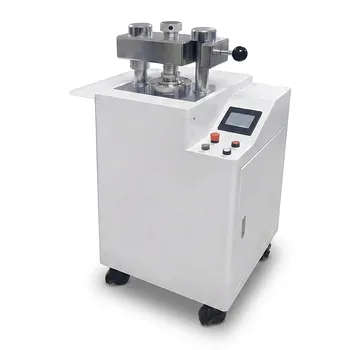
Desktop manual pellet presses are compact, high-force laboratory instruments designed specifically for preparing compound samples in materials and chemistry research. These units typically offer pressing capacities of up to 24 or 40 metric tons, utilizing a built-in hydraulic pump to generate the necessary force for creating high-quality pellets.
The core value of a desktop manual pellet press lies in its ability to deliver substantial force—up to 40 metric tons—within a compact footprint that is safe enough for general lab benches and versatile enough for controlled environments like glove boxes.
Core Capabilities and Mechanisms
High-Force Capacity
Despite their compact size, these presses are engineered to deliver significant pressure. Common configurations are capable of exerting up to 24 or 40 metric tons of force. This high capacity is essential for compacting powders into solid samples for analytical testing in chemistry and materials science.
Integrated Hydraulic Systems
The force generation is handled by a built-in hydraulic pump. This integration ensures the unit remains self-contained without requiring external compressors or extensive plumbing, maintaining a small footprint suitable for desktop use.
Operational Efficiency
To streamline the workflow, many of these presses feature an auto-return function. This mechanism automatically resets the piston after the pressing cycle is complete, reducing the manual effort required between samples and speeding up the preparation process.
Safety and Environmental Adaptability
Operator Protection
High-pressure equipment presents inherent risks, particularly regarding sample failure or debris. To mitigate this, these presses frequently include a transparent safety shield. This allows the researcher to monitor the process visually while being protected from potential hazards.
Controlled Atmosphere Compatibility
Advanced research often requires handling air-sensitive materials. These presses are designed to be suitable for operation inside a glove box. They are compatible with various atmospheres, including both oxidizing and inert gas environments, ensuring sample integrity is maintained during the pressing process.
Understanding the Trade-offs
Manual vs. Automated Operation
While cost-effective and robust, these are manual instruments. They rely on the operator to actuate the hydraulic pump. For laboratories processing high volumes of samples daily, the physical effort required for manual pumping may become a bottleneck compared to electric or automated alternatives.
Desktop Constraints
The desktop form factor is a significant advantage for space-saving, but it imposes physical limits. While 40 metric tons is substantial, ultra-high-pressure industrial applications may require larger, floor-standing units that exceed the capabilities of a standard desktop model.
Making the Right Choice for Your Laboratory
Selecting the right press depends on your specific research requirements and environmental constraints.
- If your primary focus is handling sensitive compounds: Prioritize a unit explicitly rated for glove box compatibility to ensure it functions correctly in inert or oxidizing atmospheres.
- If your primary focus is dense material compaction: Ensure you select a model rated for the higher 40 metric ton capacity rather than the standard 24-ton version to maximize density.
- If your primary focus is user safety: Verify the inclusion of a transparent safety shield to protect operators without obscuring their view of the sample.
By balancing force capacity with environmental flexibility, you can secure a reliable tool that ensures consistent sample preparation for your critical experiments.
Summary Table:
| Feature | Specification/Capability | Key Benefit |
|---|---|---|
| Pressing Capacity | Up to 24 or 40 metric tons | Enables high-density compaction for analytical testing |
| Force Generation | Integrated hydraulic pump | Self-contained, compact design without external power |
| Safety | Transparent safety shield | Protects operator from debris while allowing visual monitoring |
| Environment | Glove box & inert gas compatible | Ideal for air-sensitive materials and controlled atmospheres |
| Efficiency | Auto-return piston function | Speeds up workflow by resetting automatically after cycles |
Elevate Your Sample Quality with KINTEK Pressing Solutions
Precision in research starts with uniform sample preparation. KINTEK specializes in comprehensive laboratory pressing solutions tailored for advanced battery research and materials science. Whether you need the portability of a desktop manual pellet press, the consistency of automatic or heated models, or the specialized capabilities of cold and warm isostatic presses, our equipment is designed for maximum durability and safety.
Our presses are fully glovebox-compatible, ensuring your sensitive compounds remain uncontaminated. Contact KINTEK today to discuss your specific force requirements and let our experts help you select the perfect press to accelerate your laboratory's breakthroughs.
Related Products
- Manual Cold Isostatic Pressing CIP Machine Pellet Press
- Manual Laboratory Hydraulic Pellet Press Lab Hydraulic Press
- Manual Laboratory Hydraulic Press Lab Pellet Press
- Automatic XRF Pellet Press for Laboratory Spectrometry Sample Preparation
- Automatic Laboratory Hydraulic Press Lab Pellet Press Machine
People Also Ask
- Why is Cold Isostatic Pressing (CIP) necessary for SBN ceramics? Achieve High-Density and Crack-Free Sintering
- Why is Cold Isostatic Pressing (CIP) applied after uniaxial pressing? Optimize Superconductor Precursor Density
- What are the process advantages of using Cold Isostatic Pressing (CIP) for LSMO? Achieve Defect-Free Density
- What types of equipment are available for cold isostatic pressing? Explore CIP Solutions for Labs and Production
- What are the technical advantages of cold isostatic pressing equipment compared to uniaxial compression equipment? Learn More!