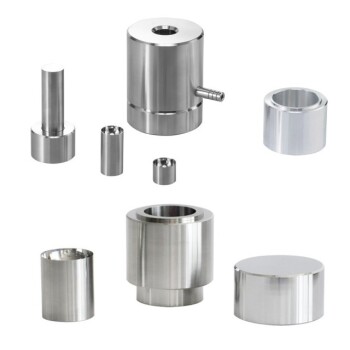
For standard-sized pellets, typically created using a 13 mm diameter die, the standard applied load is 10 tonnes. This application of force results in an internal pressure of approximately 739 MPa, which is generally sufficient to compress loose powder into a solid, stable disc for analysis.
To achieve a stable pellet in a standard 13 mm die, a load of 10 tonnes is required to generate the necessary 739 MPa of pressure; altering the die size requires a significant adjustment in load to maintain effective pressure.
Analyzing Load Requirements by Die Size
Standard 13 mm Dies
The most common application for pellet preparation involves a 13 mm diameter die.
To bind the sample material effectively within this surface area, the press must apply a load of 10 tonnes.
This specific load generates 739 MPa of pressure, which is the standard benchmark for creating cohesive pellets without compromising the structural integrity of the die.
Mini 7 mm Dies
When working with smaller sample quantities, you may opt for a "mini" 7 mm diameter die.
It is critical to note that load requirements do not scale linearly with diameter; this smaller die requires a load of only 2.0 tonnes.
Despite the significantly lower load, the reduced surface area results in a pressure of 500 MPa, which is sufficient for smaller pellet formation.
The Relationship Between Load and Pressure
Pressure is the Key Variable
While you set the "load" (tonnes) on the machine, the sample responds to "pressure" (MPa).
Pressure is defined as the force applied divided by the surface area of the die.
Therefore, a smaller die requires significantly less force to achieve a similar internal pressure compared to a larger die.
Avoiding Calculation Errors
A common mistake is applying "standard" loads to "mini" dies.
Applying 10 tonnes of load to a 7 mm die would result in massive over-pressurization, likely destroying the die or the sample.
Always calculate the load based on the specific surface area of the die you are using.
Understanding the Trade-offs
Risks of Over-Pressurization
Applying excessive load to increase pellet density offers diminishing returns.
If you exceed the rated pressure (e.g., applying >10 tonnes on a 13 mm die), you risk catastrophic failure of the die steel.
Furthermore, excessive pressure can cause distinct internal stress faults in the pellet, leading to capping or lamination where the pellet splits horizontally.
Risks of Under-Pressurization
Conversely, applying insufficient load protects the die but compromises the analysis.
If the pressure drops significantly below the standard values (e.g., 739 MPa for 13 mm), the pellet surface may be porous or loose.
This lack of cohesion can lead to flaking inside the spectrometer, potentially contaminating sensitive detectors.
Making the Right Choice for Your Goal
To ensure equipment safety and sample quality, match your load settings to your specific die geometry:
- If your primary focus is standard 13 mm pellets: Set your hydraulic press to apply 10 tonnes of load to achieve the target 739 MPa pressure.
- If your primary focus is mini 7 mm pellets: Reduce your applied load to 2.0 tonnes to achieve a safe and effective 500 MPa pressure.
By strictly adhering to these load-to-diameter ratios, you ensure the longevity of your die sets while producing consistent, high-quality pellets for analysis.
Summary Table:
| Die Diameter | Applied Load (Tonnes) | Internal Pressure (MPa) | Recommended Use Case |
|---|---|---|---|
| 13 mm (Standard) | 10 Tonnes | 739 MPa | Standard cohesive pellet preparation |
| 7 mm (Mini) | 2 Tonnes | 500 MPa | Small sample quantities |
| Over-Pressurized | >10 Tonnes (for 13mm) | Excessive | Risk of die failure and pellet capping |
Elevate Your Sample Preparation with KINTEK
Precision is critical in pelletizing. KINTEK specializes in comprehensive laboratory pressing solutions, offering a versatile range of manual, automatic, heated, and glovebox-compatible models, alongside advanced cold and warm isostatic presses.
Whether you are conducting battery research or spectroscopic analysis, our expert-engineered equipment ensures you achieve the exact pressure needed without risking equipment failure. Contact KINTEK today to find the perfect press for your lab’s specific needs and ensure consistent, high-quality results every time.
Related Products
- XRF KBR Plastic Ring Lab Powder Pellet Pressing Mold for FTIR
- XRF KBR Steel Ring Lab Powder Pellet Pressing Mold for FTIR
- Lab Infrared Press Mold for No Demolding
- Lab Ring Press Mold for Sample Preparation
- Lab XRF Boric Acid Powder Pellet Pressing Mold for Laboratory Use
People Also Ask
- What is the purpose of making KBr pellets for FTIR? Achieve Precise Molecular Analysis with Solid Samples
- What factors should be considered when choosing a lab press for XRF pellet preparation? Ensure Accurate and Consistent Results
- Why are pellets used in XRF analysis, and what is their limitation? Boost Accuracy and Speed in Your Lab
- How are pellets prepared for XRF analysis and what is a potential drawback? Master XRF Sample Prep and Accuracy
- What are the different types of XRF pellet preparation methods available? Manual, Hydraulic, and Automated Presses Explained