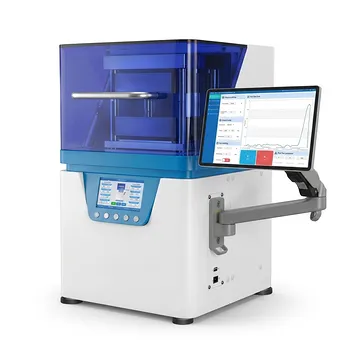
For a standard cement sample preparation setup, specifically when utilizing a 32 mm diameter die, the typical applied load is 20 tonnes. This specific force application results in an internal sample pressure of approximately 256 MPa.
Core Takeaway While 20 tonnes is the standard operational benchmark, strictly adhering to this load is only valid for a 32 mm die. Pressure (256 MPa) is the critical variable that determines sample quality; the load must be adjusted if your die geometry changes.
Analyzing the Process Variables
To ensure consistent sample preparation, it is vital to distinguish between the force applied by the machine and the pressure experienced by the material.
The Standard Reference Point
In the context of cement analysis, the most common reference standard involves a 32 mm diameter die.
For this specific geometry, the industry-standard protocol calls for a load of 20 tonnes.
The Resulting Pressure
When 20 tonnes of force are distributed across the surface area of a 32 mm die, the cement is subjected to 256 MPa of pressure.
This pressure value is the "sweet spot" intended to achieve the necessary density and cohesion for accurate analytical testing.
Understanding the Trade-offs
Blindly applying a 20-tonne load without considering the context of your equipment can lead to significant errors or damage.
The Risk of Die Variation
The relationship between load and pressure is dictated by the surface area of the die.
If you apply 20 tonnes to a die smaller than 32 mm, the pressure will skyrocket above 256 MPa, potentially crushing the sample or damaging the die.
Conversely, applying the same 20 tonnes to a larger die will result in insufficient pressure, leading to loose, unstable pellets that yield poor data.
Machine Calibration
The figure of 20 tonnes is a nominal value often displayed on manual hydraulic press gauges.
However, the actual pressure of 256 MPa is what ensures scientific repeatability.
Reliance on the "tonnes" reading is a trade-off of convenience over precision; always verify that your specific load cell accurately translates to the target pressure.
Making the Right Choice for Your Goal
To achieve high-quality cement samples, your approach should depend on your specific hardware configuration.
- If your primary focus is a standard 32 mm die: Apply a load of 20 tonnes to achieve the target pressure of 256 MPa.
- If your primary focus is a non-standard die size: Calculate the required load to achieve 256 MPa specifically, rather than defaulting to 20 tonnes.
Consistency in pressure is the key to consistency in analysis.
Summary Table:
| Variable | Standard Specification | Impact of Variation |
|---|---|---|
| Die Diameter | 32 mm | Smaller dies increase pressure; larger dies decrease it. |
| Applied Load | 20 Tonnes | Must be recalculated if die diameter changes. |
| Sample Pressure | 256 MPa | The critical variable for density and cohesion. |
| Sample Quality | High Density/Stable | Incorrect pressure leads to unstable pellets or die damage. |
Elevate Your Cement Analysis Precision with KINTEK
Don't let inconsistent pressure compromise your research data. KINTEK specializes in comprehensive laboratory pressing solutions, offering a versatile range of manual, automatic, heated, and multifunctional presses, as well as specialized glovebox-compatible and isostatic models (CIP/WIP) ideal for battery and material research.
Whether you need to hit the 256 MPa benchmark for standard cement pellets or require a custom load for unique die geometries, our expert team is here to help you select the perfect equipment for repeatable, high-quality results.
Ready to optimize your sample preparation? Contact KINTEK today for a tailored solution!
Related Products
- Automatic Hydraulic Hot Press with Large Plate and Precision Temperature Control for Advanced Material Sample Preparation and Industrial Research
- Laboratory Hydraulic Pellet Press for XRF KBR FTIR Lab Press
- Automatic Fluorescence Sample Preparation Press 40 Ton Lab Pellet Press for XRF Analysis
- Automatic XRF Pellet Press for Laboratory Spectrometry Sample Preparation
- Automatic Laboratory Hydraulic Press for XRF and KBR Pellet Pressing
People Also Ask
- What are the specific features and applications of hydraulic hot press machines? Precision Solutions for Modern Labs
- How does an automatic hydraulic press operate? Achieve Precision and Consistency in Lab Pelleting
- What are the advantages and common applications of an automatic hydraulic press? Elevate Your Lab's Precision
- What is the technical significance of setting a precise dwell time? Achieve Peak Material Density and Stability
- When is an automatic hydraulic press more suitable than a manual press? Scale Your Lab with Precision & Speed