
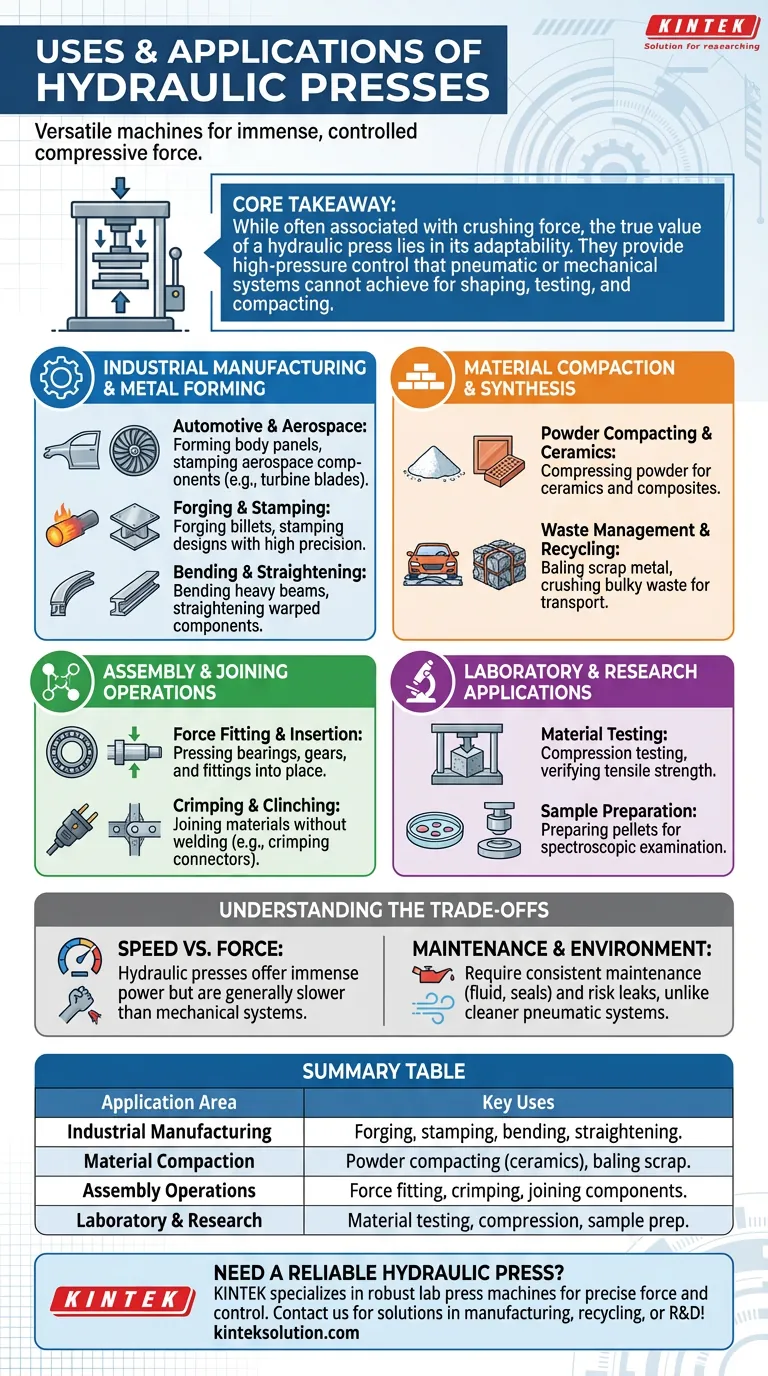
Hydraulic presses are versatile, foundational machines utilized across industries to generate immense, controlled compressive force for shaping, testing, and compacting materials. Their primary applications range from heavy-duty industrial manufacturing—such as forging automotive body panels and stamping aerospace components—to precision laboratory tasks like material testing and preparing samples for analysis.
Core Takeaway While often associated with crushing force, the true value of a hydraulic press lies in its adaptability. Whether the goal is compacting loose powder into solid ceramics, reshaping steel beams, or testing the tensile strength of concrete, these machines provide the necessary high-pressure control that pneumatic or mechanical systems simply cannot achieve.
Industrial Manufacturing and Metal Forming
Automotive and Aerospace Production
In the automotive sector, hydraulic presses are critical for forming large body panels, assembling complex components, and manufacturing structural parts. Similarly, the aerospace industry relies on them to shape high-strength materials into intricate forms, such as turbine blades, which require consistent, extreme pressure.
Forging and Stamping
These presses are the standard for forging operations, where metal billets are shaped into desired forms using dies. They are also used for stamping, where the machine presses a design or shape into sheet metal with high precision.
Bending and Straightening
Construction and heavy fabrication industries utilize hydraulic presses to bend metal beams or large plates to specific angles. Conversely, they are equally effective at straightening warped metal components to ensure structural integrity.
Material Compaction and Synthesis
Powder Compacting and Ceramics
Hydraulic presses excel at compressing powdered materials into solid forms. This application is vital in manufacturing ceramics (such as tiles and bricks) at room temperature and creating composite materials. It is even used in niche food processing applications, such as producing fat-free cocoa powder.
Waste Management and Recycling
In recycling centers, these machines are essential for scrap baling. They crush bulky waste materials, including entire automobiles and loose scrap metal, into dense bales for efficient transport and storage.
Assembly and Joining Operations
Force Fitting and Insertion
Beyond shaping materials, hydraulic presses are used to force components together. This includes pressing bearings, gears, and fittings into shafts or housings where a tight interference fit is required.
Crimping and Clinching
They facilitate assembly operations like riveting and crimping, joining two materials without welding. This is common in electrical industries for joining connectors and in automotive assembly for clinching sheet metal.
Laboratory and Research Applications
Material Testing
Laboratories use hydraulic presses to verify the physical limits of materials. This includes compression testing of concrete to verify tensile strength and investigating how substances react under high-pressure conditions.
Sample Preparation
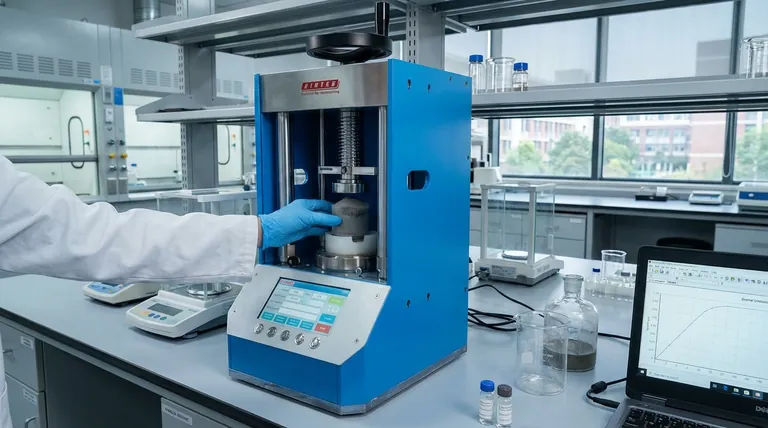
In scientific research, precision presses are used to prepare pellets for spectroscopic examination. They compress powder mixtures into uniform discs, ensuring accurate compositional analysis.
Understanding the Trade-offs
Speed vs. Force
While hydraulic presses offer immense power (often exceeding 10,000 psi), they are generally slower than mechanical or pneumatic presses. If your application requires high-speed, rapid-fire cycling (like canning or small part stamping), a hydraulic system may be a bottleneck.
Maintenance and Environment
Hydraulic systems rely on fluid dynamics, which introduces the risk of leaks and pressure drops. They require consistent maintenance of seals and hydraulic fluid to prevent contamination and ensure safety, unlike cleaner pneumatic systems that use air.
Making the Right Choice for Your Goal
Selecting the right application depends entirely on the material constraints and the volume of production required.
- If your primary focus is heavy metal fabrication: Prioritize presses designed for forging and stamping to handle the immense force required for shaping steel billets and beams.
- If your primary focus is scientific accuracy: Utilize laboratory-grade presses specifically designed for sample preparation and destructive testing to ensure data precision.
- If your primary focus is waste management: Look for baling presses optimized for volume reduction to lower transport costs of scrap materials.
Ultimately, the utility of a hydraulic press is defined by its ability to deliver high-tonnage force with precise control, making it indispensable for any task requiring the alteration of resistant materials.
Summary Table:
| Application Area | Key Uses |
|---|---|
| Industrial Manufacturing | Forging, stamping, bending, and straightening metal components. |
| Material Compaction | Powder compacting for ceramics, food processing, and scrap baling. |
| Assembly Operations | Force fitting bearings, crimping, and joining components. |
| Laboratory & Research | Material testing, compression analysis, and sample preparation. |
Need a reliable hydraulic press for your specific application? At KINTEK, we specialize in designing robust lab press machines—including automatic, isostatic, and heated lab presses—to meet your precise force and control requirements. Whether you're in manufacturing, recycling, or R&D, our solutions ensure accuracy, durability, and efficiency. Contact us today to discuss how we can support your project with the right hydraulic press technology!
Visual Guide
Related Products
- Manual Heated Hydraulic Lab Press with Integrated Hot Plates Hydraulic Press Machine
- Automatic High Temperature Heated Hydraulic Press Machine with Heated Plates for Lab
- Automatic Heated Hydraulic Press Machine with Hot Plates for Laboratory
- Laboratory Hydraulic Press 2T Lab Pellet Press for KBR FTIR
- Automatic Laboratory Hydraulic Press Lab Pellet Press Machine
People Also Ask
- Why is a laboratory hydraulic press with heating plates required for PLA/TEC films? Achieve Precise Sample Integrity
- Why is a manual hydraulic heated lab press essential for compleximer materials? Unlock Advanced Material Synthesis
- Function of a Laboratory Hydraulic Press with Heated Platens in SSE? Enhance Battery Density & Conductivity
- What role does a lab manual hydraulic press play in Li9B19S33 ionic conductivity? Optimize Pellet Characterization
- What are the main benefits of performing proper maintenance on a heated lab press? Ensure Accuracy & Safety



















