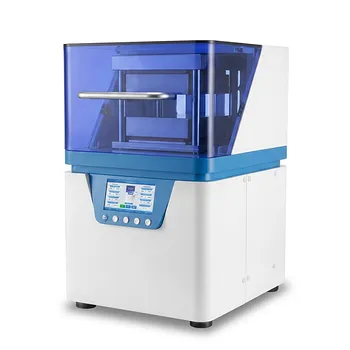
Hydraulic presses are defined by their ability to decouple input effort from output power, utilizing fluid mechanics to generate massive force from a relatively small energy source. Their distinct combination of power and versatility stems from force multiplication, which delivers high tonnage, and precision control, which allows operators to finely regulate speed, pressure, and duration for exact repeatability.
The true value of a hydraulic press is not just its raw strength, but its adaptability; it provides a customizable platform where tooling, temperature, and pressure parameters can be adjusted to handle everything from heavy-duty metal forming to delicate laboratory spectroscopy.
The Mechanics of Power
The "power" of a hydraulic press is a function of physics and control systems.
Force Multiplication
The fundamental characteristic of these machines is hydraulic leverage. By applying pressure to a fluid in a small cylinder, the system transfers that energy to a larger cylinder, generating an output force significantly greater than the input. This allows the press to perform heavy-duty applications that require immense tonnage.
Precision Control Systems
Power requires management to be useful. Through sophisticated control valves, operators can govern the piston’s movement with high accuracy. This allows for the precise regulation of the force exerted, ensuring that delicate tasks are not crushed and heavy tasks receive sufficient pressure.
Duration and Dwell Time
Beyond just how much force is applied, these presses control how long it is applied. The ability to maintain specific pressure for a set duration is critical for tasks requiring material flow or curing.
Unlocking Versatility
Versatility is what allows a single machine to serve diverse industries, from manufacturing floors to research laboratories.
Adaptable Tooling and Operation
A hydraulic press is essentially a blank canvas. By changing the tooling (dies and molds) and adjusting operating parameters, the same machine can switch between diverse operations such as forming, stamping, bending, and pressing.
Integration of Heat and Pressure
Heated hydraulic presses expand the machine's utility to temperature-sensitive materials. By adjusting both pressure and heat, operators can process plastics, rubber, and composites. This is essential for applications ranging from industrial molding to the creation of sample discs for FTIR spectroscopy.
Programmable Logic and Automation
Modern powered presses often feature electronic integration, including LED touchscreens and pre-stored programs. This allows for the creation of custom programmable loads, making the machine ideal for producing large volumes of identical products or pellets with high stability.
Platen Flexibility
In laboratory settings, versatility is enhanced by interchangeable platens. These are available in various sizes to accommodate different sample dimensions and surface materials—such as stainless steel, ceramic, or aluminum—to meet specific experimental needs.
Understanding the Trade-offs
To make an informed decision, you must recognize the limitations inherent in hydraulic systems.
Speed vs. Power
While hydraulic presses offer immense force and control, they are generally slower than mechanical fly-wheel presses. If your primary metric is high-speed, rapid-fire production (strokes per minute), a hydraulic system may create a bottleneck.
Maintenance Dependencies
The efficiency of a hydraulic press relies heavily on the integrity of its electronic components and fluid systems. While modern electronics reduce downtime, the system still requires vigilance regarding seals and fluid cleanliness to prevent leaks and maintain pressure stability.
Safety as a Core Characteristic
High-force machinery presents inherent risks, but hydraulic presses are designed with specific mitigation features.
Overload Protection
Unlike mechanical presses, which can jam if overloaded, hydraulic systems are typically equipped with pressure relief valves. These automatically divert fluid if the pressure exceeds safe limits, preventing catastrophic machine failure.
Operator Safety Mechanisms
To protect the user, these presses frequently utilize interlocking systems. These ensure the machine cannot operate unless safety guards are in place, significantly reducing the risk of injury during operation.
Making the Right Choice for Your Goal
Selecting the right hydraulic press depends on matching its characteristics to your specific output requirements.
- If your primary focus is heavy industrial forming: Prioritize Force Multiplication capabilities and ensure the tonnage rating exceeds your maximum expected load to prevent system strain.
- If your primary focus is laboratory research: Look for Precision Control and heated platen options to ensure accurate, repeatable results for temperature-sensitive materials.
- If your primary focus is high-volume production: Choose a model with Programmable Loads and pre-stored programs to ensure every unit is identical while minimizing setup time.
Ultimately, the best hydraulic press is one that balances raw force with the specific level of control your materials demand.
Summary Table:
| Key Characteristic | Functional Benefit | Ideal Application |
|---|---|---|
| Force Multiplication | Generates massive tonnage from minimal input | Heavy-duty metal forming & pellet pressing |
| Precision Control | Regulates speed, pressure, and dwell time | Delicate material testing & spectroscopy |
| Thermal Integration | Combines heat and pressure for material flow | Plastic molding & composite research |
| Programmable Logic | Ensures repeatability and automated cycles | High-volume production & stable pelletizing |
| Safety Interlocks | Overload protection & operator shielding | High-pressure laboratory environments |
Elevate Your Pressing Precision with KINTEK
Unlock the full potential of your research with KINTEK’s advanced hydraulic solutions. As specialists in comprehensive laboratory pressing technology, we offer a versatile range of equipment including manual, automatic, heated, and multifunctional models, as well as glovebox-compatible units and isostatic presses (cold and warm).
Whether you are advancing battery research, creating high-quality pellets, or developing new composites, KINTEK provides the precise control and durability your workflow demands.
Ready to optimize your lab’s efficiency? Contact our experts today to find the perfect pressing solution for your specific application.
Related Products
- Automatic Hydraulic Hot Press with Large Plate and Precision Temperature Control for Advanced Material Sample Preparation and Industrial Research
- Automatic Hydraulic Heat Press Machine with Multi Stage Programmable Control and Integrated Water Cooling Plate Size 180x180mm
- Automatic High Temperature Heated Hydraulic Press Machine with Heated Plates for Lab
- Automatic Heated Hydraulic Lab Press with Programmable Touch Screen Controls and Precision Temperature Regulation
- Manual Heated Hydraulic Lab Press with Integrated Hot Plates Hydraulic Press Machine
People Also Ask
- What are the specific features and applications of hydraulic hot press machines? Precision Solutions for Modern Labs
- How does an automatic hydraulic press operate? Achieve Precision and Consistency in Lab Pelleting
- What are the advantages and common applications of an automatic hydraulic press? Elevate Your Lab's Precision
- What is the technical significance of setting a precise dwell time? Achieve Peak Material Density and Stability
- When is an automatic hydraulic press more suitable than a manual press? Scale Your Lab with Precision & Speed