
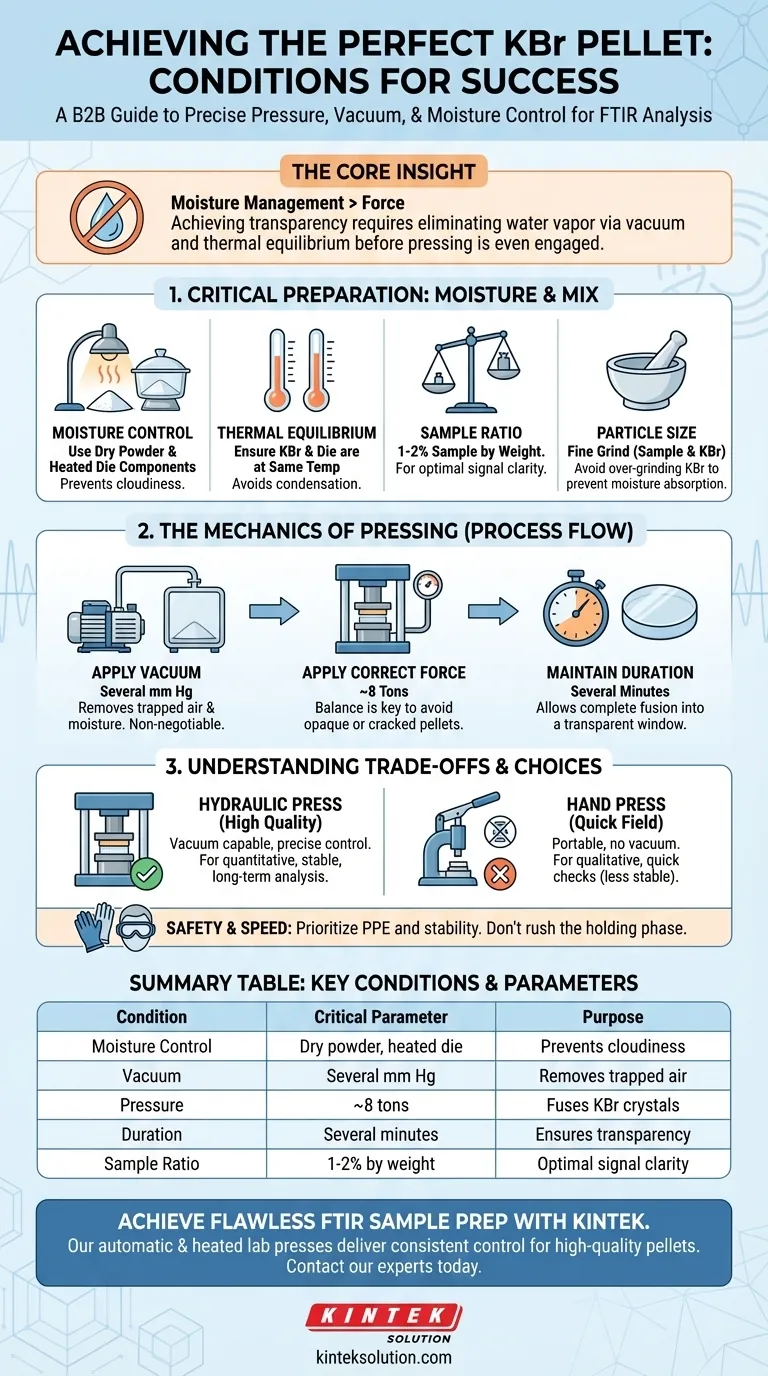
To form a stable, transparent KBr pellet, you must create a vacuum environment of several mm Hg to remove trapped air and moisture, followed by the application of approximately 8 tons of pressure maintained for several minutes. Success depends heavily on controlling moisture by using dry powder and pre-heated die components to ensure the pellet does not become cloudy or opaque.
The Core Insight Achieving a high-quality KBr pellet is not just about force; it is about moisture management. While hydraulic pressure creates the solid disk, the transparency required for accurate analysis is only achieved by rigorously eliminating water vapor through vacuum and thermal equilibrium before the press is even engaged.
Critical Preparation Conditions
Controlling Moisture and Temperature
The most common cause of pellet failure is moisture absorption. Potassium bromide (KBr) is hygroscopic, meaning it pulls water from the air, which ruins transparency. To prevent this, you must heat the anvils and the die set body to ensure they are completely dry.
Thermal Equilibrium
Ensure the KBr powder and the die set are at the same temperature before loading. If warm powder touches cold metal (or vice versa), condensation can occur, resulting in a cloudy, "wet" pellet that yields poor spectral data.
The Sample-to-Matrix Ratio
Precision in mixing is essential for signal clarity. A typical mix should contain only 1-2% sample by weight relative to the KBr powder. This ensures the sample is dilute enough to allow light transmission while providing a strong enough signal for detection.
Particle Size and Grinding
Both the sample and the KBr must be ground finely to prevent the scattering of IR light. However, you must be careful not to over-grind the KBr itself. Excessive grinding of the salt matrix exposes new crystal facets that absorb moisture more rapidly.
The Mechanics of Pressing
Vacuum Application
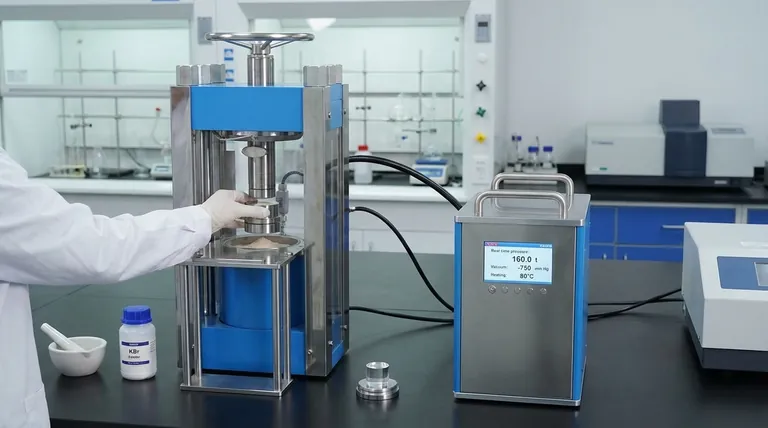
Before applying full pressure, apply a vacuum of several mm Hg to the die set. This step is non-negotiable for high-quality work, as it evacuates air and moisture trapped between the particles. Ensure all seals in the die set are in good condition and positioned correctly to maintain this vacuum.
Applying the Correct Force
For a standard hydraulic press, apply a force of approximately 8 tons. Pressure control is a delicate balance: insufficient pressure results in an opaque, loosely packed pellet, while excessive pressure can cause the pellet to crack due to internal stress.
Duration of Pressure
Force must be sustained, not just applied momentarily. Maintain the 8-ton load for several minutes. This duration allows the KBr crystals to fuse completely into a unified, transparent window.
Understanding the Trade-offs
Hydraulic vs. Hand Press
A hydraulic press allows for vacuum evacuation and precise pressure control, producing pellets suitable for long-term storage and high-sensitivity analysis. Conversely, a hand press is portable and requires less space but typically cannot be evacuated efficiently. Consequently, pellets made by hand are generally not suitable for long-term storage or critical quantitative work.
Safety vs. Speed
Operating a hydraulic press involves significant force and potential hazards. While it may be tempting to rush the "holding" phase, doing so compromises pellet quality. Furthermore, you must always prioritize safety by wearing gloves and safety glasses and ensuring the press is stable on the workbench to prevent movement during operation.
Making the Right Choice for Your Goal
To ensure you are applying the right method for your specific analytical needs, consider the following:
- If your primary focus is high-quality, reproducible spectra: Use a hydraulic press with a vacuum step, ensuring the die is heated and the mixture is 1-2% sample by weight.
- If your primary focus is quick, qualitative field analysis: Use a portable hand press, but understand that the pellet may suffer from moisture effects and is not stable for storage.
- If your primary focus is preventing cloudy pellets: Prioritize thermal equilibrium by ensuring your KBr powder and die set are dry and at the exact same temperature before pressing.
Mastering the KBr pellet technique requires viewing moisture as your primary contaminant and pressure as the tool to seal it out.
Summary Table:
| Key Condition | Critical Parameter | Purpose |
|---|---|---|
| Moisture Control | Dry powder, heated die components | Prevents cloudiness and opacity |
| Vacuum | Several mm Hg | Removes trapped air and moisture |
| Pressure | ~8 tons | Fuses KBr crystals into a solid disk |
| Pressure Duration | Several minutes | Ensures complete fusion and transparency |
| Sample Ratio | 1-2% sample by weight | Ensures optimal signal clarity for analysis |
Achieve flawless FTIR sample preparation with the right lab press.
Forming a perfect KBr pellet is a delicate balance of precise pressure control and rigorous moisture management. KINTEK's range of automatic and heated lab presses are engineered to deliver the consistent vacuum, pressure, and temperature control necessary for producing transparent, high-quality pellets every time.
Whether your laboratory requires high-throughput reproducibility for quantitative analysis or robust solutions for sensitive materials, our expertise ensures your sample preparation is never a variable.
Enhance your analytical accuracy. Contact our experts today to find the ideal press for your specific application.
Visual Guide
Related Products
- Laboratory Hydraulic Press 2T Lab Pellet Press for KBR FTIR
- XRF KBR Plastic Ring Lab Powder Pellet Pressing Mold for FTIR
- Laboratory Hydraulic Pellet Press for XRF KBR FTIR Lab Press
- XRF KBR Steel Ring Lab Powder Pellet Pressing Mold for FTIR
- Automatic Laboratory Hydraulic Press for XRF and KBR Pellet Pressing
People Also Ask
- What is the role of a laboratory pressure machine and KBr in FTIR? Master Sample Preparation for Flame Retardants
- What is the role of a laboratory hydraulic press in high-loading NCM811 cathode prep for solid-state batteries?
- Why is a laboratory hydraulic press necessary for sample preparation? Precise Pelleting for Spiro Heterocyclic Analysis
- What role does a laboratory hydraulic press play in reaction pellets? Optimizing Lunar Soil and Metal Fuel Density
- Why is a laboratory hydraulic press required for M-N-C catalyst characterization? Enhance XAS and Mössbauer Accuracy



















