
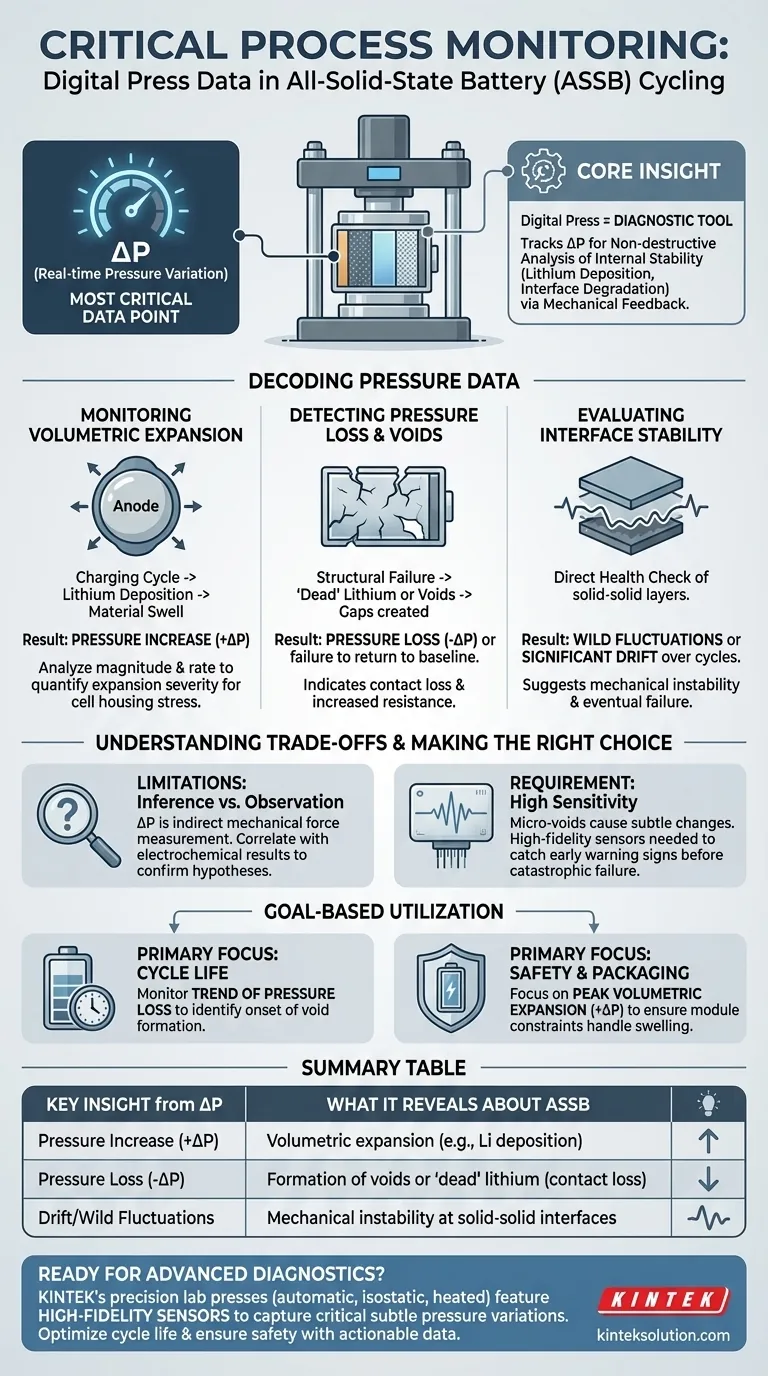
Real-time pressure variation (ΔP) is the most critical data point obtained from a digital press during all-solid-state battery (ASSB) cycling.
While the primary function of the press is to apply a constant stack pressure, the continuous monitoring of deviations from this baseline provides a window into the cell's internal mechanics. This data allows you to correlate electrochemical activity with physical changes, such as expansion or void formation, without opening the cell.
Core Insight: The digital press transforms mechanical pressure into a diagnostic tool. By tracking ΔP, you move beyond simple load application to a non-destructive analysis of internal stability, inferring chemical phenomena like lithium deposition and interface degradation through mechanical feedback.
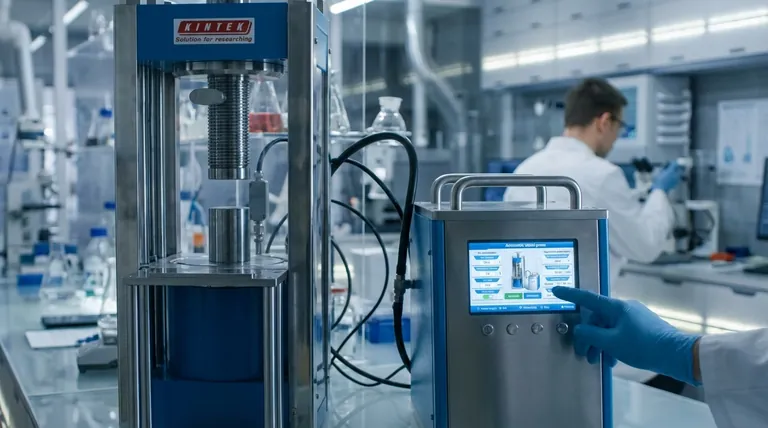
Decoding the Pressure Data
To understand the health of an all-solid-state battery, you must look at what the pressure changes represent. The data points act as a proxy for internal physical transformations.
Monitoring Volumetric Expansion
During the charging cycle, lithium ions move and deposit within the anode structure.
This deposition inevitably causes the material to swell. A digital press captures this as a distinctive increase in pressure (positive ΔP).
By analyzing the magnitude and rate of this pressure spike, you can quantify the severity of the volumetric expansion. This is essential for determining if the cell housing can withstand the mechanical stress generated during operation.
Detecting Pressure Loss and Voids
Conversely, the data can reveal structural failures within the cell.
If the digital press records a pressure loss (negative ΔP) or a failure to return to baseline pressure, it often indicates the formation of "dead" lithium or voids.
Voids create gaps where contact is lost between solid particles. This loss of contact increases internal resistance and degrades performance. The pressure data alerts you to this structural collapse immediately.
Evaluating Interface Stability
The most valuable application of this data is the assessment of mechanical stability at the internal interfaces.
Solid-state batteries rely on perfect contact between layers. The ΔP data serves as a direct "health check" of these interfaces.
If the pressure fluctuates wildly or drifts significantly over many cycles, it suggests the internal interfaces are mechanically unstable, leading to eventual cell failure.
Understanding the Trade-offs
While pressure monitoring offers powerful insights, it is important to recognize the limitations of this data when designing your testing protocols.
Inference vs. Direct Observation
It is critical to remember that ΔP is an indirect measurement.
You are measuring mechanical force to infer electrochemical phenomena. While a pressure drop suggests void formation, it does not image the void itself. You must correlate this data with electrochemical results to confirm your hypothesis.
The Requirement for High Sensitivity
The data is only as good as the sensor's resolution.
Micro-voids and early-stage dead lithium formation cause very subtle pressure changes. If the digital press lacks high-fidelity sensors, you may miss the early warning signs of degradation, seeing the problem only after catastrophic failure has occurred.
Making the Right Choice for Your Goal
How you utilize this data depends on the specific barrier you are trying to break in your battery research.
- If your primary focus is Cycle Life: Monitor the trend of pressure loss over time to identify when void formation begins to sever internal contact.
- If your primary focus is Safety and Packaging: Focus on the peak volumetric expansion (positive ΔP) to ensure your module constraints can handle the swelling without rupturing.
By treating the digital press as a diagnostic monitor rather than just a clamp, you turn mechanical constraints into actionable data for optimizing cell longevity.
Summary Table:
| Key Insight from ΔP Data | What It Reveals About the ASSB |
|---|---|
| Pressure Increase (Positive ΔP) | Volumetric expansion during charging (e.g., lithium deposition). |
| Pressure Loss (Negative ΔP) | Formation of voids or 'dead' lithium, indicating loss of internal contact. |
| Drift/Wild Fluctuations | Mechanical instability at critical solid-solid interfaces. |
Ready to transform your all-solid-state battery testing from simple clamping to advanced diagnostics?
KINTEK's precision lab presses (including automatic, isostatic, and heated models) are engineered with the high-fidelity sensors required to capture the subtle pressure variations that are critical for your research. Our equipment provides the actionable data you need to optimize cycle life and ensure safety.
Let's discuss how our solutions can bring clarity to your development process. Contact our experts today for a personalized consultation.
Visual Guide
Related Products
- Warm Isostatic Press for Solid State Battery Research Warm Isostatic Press
- Laboratory Hydraulic Press Lab Pellet Press Button Battery Press
- Lab Infrared Press Mold for Laboratory Applications
- Button Battery Sealing Press Machine for Lab
- Carbide Lab Press Mold for Laboratory Sample Preparation
People Also Ask
- Why must composite cathodes be sealed in vacuum lamination bags for WIP? Ensure Battery Stability and Density
- What is the function of elastic molds in warm isostatic pressing? Achieve Uniform Density in Composite Particles
- How do sacrificial volume materials (SVM) maintain microchannels in isostatic pressing? Ensure Structural Integrity
- What is the process involved in warm isostatic pressing? Mastering Uniform Density with WIP Technology
- How does Warm Isostatic Pressing differ from traditional pressing methods? Unlock Uniform Density for Complex Parts







