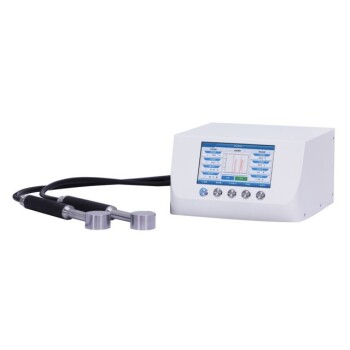
High-power heating equipment must provide a highly stable and constant temperature environment, specifically within the range of 900K to 1200K. To effectively study ion exchange kinetics, the equipment requires precise temperature control systems capable of maintaining this stability to fully activate ion diffusion mechanisms. This rigorous control is essential because the diffusion coefficient ($D_{IX}$) varies significantly with temperature fluctuations.
The core requirement for studying these kinetics is the ability to simulate average Mean Square Displacement (MSD) through precise thermal regulation. Without a stable environment at 1200K, it is impossible to accurately isolate the influence of ion size effects on the diffusion process.
The Criticality of Thermal Stability
Activating Diffusion Mechanisms
For solid electrolytes, reaching a specific thermal threshold is not optional; it is a catalyst for movement.
Equipment must reliably operate between 900K and 1200K to ensure the activation of ion diffusion mechanisms. Below this range, the kinetic activity may be insufficient for measurable exchange.
The Temperature-Diffusion Relationship
The diffusion coefficient ($D_{IX}$) is highly sensitive to thermal conditions.
Because $D_{IX}$ varies significantly with temperature, even minor fluctuations can skew kinetic data. Precise temperature control is the only way to ensure that observed changes are due to material properties, not equipment instability.
Simulating Kinetics and Displacement
Controlling Mean Square Displacement (MSD)
The heating equipment serves a role beyond simple heating; it acts as a simulator for kinetic behavior.
The system must be capable of simulating average Mean Square Displacement (MSD) across various temperature gradients. This simulation is the metric by which researchers gauge the movement and exchange of ions within the lattice.
Analyzing Ion Size Effects
A stable high-temperature environment allows for the isolation of specific variables.
By maintaining constant conditions at 1200K, researchers can accurately study how ion size effects influence diffusion kinetics. This specific analysis is only valid when the thermal variable is strictly controlled.
Understanding the Trade-offs
Sensitivity to Fluctuations
While high sensitivity in a control system is desirable, it introduces complexity.
If the equipment lacks the precision to simulate MSD accurately, the resulting data regarding ion size influence will be flawed. There is a direct trade-off between the simplicity of the heating element and the reliability of the kinetic data produced.
Energy vs. Precision
Maintaining a constant 1200K requires significant energy input and sophisticated insulation.
Researchers must ensure the equipment is rated for continuous high-power operation. Underrated equipment may reach the target temperature but fail to maintain the constant environment required for valid diffusion analysis.
Making the Right Choice for Your Experiment
To ensure the validity of your ion exchange data, prioritize the heating control system above raw power.
- If your primary focus is determining the Diffusion Coefficient ($D_{IX}$): Prioritize a system with a PID controller that minimizes oscillation to prevent thermal noise from corrupting your data.
- If your primary focus is studying Ion Size Effects: Ensure the equipment can hold a constant 1200K for extended periods to allow for the complete simulation of Mean Square Displacement.
Precision in heating is the prerequisite for precision in kinetic analysis.
Summary Table:
| Requirement | Specification for Solid Electrolytes | Impact on Kinetics |
|---|---|---|
| Temperature Range | 900K to 1200K | Activates necessary ion diffusion mechanisms |
| Thermal Stability | High Precision / Constant | Prevents skewing of Diffusion Coefficient ($D_{IX}$) |
| Control Mechanism | PID Controller / Minimal Oscillation | Essential for simulating Mean Square Displacement (MSD) |
| Operational Rating | Continuous High-Power | Ensures isolation of ion size effects during analysis |
Elevate Your Solid Electrolyte Research with KINTEK
Precise kinetic analysis demands uncompromising thermal stability. KINTEK specializes in comprehensive laboratory pressing and heating solutions, offering high-performance muffle furnaces and specialized equipment designed to maintain the rigorous environments required for battery research and material science.
Whether you need manual, automatic, or heated models for material preparation, or advanced isostatic presses, we provide the tools to ensure your research is accurate and reproducible. Don't let thermal fluctuations compromise your data.
Contact KINTEK Today for a Tailored Solution
References
- Harsh Jagad, Yue Qi. Ion Size Effects on the Thermodynamic, Kinetic, and Mechanical Properties during Ion Exchange in Solid-State Electrolytes. DOI: 10.1021/acs.chemmater.5c01147
This article is also based on technical information from Kintek Solution Knowledge Base .
Related Products
- Lab Double Plate Heating Mold for Laboratory Use
- Infrared Heating Quantitative Flat Plate Mold for Precise Temperature Control
- Lab Infrared Press Mold for No Demolding
- Lab Cylindrical Press Mold for Laboratory Use
- Split Automatic Heated Hydraulic Press Machine with Heated Plates
People Also Ask
- How does the geometry of laboratory molds influence mycelium-based composites? Optimize Density and Strength
- Why are precision laboratory molds essential for forming basalt-reinforced lightweight concrete specimens?
- Why are high-precision laboratory molds and specific compaction processes required? Ensure Data Integrity in Soil Research
- What is the purpose of using a laboratory hot plate and weight pressing? Mastering Cellulose Filament Bond Strength
- How is a laboratory hot plate utilized in Li-Si alloy electrode preparation? Achieve High-Activity Battery Materials