
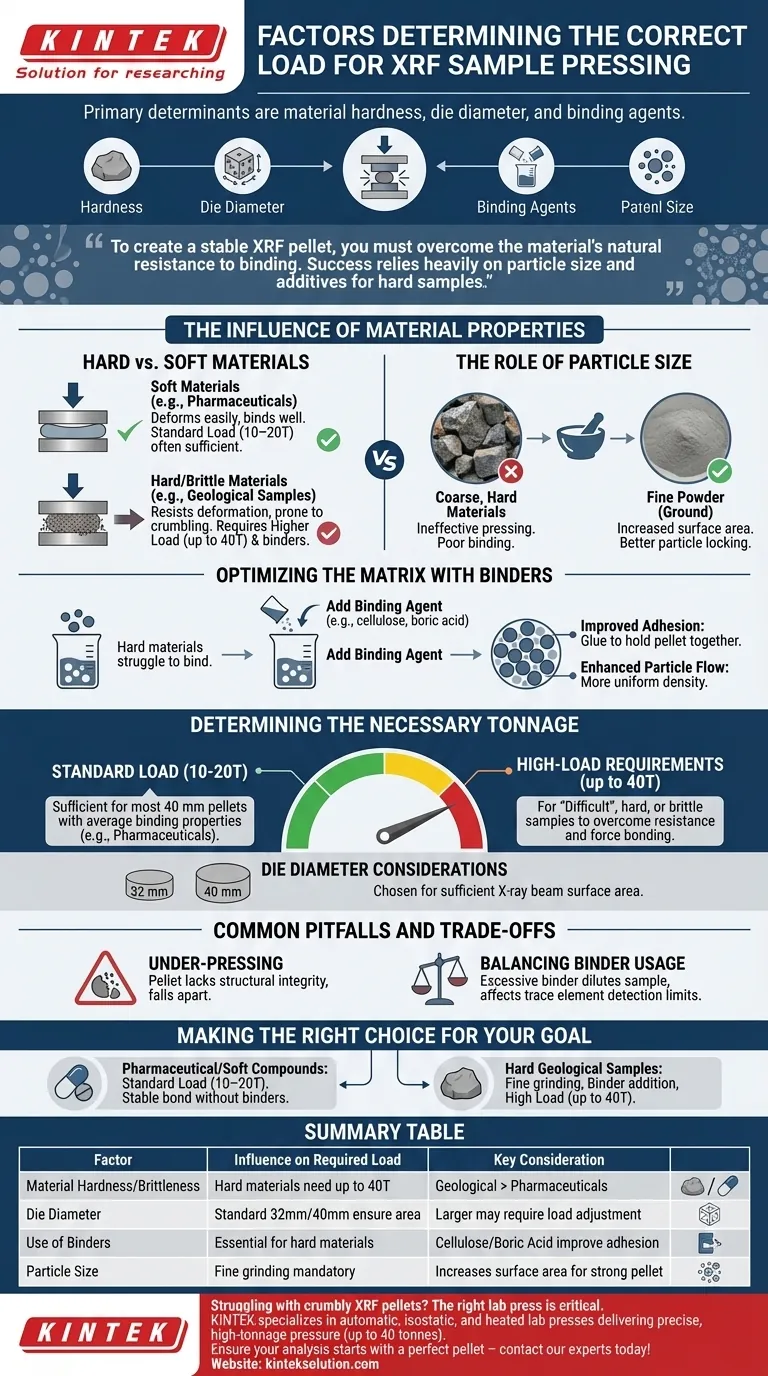
The primary factors determining the correct load for XRF sample pressing are the hardness and brittleness of the material, the diameter of the die, and the necessity of binding agents. While a load of 10 to 20 tonnes is standard for most 40 mm pellets, hard or brittle materials often require significantly higher pressures—up to 40 tonnes—along with specific preparation steps to ensure the pellet remains intact.
To create a stable XRF pellet, you must overcome the material's natural resistance to binding. While pressure is the mechanism, the success of the bond relies heavily on particle size and the use of additives to compensate for the lack of natural adhesion in hard samples.

The Influence of Material Properties
Hard vs. Soft Materials
The physical characteristics of your sample are the most critical variable. Soft materials, such as many pharmaceutical compounds, deform easily under pressure and bind relatively well.
Hard and brittle materials, such as geological samples, resist this deformation. They have a much harder time binding to one another, making them prone to crumbling if not processed correctly.
The Role of Particle Size
You cannot effectively press coarse, hard materials. To achieve a stable pellet, solid samples must be ground to a very fine powder before pressing.
Fine grinding increases the surface area available for contact. This allows the particles to lock together more effectively when the load is applied.
Optimizing the Matrix with Binders
Improving Adhesion
Because hard materials struggle to bind, pressure alone is often insufficient. You must mix these powders with a binding agent, such as cellulose or boric acid.
Enhancing Particle Flow
Binders serve a dual purpose: they act as a glue to hold the pellet together and they improve the flow of particles during the pressing process. This results in a more uniform density across the pellet.
Determining the Necessary Tonnage
Standard Load Guidelines
For most standard applications using a 40 mm die, a load of 10 to 20 tonnes is sufficient. This range typically provides enough force to create a fully bonded pellet for materials with average binding properties.
High-Load Requirements
"Difficult" samples—specifically those that are exceptionally hard or brittle—require more force to overcome their resistance to bonding.
For these challenging materials, you may need to increase the load up to 40 tonnes. This extreme pressure helps force the reluctant particles and binder into a cohesive unit.
Die Diameter Considerations
Pellets are commonly pressed in diameters of 32 mm or 40 mm. These sizes are chosen to ensure there is sufficient surface area for the spectrometer's X-ray beam to analyze the sample.
Common Pitfalls and Trade-offs
The Risk of Under-Pressing
The most common failure mode in XRF preparation is a pellet that falls apart after extraction. If the load is too low for the specific brittleness of the material, the bond will be superficial and the pellet will lack structural integrity.
Balancing Binder Usage
While binders are essential for hard geological samples, they are an additive. You must ensure the ratio of binder to sample allows for physical stability without diluting the sample so much that it affects detection limits for trace elements.
Making the Right Choice for Your Goal
To ensure analytical accuracy and sample durability, match your pressing parameters to your specific material type:
- If your primary focus is Pharmaceutical or Soft Compounds: A standard load of 10–20 tonnes is typically sufficient to achieve a stable bond without additional binders.
- If your primary focus is Hard Geological Samples: You must grind the sample to a fine powder, mix it with a binder like cellulose, and be prepared to apply loads up to 40 tonnes.
Successful XRF analysis begins with a sample preparation process that respects the physical limitations of the material.
Summary Table:
| Factor | Influence on Required Load | Key Consideration |
|---|---|---|
| Material Hardness/Brittleness | Hard/brittle materials require higher loads (up to 40T) | Geological samples need more pressure than soft pharmaceuticals |
| Die Diameter | Standard 32mm or 40mm dies ensure sufficient analysis surface area | Larger diameters may require adjustments to total load |
| Use of Binders | Essential for hard materials; reduces risk of crumbling | Cellulose or boric acid improve adhesion and particle flow |
| Particle Size | Fine grinding is mandatory for effective binding | Increases surface area for a stronger pellet |
Struggling with crumbly XRF pellets or inconsistent results? The right lab press is critical for successful sample preparation. KINTEK specializes in automatic lab presses, isostatic presses, and heated lab presses designed to deliver the precise, high-tonnage pressure (up to 40 tonnes) needed for hard geological samples, pharmaceuticals, and other challenging materials. Ensure your analysis starts with a perfect pellet – contact our experts today to find the ideal press for your laboratory's needs!
Visual Guide
Related Products
- Laboratory Hydraulic Pellet Press for XRF KBR FTIR Lab Press
- Automatic Laboratory Hydraulic Press for XRF and KBR Pellet Pressing
- Lab XRF Boric Acid Powder Pellet Pressing Mold for Laboratory Use
- Carbide Lab Press Mold for Laboratory Sample Preparation
- XRF KBR Plastic Ring Lab Powder Pellet Pressing Mold for FTIR
People Also Ask
- Laboratory Pellet Press for Solar PV Recycling: Ensuring High-Precision Material Analysis and Purity
- Why is a professional laboratory pellet press required for XRF of silica sand? Achieve +/- 0.10% Precision
- Why is high consistency in holding pressure from a laboratory pellet press required when preparing multi-component alloy specimens?
- Why Use a Laboratory Pellet Press for PXRD Anode Material Prep? Standardize Samples for Precise Analysis
- What are the different types of pellet-making tools available for labs? Choose the Right Press for Your Sample



















