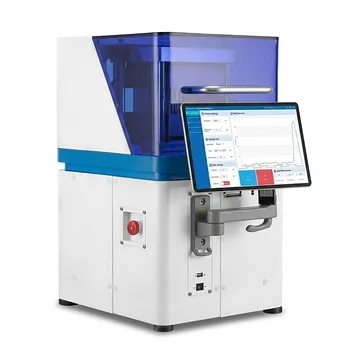
Selecting the right hydraulic lab press requires aligning the machine's specific capabilities with the physical and thermal demands of your pellet die set. To ensure consistent results, you must prioritize accurate force measurement via a reliable gauge, sufficient tonnage capacity for your specific material, precise temperature control if heating is involved, and a design that facilitates easy maintenance and cleaning.
The optimal press is not simply the most powerful one, but the unit that offers the precise control and physical clearance necessary to operate your specific die set safely and repeatably.
Force and Capacity Requirements
Accurate Force Measurement
The most critical feature of a lab press is the force gauge. You must be able to accurately read the applied force to prevent exceeding the maximum pressure rating of your die set, which could cause catastrophic failure.
Matching Tonnage to Application
Select a press capacity that exceeds your required operating pressure but offers good resolution at your target force. While presses range from 15 to over 100 tons, using a massive press for a delicate, low-force application can lead to inaccuracy.
Physical Dimensions and Compatibility
Platen Size and Clearance
The platen size must be large enough to fully support the base of your die set. Additionally, ensure the vertical "daylight" opening is sufficient to insert and remove the die assembly comfortably.
Benchtop vs. Floor Models
Evaluate your available lab space. Benchtop models are generally sufficient for standard pelletizing applications, while floor models are necessary for larger samples or higher tonnage requirements.
Thermal Capabilities
Temperature Range and Control
If your application requires heated pressing, verify the press can achieve and maintain the specific temperature range (often 600°F to 1200°F) required for your material.
Thermal Stability and Hold Time
Beyond just reaching a temperature, the press must be able to hold that temperature precisely for the duration of the cycle. Inconsistent heating can lead to density gradients or structural flaws in the finished pellet.
Operational Efficiency and Maintenance
Ease of Maintenance
According to the primary principles of press selection, you should prioritize units designed for easy upkeep. Look for presses with accessible components that allow for straightforward cleaning and part replacement, which is vital for preventing cross-contamination in a lab setting.
Control Systems
Consider whether you need computer control options. For research requiring strict reproducibility, features like programmable cycles, data logging, and automated pressure holding can eliminate operator error.
Understanding the Trade-offs
Manual vs. Automated Systems
Manual presses are cost-effective and robust, offering tactile feedback that is excellent for simple, low-volume tasks. However, they rely heavily on operator skill for consistency.
Automated/Programmable presses ensure high repeatability and data capture, which is essential for regulated environments. The trade-off is a significantly higher cost and increased complexity in repairs if the electronics fail.
Tonnage vs. Sensitivity
Buying a press with vastly more capacity than needed (e.g., a 100-ton press for a 5-ton application) often results in a loss of sensitivity. Gauges on high-capacity machines may not provide accurate readings at the very bottom of their range.
Making the Right Choice for Your Goal
To select the best press for your specific lab, align your choice with your primary objective:
- If your primary focus is basic sample preparation: Prioritize a robust manual benchtop press with a high-visibility analog gauge and easy-to-clean platens.
- If your primary focus is complex material research: Invest in a programmable press with integrated heating, data logging, and precise pressure holding capabilities.
- If your primary focus is high-force applications: Ensure you select a floor model with a large safety shield and a capacity rating at least 20% higher than your maximum expected load.
Choose the press that protects your expensive die sets while delivering the consistency your research demands.
Summary Table:
| Feature Category | Key Considerations | Impact on Research |
|---|---|---|
| Force & Tonnage | Gauge accuracy & capacity (15-100+ tons) | Prevents die damage and ensures sample density. |
| Physical Specs | Platen size and vertical clearance | Determines die compatibility and ease of operation. |
| Thermal Control | Temperature range (up to 1200°F) & stability | Essential for heat-treated pelletizing and material stability. |
| Automation | Manual vs. Programmable/Digital control | Influences reproducibility, data logging, and labor costs. |
| Maintenance | Accessible components and easy-to-clean platens | Reduces cross-contamination and extends equipment life. |
Elevate Your Material Research with KINTEK
Don't let inconsistent pressing compromise your laboratory results. KINTEK specializes in comprehensive laboratory pressing solutions tailored to your specific research needs. Whether you are conducting cutting-edge battery research or routine sample preparation, we offer a diverse range of high-performance equipment including:
- Manual & Automatic Presses for ultimate control or high-throughput repeatability.
- Heated & Multifunctional Models for complex thermal material processing.
- Glovebox-Compatible & Isostatic Presses (CIP/WIP) for specialized environments.
Our team is ready to help you match the perfect press to your pellet die set, ensuring safety, precision, and durability.
Ready to optimize your lab? Contact our experts today to find the ideal pressing solution for your application.
Related Products
- 24T 30T 60T Heated Hydraulic Lab Press Machine with Hot Plates for Laboratory
- Automatic Heated Hydraulic Lab Press with Programmable Touch Screen Controls and Precision Temperature Regulation
- Automatic Heated Hydraulic Lab Press 120x120mm Plate Fully Automated Material Research Press
- Automatic Heated Hydraulic Lab Press Machine 200x200 Plate Size for Battery Research and Materials Science
- Laboratory Hydraulic Press 2T Lab Pellet Press for KBR FTIR
People Also Ask
- Function of a Laboratory Hydraulic Press with Heated Platens in SSE? Enhance Battery Density & Conductivity
- Why is a laboratory hydraulic press with heating plates required for PLA/TEC films? Achieve Precise Sample Integrity
- What role does a laboratory heated hydraulic press play in LTCC? Essential for High-Density Ceramic Lamination
- What is the primary function of a laboratory heated hydraulic press? Mastering Thermoplastic Carbon Fiber Composites
- What is the critical role of a laboratory heated hydraulic press? Mastering PVC Sample Prep for Testing