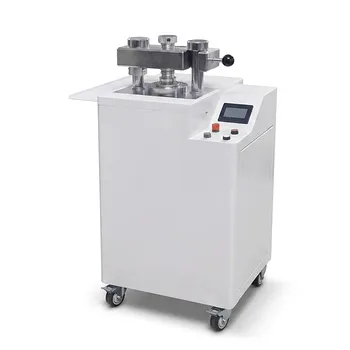
Precision in pillar-type laboratory presses relies on a synergy between structural alignment, friction management, and digital command. The accuracy of the machine bed's movement is primarily ensured by proper pillar guiding arrangements, consistent automatic lubrication systems, and advanced touchscreen control panels. Together, these features minimize mechanical error and ensure repeatable performance.
Accurate movement is not just about rigidity; it requires a frictionless path and precise command. While pillar guides provide the alignment, automatic lubrication and digital controls ensure the motion remains smooth and exact over the machine's lifespan.
Mechanical Stability and Alignment
The physical construction of the press defines its baseline accuracy. If the structural components allow for play or shifting, no amount of software correction can fix the error.
The Role of Pillar Guiding
The most critical mechanical feature is the proper pillar guiding arrangement. These guides act as the tracks for the machine bed, restricting movement strictly to the vertical axis.
High-quality guiding prevents lateral shifting or tilting of the platen under load. This ensures that force is applied evenly across the entire surface of your sample.
Preventing Structural Deflection
Pillar guides also contribute to the overall stiffness of the frame. By maintaining tight tolerances between the pillars and the moving bed, the system resists deflection during high-pressure cycles.
Friction Management and Control
Even perfectly aligned metal components will lose accuracy if friction is not managed. Furthermore, the best mechanics require precise instructions to function correctly.
Ensuring Consistency with Automatic Lubrication
Friction causes wear and erratic movement. An automatic lubrication system is essential for maintaining accuracy over time.
This system ensures a constant, even film of lubricant exists between moving parts. It prevents "stick-slip" motion, where the bed jerks rather than glides, ensuring smooth velocity control.
Crucially, it reduces physical wear on the pillars. Without this protection, gaps would eventually form in the guiding mechanism, permanently destroying the machine's precision.
Digital Precision via Touchscreen Panels
Mechanical accuracy must be paired with precise inputs. Touchscreen control panels allow operators to define exact parameters for movement and pressure.
This eliminates the variability and ambiguity associated with manual valves or analog dials. The digital interface ensures the machine executes the movement profile exactly as programmed, every single time.
Understanding the Trade-offs
While these features significantly enhance accuracy, they introduce maintenance requirements that cannot be ignored.
Complexity vs. Maintenance
Automatic lubrication systems add a layer of complexity. If the system fails or the reservoir runs dry, the machine may continue to operate while causing unseen damage to the guides.
Dependency on Calibration
Touchscreen controls rely on sensors and software. If the underlying sensors drift or are not calibrated regularly, the screen may display "accurate" numbers that do not reflect reality.
Making the Right Choice for Your Goal
When selecting or maintaining a laboratory press, identify which aspect of accuracy is most critical to your specific application.
- If your primary focus is long-term durability: Prioritize machines with robust automatic lubrication systems to protect the guiding surfaces from wear.
- If your primary focus is experimental repeatability: Ensure the unit features a high-resolution touchscreen control panel to eliminate operator variability.
- If your primary focus is sample uniformity: Verify the quality of the pillar guiding arrangements to ensure absolute parallelism during compression.
True accuracy is the result of maintained mechanical alignment driven by precise digital control.
Summary Table:
| Feature | Primary Function | Impact on Accuracy |
|---|---|---|
| Pillar Guiding | Vertical Alignment | Prevents lateral shifting and ensures uniform force distribution. |
| Auto-Lubrication | Friction Reduction | Eliminates 'stick-slip' motion and prevents mechanical wear. |
| Touchscreen Panel | Digital Command | Enables precise parameter input and repeatable movement profiles. |
| Structural Rigidity | Deflection Resistance | Maintains tight tolerances under high-pressure cycles. |
Elevate Your Material Research with KINTEK Precision
Don't let mechanical variability compromise your experimental results. KINTEK specializes in comprehensive laboratory pressing solutions designed for absolute accuracy. Whether you require manual, automatic, heated, multifunctional, or glovebox-compatible models, our presses are engineered with superior pillar guiding and advanced digital controls to meet the rigorous demands of battery research and material science.
From cold and warm isostatic presses to specialized lab units, we provide the tools you need for uniform sample preparation. Contact KINTEK today to discuss how our laboratory pressing solutions can enhance your lab's efficiency and precision.
Related Products
- Laboratory Hydraulic Pellet Press for XRF KBR FTIR Lab Press
- Laboratory Hydraulic Split Electric Lab Pellet Press
- Laboratory Hydraulic Press Lab Pellet Press Button Battery Press
- Automatic XRF Pellet Press for Laboratory Spectrometry Sample Preparation
- Manual Laboratory Hydraulic Pellet Press Lab Hydraulic Press
People Also Ask
- Why is a laboratory pellet press used to pre-press BaSnF4 samples? Ensure Precision in High-Pressure Studies
- What is the necessity of a laboratory pellet press for alcohol by-product fuels? Maximize Energy Density & Consistency
- Why Use a Laboratory Pellet Press for PXRD Anode Material Prep? Standardize Samples for Precise Analysis
- What are the different types of pellet-making tools available for labs? Choose the Right Press for Your Sample
- Why is a professional laboratory pellet press required for XRF of silica sand? Achieve +/- 0.10% Precision