
In any industry where material failure can lead to catastrophic outcomes, the hydraulic press serves as a fundamental tool for validation. Fields like construction, manufacturing, and advanced research rely on it to test the strength, durability, and behavior of materials under controlled force. This testing ensures that everything from a concrete pillar to a sensitive chemical compound performs exactly as designed.
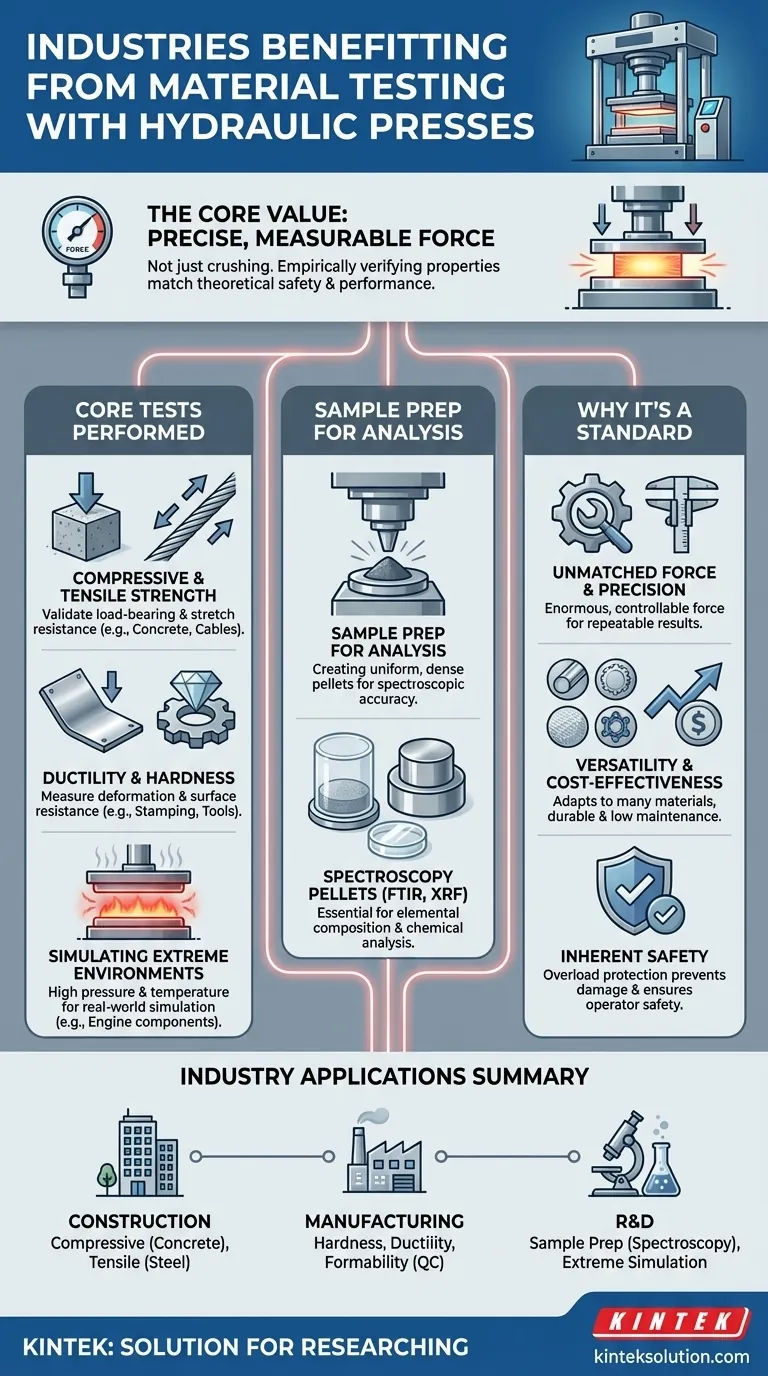
The core value of a hydraulic press in material testing is not just its ability to crush things. It lies in its capacity to apply precise, measurable force, allowing engineers and scientists to empirically verify that a material's properties match the theoretical requirements for safety and performance.
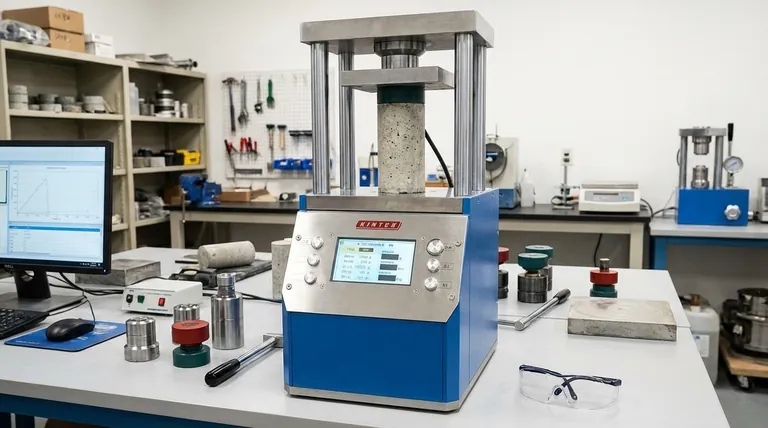
Beyond Simple Strength: The Core Tests Performed
A hydraulic press is far more than a simple brute-force instrument. It is used to conduct a range of specific tests that reveal the complex mechanical properties of a material, providing critical data for design and quality control.
Compressive and Tensile Strength
The most intuitive use is compressive strength testing, where a material is squeezed until it deforms or fractures. This is essential in construction to validate the load-bearing capacity of concrete or bricks.
Conversely, a press can be configured for tensile testing, pulling a material apart to measure its ability to resist being stretched. This data is vital for designing components like cables, bolts, and structural beams.
Ductility and Hardness
Ductility is a measure of a material's ability to deform under stress without breaking. A press is used to controllably bend or stretch a sample, providing key insights for manufacturing processes like stamping or forming metal parts.
Hardness refers to a material's resistance to surface indentation or scratching. The press applies a precise force through a standardized indenter to quantify this property, which is crucial for tools, bearings, and wear-resistant coatings.
Simulating Extreme Environments
Modern laboratories often use heated hydraulic presses. By applying both immense pressure and high temperatures simultaneously, they can simulate the extreme operating conditions inside an engine, a reactor, or deep within the earth's crust. This is invaluable for materials science and engineering research.
The Hidden Role: Sample Preparation for Analysis
Beyond testing mechanical limits, the hydraulic press plays a critical support role in a laboratory: creating perfect samples for other analytical instruments. The quality of the analysis depends entirely on the quality of the sample.
Ensuring Analytical Accuracy
For many types of compositional analysis, a material must be in a uniform, densely compacted form. A hydraulic press is the ideal tool for creating this, ensuring that the components of a powdered mixture are evenly distributed.
Creating Pellets for Spectroscopy
In FTIR spectroscopy, chemists press potassium bromide (KBr) powder mixed with a sample into a thin, transparent pellet. The high pressure ensures there are no imperfections that could interfere with the infrared light.
Similarly, for XRF analysis, the press creates smooth, flat pellets from powdered samples. This uniform surface is essential for obtaining accurate and repeatable data about the material's elemental composition.
Why the Hydraulic Press is a Laboratory Standard
The hydraulic press is a ubiquitous tool in materials testing because it offers a combination of power, precision, and practicality that is difficult to match.
Unmatched Force and Precision
The core advantage of hydraulics is the ability to generate enormous force from a small input. More importantly, this force can be applied smoothly and controlled with extreme precision, allowing for repeatable and standardized testing.
Versatility and Cost-Effectiveness
A single press can be adapted to test a vast range of materials, from metals and ceramics to polymers and composites. They are also known for their durability and minimal maintenance requirements, making them a cost-effective long-term investment for any lab.
Inherent Safety
Professional-grade hydraulic presses are designed with overload protection and other safety features. This prevents damage to the machine and ensures a safe operating environment when dealing with the extreme forces required to make materials fail.
Making the Right Choice for Your Application
The specific tests you perform are dictated entirely by your industry's end goal.
- If your primary focus is construction or civil engineering: You will use a hydraulic press to verify the compressive strength of concrete and the tensile properties of structural steel.
- If your primary focus is manufacturing or automotive: You will rely on it for quality control, testing the hardness, ductility, and formability of metal alloys and polymers used in components.
- If your primary focus is research and development (R&D): The press is your tool for creating precise samples for spectroscopic analysis and for investigating how novel materials behave under extreme pressure and heat.
Ultimately, understanding the function of a hydraulic press empowers you to move from simply assuming material quality to empirically proving it.
Summary Table:
| Industry | Key Applications |
|---|---|
| Construction | Compressive strength testing of concrete, tensile testing of steel |
| Manufacturing | Hardness, ductility, and formability testing for quality control |
| R&D | Sample preparation for spectroscopy, simulation of extreme conditions |
Ready to enhance your material testing with precision and reliability? KINTEK specializes in lab press machines, including automatic lab presses, isostatic presses, and heated lab presses, designed to meet the rigorous demands of laboratories in construction, manufacturing, and R&D. Our equipment ensures accurate force application, durability, and safety, helping you validate material properties and improve quality control. Contact us today to discuss how our solutions can benefit your specific needs and drive your projects forward!
Visual Guide
Related Products
- Automatic High Temperature Heated Hydraulic Press Machine with Heated Plates for Lab
- Manual Heated Hydraulic Lab Press with Integrated Hot Plates Hydraulic Press Machine
- Heated Hydraulic Press Machine with Heated Plates for Vacuum Box Laboratory Hot Press
- Laboratory Hydraulic Press 2T Lab Pellet Press for KBR FTIR
- Laboratory Hydraulic Press Lab Pellet Press Machine for Glove Box
People Also Ask
- Function of a Laboratory Hydraulic Press with Heated Platens in SSE? Enhance Battery Density & Conductivity
- What are the requirements for electrode pressing with high-viscosity ionic liquids like EMIM TFSI? Optimize Performance
- How does a laboratory heated hydraulic press facilitate PBN sample prep for WAXS? Achieve Precise X-Ray Scattering
- What are the industrial applications of heated hydraulic presses? Master Heat & Force for Precision Manufacturing
- Why is a laboratory hydraulic press with heating plates required for PLA/TEC films? Achieve Precise Sample Integrity



















