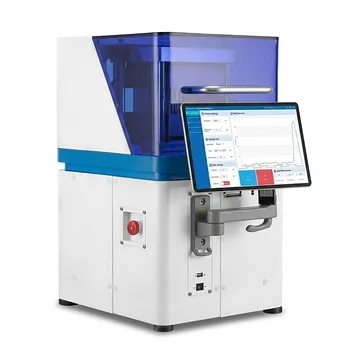
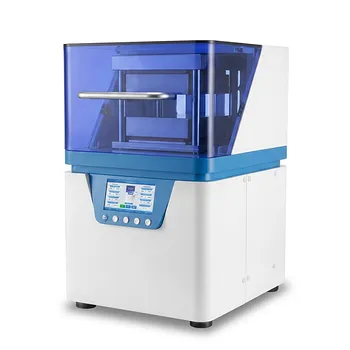
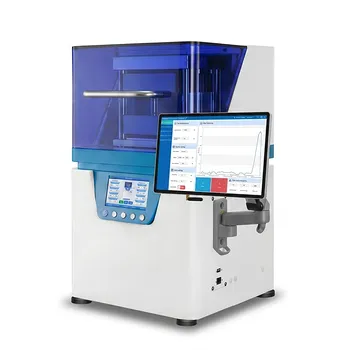
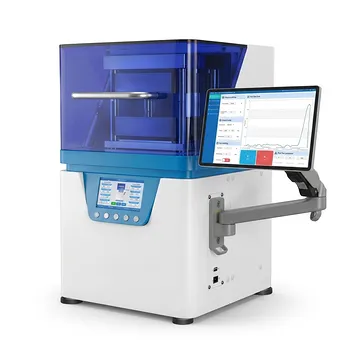
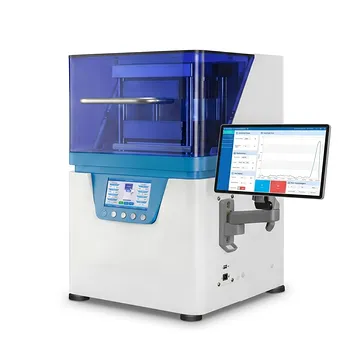
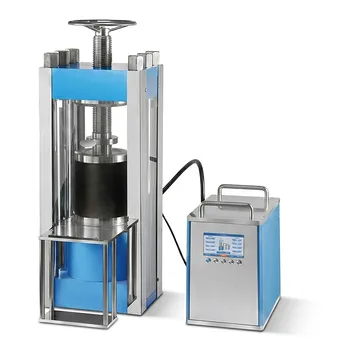
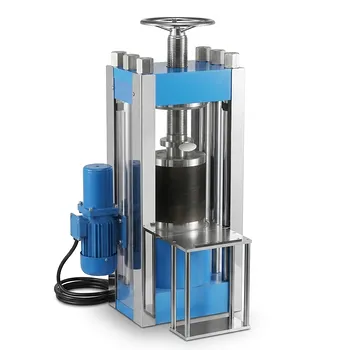
A hot press, also known as a hydraulic hot press or heat press machine, is an engineering device designed to shape, bond, or sinter materials through the simultaneous application of controlled heat and pressure. Its fundamental operational principle relies on the First Law of Thermodynamics, utilizing heat transfer to alter the internal energy of materials, thereby changing their physical state to facilitate bonding or forming.
Core Insight: A hot press is not merely about squashing materials together; it is a precision instrument that manages the "energy budget" of a material. By synchronizing mechanical force (pressure) with thermal energy (heat), it induces phase changes—such as melting solder, curing adhesives, or sintering powders—that would be impossible with pressure or heat alone.
The Operational Principle: Energy and Force
The hot press operates by coordinating two distinct physical forces to alter the material's internal structure.
Thermodynamic Transformation
As stated in the primary reference, the machine functions based on heat transfer principles. By introducing thermal energy, the machine increases the internal energy of the workpiece.
This energy shift allows materials to flow, cure, or bond at the molecular level. The heating speed is adjustable, allowing operators to match the energy input to the specific material's thermal conductivity and melting point.
Hydraulic and Pneumatic Pressure
While heat softens or activates the material, pressure dictates the form and density.
The machine typically utilizes oil pressure and compressed air to drive a hydraulic cylinder. This pressure ensures that materials are compacted to the correct density (low strain-rate) and that bonding surfaces have zero gaps during the thermal cycle.
The Standard Operating Sequence
Regardless of the specific application, most hot presses follow a strict six-step process to ensure consistency.
1. Preparation and Placement
The material is positioned in a mold or directly between the heating platens. For precise applications, this may involve a CCD vision system for accurate alignment.
2. Parameter Setting
The operator inputs critical variables into the control system. These include target temperature, pressure limits, heating rates, and holding times.
3. Heating and Pressing
The cycle begins. The platens heat up (often using multi-stage temperature rise profiles) while the hydraulic system applies the pre-set pressure.
4. The "Dwell" Phase
This is the most critical step. The machine maintains the set temperature and pressure for a specific duration (the holding time). This allows the chemical or physical changes—such as sintering or solder flow—to complete fully.
5. Cooling and Release
Pressure is released, and the system cools down. Controlled cooling is vital to prevent thermal shock or warping of the newly bonded material.
6. Removal
Once the sample reaches a safe temperature, it is removed. The result is a permanently bonded or shaped component.
Key Features for Precision Control
Modern hot presses rely on advanced technology to maintain the delicate balance between heat and pressure.
Pulse Heating Technology
To avoid overheating, high-end units use pulse heating. This allows for extremely rapid temperature sampling (often as fast as 0.1 seconds), ensuring the temperature curve stays exactly where it needs to be.
Structural Integrity
Rigidity is essential for even pressure. Frames are often constructed from single processed steel plates or use a four-column, three-plate structure. This design prevents the platens from tilting under high pressure, which would result in uneven thickness.
Diverse Working Modes
To accommodate different production speeds, platforms may be configured as single, rotary, or left-right mobile stations. This allows operators to load one sample while another is being pressed.
Understanding the Trade-offs
While hot pressing is highly effective, it introduces specific operational constraints that must be managed.
Cycle Time vs. Throughput
Because the process requires a "dwell" time for heat transfer and curing, it is generally slower than cold stamping. High-volume production requires rotary tables or multi-station machines to mitigate this bottleneck.
Complexity of Parameters
Success depends on the precise calibration of heat, pressure, and time. If the temperature rises too fast, the material may degrade; if the pressure is too low, voids may form. The use of real-time temperature curve displays is critical to spotting these errors early.
Infrastructure Requirements
These are not plug-and-play devices. They often require robust auxiliary systems, including specific voltage inputs, clean compressed air sources, and hydraulic oil maintenance.
Making the Right Choice for Your Goal
When selecting or operating a hot press, your specific end-goal dictates the necessary features.
- If your primary focus is Research and Development: Prioritize a laboratory hot press with high-frequency data sampling (0.1s) and programmable multi-stage heating profiles to experiment with novel materials.
- If your primary focus is Electronics Manufacturing: Look for machines with pulse heating and CCD vision systems, which are essential for the precise alignment and soldering of delicate components.
- If your primary focus is Heavy Industry or Powder Metallurgy: Ensure the machine features a high-rigidity four-column structure and powerful hydraulic systems capable of delivering the high pressure needed for sintering.
The effectiveness of a hot press is defined not just by how hot it gets, but by how precisely it can control that heat under load.
Summary Table:
| Feature | Description |
|---|---|
| Core Principle | First Law of Thermodynamics (Simultaneous Heat & Pressure) |
| Pressure Source | Hydraulic cylinder (oil) and pneumatic (compressed air) |
| Heating Method | Pulse heating or multi-stage temperature rise profiles |
| Key Components | CCD vision (alignment), four-column frame, programmable PLC |
| Primary Uses | Material sintering, adhesive curing, electronics soldering, battery research |
Elevate Your Material Research with KINTEK
As a leader in comprehensive laboratory pressing solutions, KINTEK provides the precision and reliability your research demands. Whether you need manual, automatic, heated, multifunctional, or glovebox-compatible models, our range is designed to meet the rigorous standards of modern labs. From battery research to advanced powder metallurgy, we also offer specialized cold and warm isostatic presses to ensure uniform density and superior bonding.
Ready to optimize your pressing workflow? Contact our technical experts today to find the perfect solution for your application!
Related Products
- Automatic Hydraulic Hot Press with Large Plate and Precision Temperature Control for Advanced Material Sample Preparation and Industrial Research
- Heated Hydraulic Press Machine with Heated Plates for Vacuum Box Laboratory Hot Press
- Automatic High Temperature Heated Hydraulic Press Machine with Heated Plates for Lab
- Heated Hydraulic Press Machine With Heated Plates For Vacuum Box Laboratory Hot Press
- Laboratory Manual Heated Hydraulic Press Machine with Hot Plates
People Also Ask
- What are the specific features and applications of hydraulic hot press machines? Precision Solutions for Modern Labs
- How does an automatic hydraulic press operate? Achieve Precision and Consistency in Lab Pelleting
- What are the advantages and common applications of an automatic hydraulic press? Elevate Your Lab's Precision
- What is the technical significance of setting a precise dwell time? Achieve Peak Material Density and Stability
- When is an automatic hydraulic press more suitable than a manual press? Scale Your Lab with Precision & Speed