
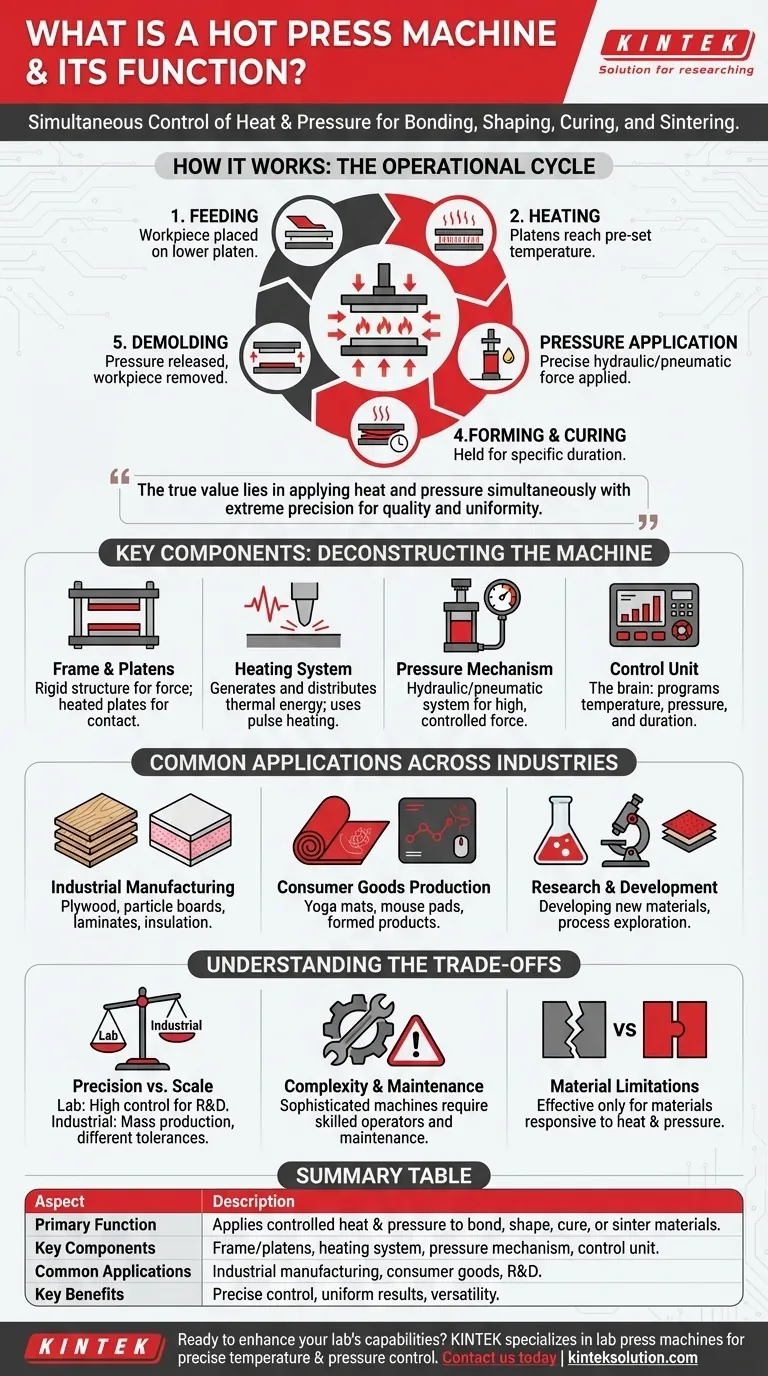
A hot press machine is a device that applies controlled heat and pressure to materials. Its primary function is to bond, shape, cure, or sinter various substances by simultaneously managing thermal and mechanical forces. This controlled process is essential for achieving high-quality, uniform results in a wide range of manufacturing and research applications.
The true value of a hot press lies not just in applying heat and pressure, but in its ability to do so simultaneously with extreme precision. This controlled process is the key to creating strong, uniform, and high-quality materials across industries from woodworking to advanced research.

How a Hot Press Achieves Its Results
A hot press fundamentally alters a material's physical or chemical structure. It doesn't just heat or squeeze; it orchestrates these forces to achieve a specific outcome.
The Core Principle: Simultaneous Force and Heat
By applying heat and pressure at the same time, the machine can soften a material enough to reshape or bond it without causing it to break. This combination forces materials to conform, bond at a molecular level, or cure into a stable, final state.
The Operational Cycle
A typical process involves several distinct stages:
- Feeding: The workpiece is placed on the lower platen or table.
- Heating: The platens heat up to a pre-set temperature, often in controlled stages.
- Pressure Application: A hydraulic or pneumatic system applies a precise amount of force. Some processes also use a vacuum (negative pressure) to remove air and ensure a perfect bond.
- Forming & Curing: The material is held under heat and pressure for a specific duration to ensure the process (bonding, shaping, etc.) is complete.
- Demolding: Pressure is released, the platens may cool, and the finished workpiece is removed.
Deconstructing the Machine: Key Components
While designs vary, most hot presses are built around a few critical systems that work in unison.
The Frame and Platens
The machine is built on a rigid structure, often a four-column, three-plate design, to withstand immense forces without flexing. The platens are the flat, heated plates that make direct contact with the workpiece, transferring both heat and pressure.
The Heating System
This system is responsible for generating and distributing thermal energy. It often uses pulse heating technology and may include components like a titanium indenter to ensure exceptionally even temperature distribution across the entire surface of the platen.
The Pressure Mechanism
Force is typically generated by a hydraulic (oil pressure) or pneumatic (compressed air) system. This allows for extremely high and precisely controlled pressure, which is monitored by digital gauges to ensure consistency.
The Control Unit
This is the brain of the machine. Advanced electronic controls allow operators to program multi-stage temperature rises, set precise pressure levels, and monitor the entire process in real time on a display.
Common Applications Across Industries
Hot press technology is versatile, making it a cornerstone of both large-scale production and cutting-edge science.
Industrial Manufacturing
This is the most common use case. Hot presses are critical for producing plywood, particle boards, and other engineered wood products. They are also used to create decorative laminates and bond insulation foam.
Consumer Goods Production
Many everyday items are made with this technology. The process is used to form and bond materials for products like yoga mats and apply graphics to mouse pads.
Research and Development
A laboratory hot press is a smaller, highly precise version used by scientists. It is crucial for developing new materials, exploring new process parameters for bonding or sintering, and preparing small-scale samples for analysis.
Understanding the Trade-offs
While powerful, hot press technology involves certain considerations that are important to understand.
Precision vs. Scale
A laboratory press offers incredible control over temperature and pressure for small samples, which is ideal for R&D. An industrial press, designed for mass production, operates on a much larger scale but may have different tolerances for control.
Complexity and Maintenance
These are sophisticated machines that combine high-pressure hydraulics, advanced heating elements, and precise electronic controls. They require skilled operators and a strict maintenance schedule to ensure safety and consistent performance.
Material Limitations
The process is only effective for materials that respond appropriately to heat and pressure. Some materials may degrade under high temperatures, while others may not bond or form correctly, requiring alternative manufacturing methods.
Making the Right Choice for Your Goal
Specifying a hot press process depends entirely on your end goal. The key is to match the machine's capabilities to the desired outcome.
- If your primary focus is mass production: You need an industrial-scale machine optimized for speed, high throughput, and repeatability for specific materials like plywood or laminates.
- If your primary focus is creating novel materials: A laboratory hot press is essential, as it provides the granular control over process parameters needed for experimentation and discovery.
- If your primary focus is quality and aesthetics: Seek systems with advanced temperature control and uniform pressure distribution, which are critical for high-finish products like decorative veneers.
Ultimately, mastering the hot press process is about leveraging controlled energy to transform raw materials into finished products with exacting precision.
Summary Table:
| Aspect | Description |
|---|---|
| Primary Function | Applies controlled heat and pressure to bond, shape, cure, or sinter materials |
| Key Components | Frame/platens, heating system, pressure mechanism, control unit |
| Common Applications | Industrial manufacturing (e.g., plywood), consumer goods (e.g., yoga mats), R&D |
| Key Benefits | Precise control, uniform results, versatility across materials and industries |
Ready to enhance your lab's capabilities with a reliable hot press machine? KINTEK specializes in lab press machines, including automatic, isostatic, and heated models, designed to deliver precise temperature and pressure control for superior material bonding and shaping. Whether you're in research or production, our solutions ensure high-quality, uniform results. Contact us today to discuss your needs and discover how we can support your laboratory goals!
Visual Guide
Related Products
- Automatic High Temperature Heated Hydraulic Press Machine with Heated Plates for Lab
- Heated Hydraulic Press Machine with Heated Plates for Vacuum Box Laboratory Hot Press
- Automatic Heated Hydraulic Press Machine with Hot Plates for Laboratory
- Heated Hydraulic Press Machine With Heated Plates For Vacuum Box Laboratory Hot Press
- Laboratory Split Manual Heated Hydraulic Press Machine with Hot Plates
People Also Ask
- Function of a Laboratory Hydraulic Press with Heated Platens in SSE? Enhance Battery Density & Conductivity
- What are the requirements for electrode pressing with high-viscosity ionic liquids like EMIM TFSI? Optimize Performance
- How does a laboratory heated hydraulic press facilitate PBN sample prep for WAXS? Achieve Precise X-Ray Scattering
- What are the industrial applications of heated hydraulic presses? Master Heat & Force for Precision Manufacturing
- Why is a laboratory hydraulic press with heating plates required for PLA/TEC films? Achieve Precise Sample Integrity



















