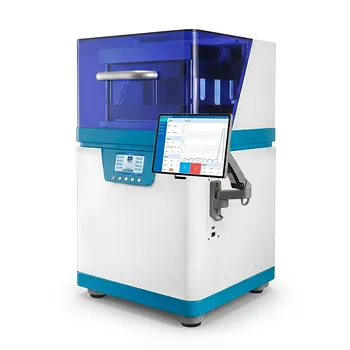
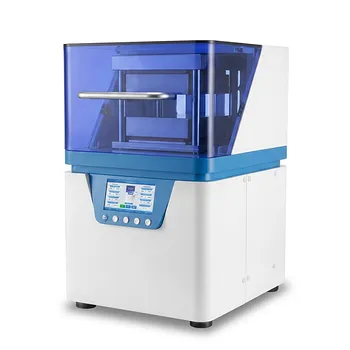
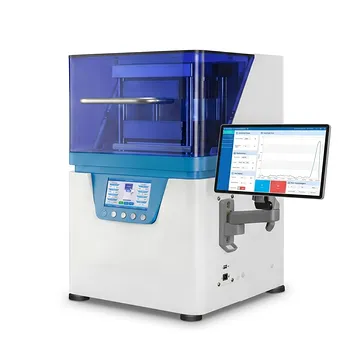
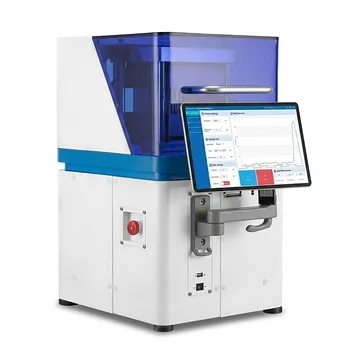
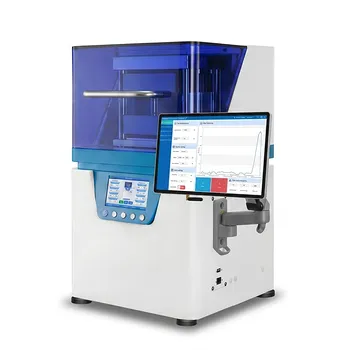
A hydraulic mini press is a compact, portable laboratory instrument designed to compress solid samples into pellets using hydraulic force. Despite weighing only around 4 kilograms, this device is capable of applying up to 2 tons of pressure through a manual handle operation. By focusing this force onto a smaller surface area—typically creating 7 mm diameter pellets rather than the standard 13 mm—it achieves internal pressures equivalent to those of much larger, heavier machines.
Core Takeaway The hydraulic mini press is a solution for laboratories that need to generate high-quality, repeatable samples without the footprint or expense of a full-sized industrial press. By reducing the sample size, it maintains high pressure capabilities in a portable, table-top format.
The Mechanics of Miniaturization
Achieving Force Through Physics
Like its full-sized counterparts, a mini press relies on Pascal’s principle. This law dictates that pressure applied to a fluid in a closed system is transmitted equally in all directions.
By applying a modest mechanical force to a small piston via a handle, the system amplifies this force through the hydraulic fluid to a larger piston. This allows a user to generate tons of load with minimal manual effort.
The Advantage of Smaller Samples
The defining feature of the mini press is its optimization for smaller die sizes. While standard presses often produce 13 mm pellets, the mini press typically produces 7 mm pellets.
This reduction in diameter is critical. Because pressure is defined as force divided by area, a smaller pellet surface area allows the machine to achieve the same specific pressure on the sample using significantly less total tonnage (2 tons vs. 15 or 25 tons).
Manual Precision
Operation is straightforward and purely mechanical. The user turns a handle to drive the hydraulic pump.
This simplicity removes the need for electricity or complex motor systems, contributing to the unit's extreme portability and low weight (approx. 4 kg).
Key Components and Utility
The Importance of the Pressure Gauge
One of the most valuable components integrated into these devices is the pressure gauge.
In scientific contexts, such as pharmaceutical research or polymer testing, consistency is paramount. The gauge allows the operator to apply the exact same load to every sample, ensuring that data gathered from the pellets is reproducible and reliable.
Primary Use Cases
These devices are predominantly found in academic, pharmaceutical, and polymer testing laboratories.
They are ideal for preparing KBr (potassium bromide) pellets for FTIR spectroscopy or X-ray fluorescence (XRF) analysis, where high-quality, transparent discs are required for accurate chemical analysis.
Understanding the Trade-offs
Sample Size Limitations
The primary limitation is inherent to its design philosophy: the pellet size.
If your analysis requires a large surface area (e.g., standard 13 mm, 32 mm, or 40 mm pellets), the mini press cannot generate sufficient force to compress the sample effectively. It is strictly limited to smaller diameters, usually around 7 mm.
Manual Operation Constraints
While the handle mechanism is efficient, it is not automated.
For high-volume laboratories processing hundreds of samples daily, the manual effort required to screw the handle for every single pellet can become fatiguing and time-consuming compared to an automated electric press.
Making the Right Choice for Your Goal
Before investing in a hydraulic mini press, evaluate your specific laboratory requirements.
- If your primary focus is portability and cost: The mini press is the superior choice, offering a lightweight (4 kg) and inexpensive solution that fits easily on a crowded benchtop or in a glovebox.
- If your primary focus is standard sample sizes: You will need a full-sized press capable of 15 to 25 tons to adequately compress 13 mm or larger pellets.
- If your primary focus is high-throughput processing: Consider a motorized press to eliminate the physical strain and time costs associated with manual handle operation.
The hydraulic mini press represents the ideal balance of power and portability for specific, small-scale analytical needs.
Summary Table:
| Feature | Hydraulic Mini Press Specification |
|---|---|
| Max Load | Up to 2 Tons |
| Standard Pellet Size | 7 mm Diameter |
| Weight | Approx. 4 kg (Portable) |
| Operation Type | Manual Handle (No electricity required) |
| Best For | KBr pellets, FTIR spectroscopy, XRF analysis |
| Key Component | Integrated Pressure Gauge for repeatability |
Optimize Your Lab Space with KINTEK Pressing Solutions
Are you looking for high-quality pellet preparation without the bulk of industrial machinery? KINTEK specializes in comprehensive laboratory pressing solutions, offering a versatile range of manual, automatic, heated, multifunctional, and glovebox-compatible models, alongside advanced cold and warm isostatic presses widely applied in battery research.
Whether you need the portability of a mini press or the high-throughput power of an automated system, our experts are ready to help you achieve perfect sample consistency.
Contact KINTEK Today to Find Your Ideal Press
Related Products
- Automatic Hydraulic Hot Press with Large Plate and Precision Temperature Control for Advanced Material Sample Preparation and Industrial Research
- Automatic Laboratory Hydraulic Press Lab Pellet Press Machine
- Laboratory Hydraulic Press Lab Pellet Press Machine for Glove Box
- Automatic Hydraulic Heat Press Machine with Multi Stage Programmable Control and Integrated Water Cooling Plate Size 180x180mm
- Automatic Heated Hydraulic Lab Press with Programmable Touch Screen Controls and Precision Temperature Regulation
People Also Ask
- What are the specific features and applications of hydraulic hot press machines? Precision Solutions for Modern Labs
- How does an automatic hydraulic press operate? Achieve Precision and Consistency in Lab Pelleting
- What are the advantages and common applications of an automatic hydraulic press? Elevate Your Lab's Precision
- What is the technical significance of setting a precise dwell time? Achieve Peak Material Density and Stability
- When is an automatic hydraulic press more suitable than a manual press? Scale Your Lab with Precision & Speed