
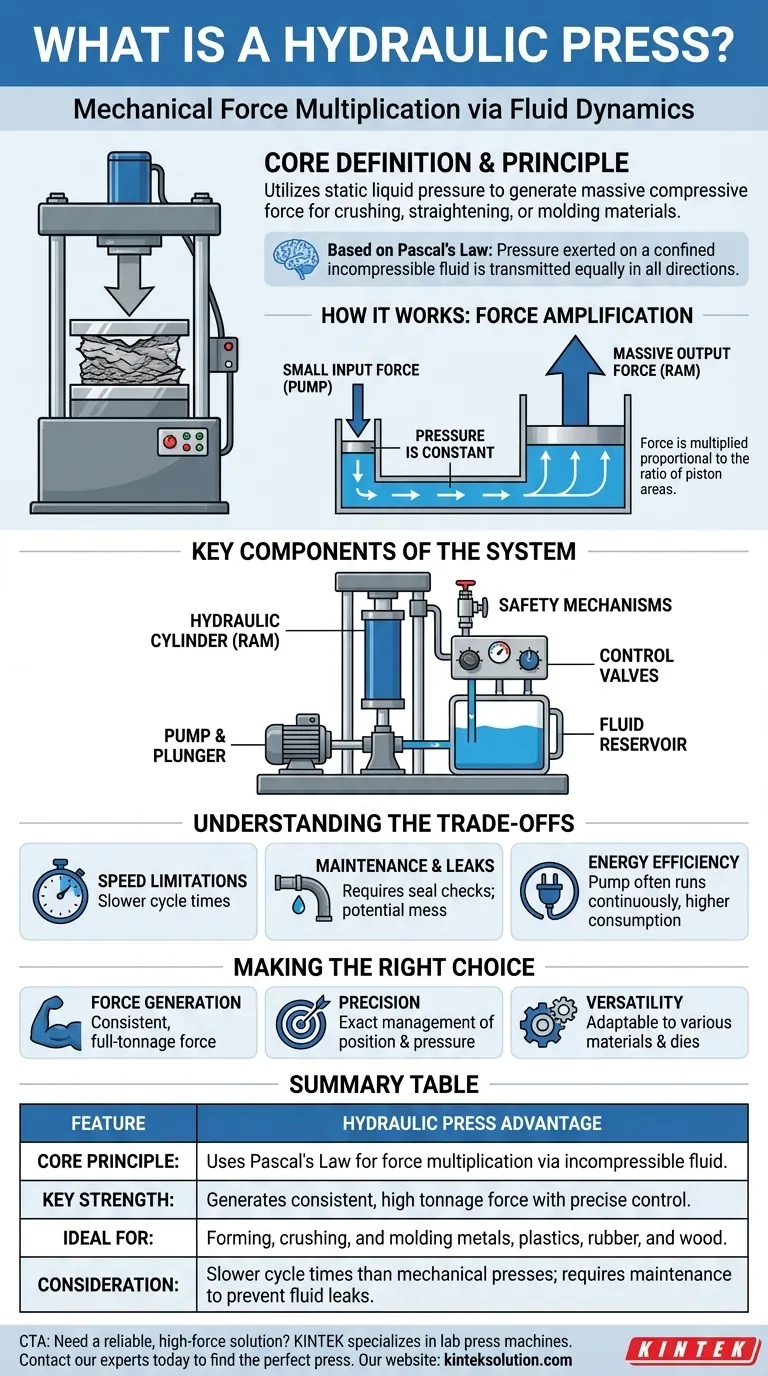
A hydraulic press is a mechanical machine that utilizes the static pressure of a liquid to generate a massive compressive force. Instead of relying on mechanical linkages like gears or levers alone, it employs a closed fluid system to amplify a small input force into enough power to crush, straighten, or mold materials such as metal, plastic, rubber, and wood.
The core value of a hydraulic press lies in force multiplication. By leveraging the physics of Pascal’s Law within a confined liquid, these machines transform a modest mechanical effort into tons of output pressure, allowing for the precise manipulation of heavy-duty materials.

How the Mechanism Works
The operation of a hydraulic press is fundamentally different from mechanical presses. It relies on fluid dynamics to transmit power effectively.
The Application of Pascal’s Law
The machine operates on Pascal’s principle, which states that pressure exerted anywhere in a confined incompressible fluid is transmitted equally in all directions throughout the fluid.
In a press, this means that a pressure change within the closed system remains constant. If you apply pressure to the fluid in one area, that same pressure is available instantly at every other point in the system to perform work.
Force Amplification
The press uses two pistons of different sizes: a small "plunger" and a larger "ram."
When the pump drives the small piston, it applies a modest force to the fluid. Because the pressure is constant, when that fluid pushes against the much larger surface area of the second piston (the ram), the resulting force is multiplied.
The total force generated is directly proportional to the ratio of the two pistons' areas. This allows a small motor or hand pump to generate immense crushing power.
Key Components of the System
While designs vary from simple single-cylinder units to complex multi-cylinder industrial machines, the anatomy remains consistent.
The Hydraulic Cylinder and Ram
This is the "business end" of the machine. The main cylinder houses the large piston (ram) which extends to deliver the compressive force to the workpiece.
The Pump and Plunger
The pump is responsible for generating the initial pressure. It pushes the plunger, forcing hydraulic fluid into the system to drive the larger cylinder.
Fluid Regulation
A reservoir stores the hydraulic oil necessary for operation. A network of pipes and hoses connects the components, ensuring the system remains closed and pressurized.
Control valves are critical for precision. They regulate the flow and pressure of the fluid, giving the operator control over the speed and force of the ram's movement.
Safety Mechanisms
Because the pressures involved are dangerous, relief valves are standard. These prevent the system from exceeding its maximum pressure rating, protecting the machine from catastrophic failure.
Understanding the Trade-offs
While hydraulic presses offer immense power, they are not the perfect solution for every application. Understanding their limitations is vital.
Speed Limitations
Hydraulic presses are generally slower than mechanical presses. Because they rely on the movement of fluid to build pressure and extend the cylinder, the cycle time for a single press can be longer.
Maintenance and Leaks
The system relies entirely on retaining pressure. Worn seals or damaged hoses can lead to hydraulic fluid leaks, which results in a loss of power and creates a messy, hazardous environment.
Energy Efficiency
To maintain constant pressure, the hydraulic pump must often run continuously. This can result in higher energy consumption compared to machines that only consume peak power during the moment of impact.
Making the Right Choice for Your Goal
The utility of a hydraulic press depends heavily on your specific manufacturing or fabrication requirements.
- If your primary focus is Force Generation: A hydraulic press is the superior choice, as it can generate consistent, full-tonnage force at any point in the stroke.
- If your primary focus is Precision: The use of control valves allows for exact management of the ram's position and pressure, making it ideal for delicate forming operations.
- If your primary focus is Versatility: These presses are adaptable to various materials, including metals and plastics, simply by changing the die and adjusting the pressure settings.
A hydraulic press is the definitive tool when you need to convert manageable input energy into maximum output power with high controllability.
Summary Table:
| Feature | Hydraulic Press Advantage |
|---|---|
| Core Principle | Uses Pascal's Law for force multiplication via incompressible fluid. |
| Key Strength | Generates consistent, high tonnage force with precise control. |
| Ideal For | Forming, crushing, and molding metals, plastics, rubber, and wood. |
| Consideration | Slower cycle times than mechanical presses; requires maintenance to prevent fluid leaks. |
Need a reliable, high-force solution for your lab or production line?
KINTEK specializes in lab press machines, including automatic, isostatic, and heated lab presses. Our hydraulic presses deliver the precise, controllable power you need for material testing, prototyping, and small-scale production.
Contact our experts today to find the perfect press for your application and experience the KINTEK difference in performance and support.
Visual Guide
Related Products
- Automatic High Temperature Heated Hydraulic Press Machine with Heated Plates for Lab
- Manual Heated Hydraulic Lab Press with Integrated Hot Plates Hydraulic Press Machine
- Heated Hydraulic Press Machine with Heated Plates for Vacuum Box Laboratory Hot Press
- Laboratory Hydraulic Press 2T Lab Pellet Press for KBR FTIR
- Laboratory Hydraulic Press Lab Pellet Press Machine for Glove Box
People Also Ask
- Function of a Laboratory Hydraulic Press with Heated Platens in SSE? Enhance Battery Density & Conductivity
- What are the requirements for electrode pressing with high-viscosity ionic liquids like EMIM TFSI? Optimize Performance
- How does a laboratory heated hydraulic press facilitate PBN sample prep for WAXS? Achieve Precise X-Ray Scattering
- What are the industrial applications of heated hydraulic presses? Master Heat & Force for Precision Manufacturing
- Why is a laboratory hydraulic press with heating plates required for PLA/TEC films? Achieve Precise Sample Integrity



















