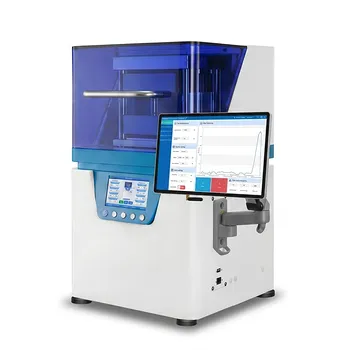
A hydraulic press is a high-power machine that utilizes a hydraulic cylinder to generate massive compressive force. Its operation relies fundamentally on Pascal’s Principle, which dictates that pressure applied to a confined fluid is transmitted equally and undiminished in all directions.
The Core Insight A hydraulic press acts as a mechanical lever for force. By applying a relatively small input force to a small area, the system uses an enclosed fluid to transfer that energy to a larger area, resulting in significantly amplified output force capable of shaping or compressing dense materials.
The Mechanics of Force Amplification
The Governing Law
The foundational rule behind every hydraulic press is Pascal’s Law.
This law states that when pressure is applied to a fluid trapped in a closed system, that pressure change occurs throughout the entire fluid.
It does not diminish as it travels; it acts with equal intensity on every surface touching the fluid.
How Pressure Becomes Power
In practice, a hydraulic press typically utilizes two pistons of different sizes.
A small force is applied to a smaller piston, creating pressure within the hydraulic fluid.
Because the fluid transmits this pressure undiminished, it pushes against a larger piston with the same intensity (pressure per square inch).
The Resulting Mechanical Advantage
Because the second piston has a much larger surface area, the total force exerted is multiplied.
This allows the machine to amplify a modest human or mechanical input into a heavy-duty output capable of industrial tasks like metalworking, auto manufacturing, or sample preparation.
Understanding the Trade-offs
Force vs. Movement
While a hydraulic press offers immense force amplification, it is not magic; it adheres to the conservation of energy.
To generate a large output force on the large piston, the small piston must be moved a significantly longer distance.
Essentially, the system trades distance and speed for raw compressive power.
System Integrity
The efficiency of the press relies entirely on the fluid being "confined."
Any leakage in the hydraulic cylinder or seals disrupts the closed system, causing an immediate drop in pressure and a loss of compressive force.
Making the Right Choice for Your Goal
Whether you are studying fluid mechanics or selecting machinery for manufacturing, understanding the relationship between pressure and area is key.
- If your primary focus is Force Generation: Prioritize a system with a high ratio between the input and output piston surface areas to maximize amplification.
- If your primary focus is Material Shaping: Ensure the press is equipped with the correct "bed" or plate to direct that compressive force accurately onto your sample.
Pascal’s Principle transforms fluid dynamics into a tool that allows minimal effort to achieve maximum impact.
Summary Table:
| Feature | Description |
|---|---|
| Core Principle | Pascal's Law (Undiminished pressure in a closed fluid) |
| Mechanism | Force amplification via small vs. large piston surface area |
| Key Component | Hydraulic fluid (oil/water) in a confined cylinder |
| Energy Trade-off | Trades distance/speed for massive compressive force |
| Critical Factor | System integrity and seal quality to maintain pressure |
Elevate Your Laboratory Precision with KINTEK
Are you looking to harness the power of Pascal’s Principle for your research? KINTEK specializes in comprehensive laboratory pressing solutions tailored for precision and durability. Whether you are conducting advanced battery research or material sample preparation, we offer a versatile range of equipment to meet your needs:
- Manual & Automatic Presses for controlled force application.
- Heated & Multifunctional Models for complex material synthesis.
- Glovebox-Compatible & Isostatic Presses (CIP/WIP) for specialized environments.
Don't let equipment limitations slow your innovation. Our experts are ready to help you select the ideal hydraulic system to achieve maximum impact with minimal effort.
Contact KINTEK today to find your perfect pressing solution!
Related Products
- Automatic Hydraulic Hot Press with Large Plate and Precision Temperature Control for Advanced Material Sample Preparation and Industrial Research
- Automatic Hydraulic Heat Press Machine with Multi Stage Programmable Control and Integrated Water Cooling Plate Size 180x180mm
- Automatic High Temperature Heated Hydraulic Press Machine with Heated Plates for Lab
- Automatic Heated Hydraulic Lab Press with Programmable Touch Screen Controls and Precision Temperature Regulation
- Manual Heated Hydraulic Lab Press with Integrated Hot Plates Hydraulic Press Machine
People Also Ask
- What are the specific features and applications of hydraulic hot press machines? Precision Solutions for Modern Labs
- How does an automatic hydraulic press operate? Achieve Precision and Consistency in Lab Pelleting
- What are the advantages and common applications of an automatic hydraulic press? Elevate Your Lab's Precision
- What is the technical significance of setting a precise dwell time? Achieve Peak Material Density and Stability
- When is an automatic hydraulic press more suitable than a manual press? Scale Your Lab with Precision & Speed