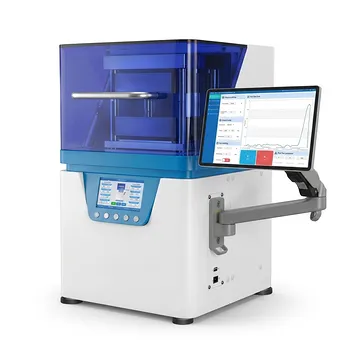
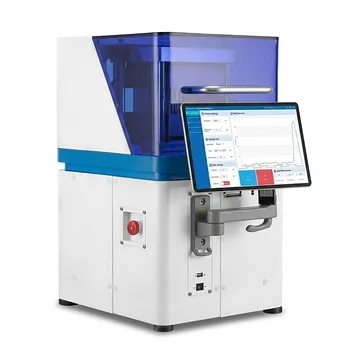
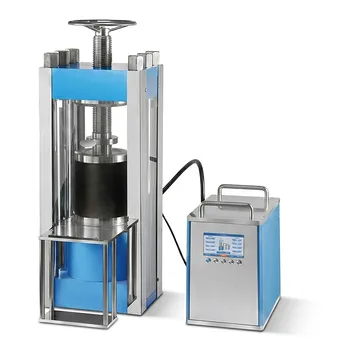
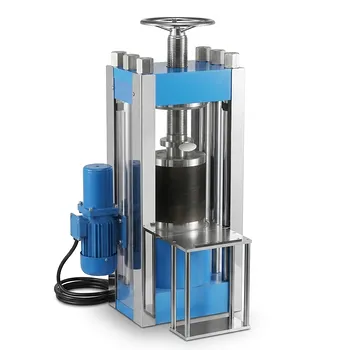
A laboratory hot press is a precision instrument designed to apply controlled heat and pressure simultaneously to materials within a research or small-batch setting. Unlike massive industrial equipment, these devices are engineered for versatility and accuracy, allowing scientists to perform tasks such as bonding, curing, sintering, and pressure forming on diverse samples.
While industrial presses act as the muscle of manufacturing, the laboratory hot press acts as the brain. It prioritizes exact control over temperature and force to validate material properties before scaling up to mass production.
The Core Functionality
Simultaneous Heat and Pressure
The fundamental operation of a laboratory hot press involves two heated platens that compress a material.
By applying thermal energy and mechanical force at the same time, the device changes the physical state of the sample. This dual-action is essential for consolidating powders, laminating composites, or molding polymers.
Precision Control
The primary distinction of a laboratory model is its high-precision control systems.
Researchers can dictate the exact temperature ramp rates and pressure dwell times. This granularity ensures that experiments are repeatable and that data regarding material behavior is accurate.
Key Applications in Research
Material Forming and Bonding
The press is frequently used to shape thermoplastic materials or bond different layers together.
In composite research, this allows for the creation of consistent test coupons. It ensures that the bond strength and material thickness meet strict experimental standards.
Curing and Sintering
For thermosetting plastics and ceramics, the hot press facilitates essential chemical and physical changes.
Curing involves hardening a polymer material through cross-linking, while sintering compacts powder materials into a solid mass without melting them. Both require the rigorous stability that a laboratory press provides.
Laboratory vs. Industrial Models
Scale and Footprint
Laboratory hot presses are significantly smaller than their industrial counterparts.
They are designed to fit on benchtops or in compact floor spaces typical of a research environment. This reduced footprint makes them accessible for universities and R&D departments.
Batch Flexibility
Industrial models are built for the rapid repetition of a single task.
In contrast, laboratory models are designed for diverse samples. A researcher can switch from pressing a ceramic tile to laminating a solar cell prototype with minimal reconfiguration.
Understanding the Limitations
Limited Throughput
The focus on precision comes at the cost of speed and volume.
These units are not designed for high-speed mass production. Attempting to use a laboratory press for large-scale manufacturing runs will result in significant bottlenecks.
Sample Size Constraints
The platen size on a laboratory press restricts the physical dimensions of the sample.
You cannot process large automotive panels or structural beams in these units. They are strictly limited to small batches and coupon-sized samples for testing.
Making the Right Choice for Your Goal
To determine if a laboratory hot press fits your requirements, consider your immediate objectives regarding scale and data quality.
- If your primary focus is Material Research: Choose a laboratory hot press to ensure high precision and the ability to frequently change material types.
- If your primary focus is Mass Manufacturing: Move towards an industrial system, as the laboratory model will not meet your volume or cycle-time requirements.
- If your primary focus is Prototyping: Use the laboratory press to dial in your processing parameters (temperature and pressure) before ordering expensive industrial tooling.
The laboratory hot press is the essential gateway between a theoretical material concept and a viable physical product.
Summary Table:
| Feature | Laboratory Hot Press | Industrial Press |
|---|---|---|
| Primary Goal | Precision research & data validation | High-speed mass production |
| Footprint | Compact (benchtop or small floor) | Large-scale manufacturing floor |
| Flexibility | High (handles diverse sample types) | Low (optimized for single tasks) |
| Key Functions | Sintering, curing, and laminating | Large-scale forming and molding |
| Sample Size | Small-batch or coupon-sized | Large industrial components |
Elevate Your Material Research with KINTEK
Precision is the backbone of scientific discovery. KINTEK specializes in comprehensive laboratory pressing solutions, offering a versatile range of manual, automatic, heated, multifunctional, and glovebox-compatible models. Whether you are working on advanced battery research or polymer development, our cold and warm isostatic presses provide the exact control your experiments demand.
Don't let equipment limitations slow down your innovation. Our experts are ready to help you select the ideal press to ensure repeatable results and seamless scalability.
Ready to refine your laboratory processes? Contact KINTEK Today to Find Your Solution
Related Products
- 24T 30T 60T Heated Hydraulic Lab Press Machine with Hot Plates for Laboratory
- Laboratory Split Manual Heated Hydraulic Press Machine with Hot Plates
- Heated Hydraulic Press Machine with Heated Plates for Vacuum Box Laboratory Hot Press
- Automatic Heated Hydraulic Press Machine with Hot Plates for Laboratory
- Automatic Large Format Laboratory Heated Hydraulic Press 400x400mm Plate Capacity
People Also Ask
- Function of a Laboratory Hydraulic Press with Heated Platens in SSE? Enhance Battery Density & Conductivity
- Why is a laboratory hydraulic press with heating plates required for PLA/TEC films? Achieve Precise Sample Integrity
- What role does a laboratory heated hydraulic press play in LTCC? Essential for High-Density Ceramic Lamination
- What is the primary function of a laboratory heated hydraulic press? Mastering Thermoplastic Carbon Fiber Composites
- What is the critical role of a laboratory heated hydraulic press? Mastering PVC Sample Prep for Testing