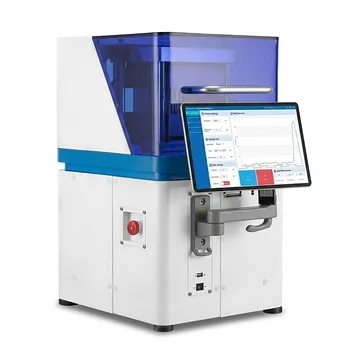
A laboratory press is a specialized machine designed to compress, mold, or compact sample materials under controlled force. Also frequently referred to as a laboratory platen press, this device is the industry standard for preparing samples—such as rubbers, polymers, and composites—for rigorous testing and analysis.
By applying high pressure through hydraulic or pneumatic systems, a laboratory press transforms loose or raw materials into uniform specimens, making it a critical tool for studying material properties and ensuring quality control.
The Core Functions of a Laboratory Press
Sample Preparation and Molding
The primary function of a laboratory press is to create consistent test specimens.
Whether you are working with polymers, rubbers, or composites, the machine molds the material into a specific shape or thickness required for further analysis.
Compacting and Compressing
Beyond molding, these presses are used to compact materials.
This is essential when working with powders or polymer beads, where the goal is to compress loose particles into a solid, unified mass.
Material Testing
Researchers use these devices to study the fundamental properties of a material.
By subjecting a sample to specific pressures, the press helps scientists understand how the material behaves under stress or during the compacting process.
Anatomy and Mechanism
Key Components
A typical laboratory press is built around three main structural elements: a sturdy frame, a ram, and a baseplate.
The sample is placed between the ram and the baseplate, which act as the opposing surfaces for compression.
The Drive System
The force behind the ram is generated by a drive system, which is typically either hydraulic or pneumatic.
These systems are capable of generating significant force, often delivering up to 1,000 pounds per square inch (psi) of pressure to the sample.
Material Versatility
Rubbers and Polymers
As noted in industry standards, these presses are heavily utilized in sectors dealing with plastics and elastomers.
They are ideal for flattening sheets or molding beads of polymer materials into test plaques.
Composites and Powders
The machine's versatility extends to complex composites and granular materials.
It allows for the precise consolidation of layers in composites or the formation of pellets from loose powders.
Understanding the Trade-offs
Pressure Limitations
While effective for most laboratory applications, specific units have pressure ceilings, such as the 1,000 psi limit mentioned for many standard systems.
You must ensure the specific press you select can achieve the compaction force required for high-density materials, as under-pressing can lead to voids in the sample.
Sample Size Constraints
These are "laboratory" presses, meaning they are designed for small-scale samples.
They are not intended for high-volume production or large-format molding, which would require industrial-scale machinery.
Making the Right Choice for Your Goal
To ensure you select the right equipment for your needs, consider the following:
- If your primary focus is basic sample prep: Look for a standard platen press capable of handling the specific molding temperature and pressure required for your polymer or rubber.
- If your primary focus is powder compaction: Ensure the press is equipped with a hydraulic system capable of delivering sufficient psi to create a solid, stable pellet without binding.
- If your primary focus is material research: Prioritize a machine with precise pressure controls to accurately study how different forces affect material properties.
The laboratory press is the bridge between raw material and reliable data, providing the consistency needed for accurate scientific analysis.
Summary Table:
| Feature | Description |
|---|---|
| Core Function | Compressing, molding, and compacting sample materials (polymers, rubbers, powders) |
| Drive Systems | Hydraulic or Pneumatic systems generating up to 1,000+ psi |
| Key Components | Sturdy frame, ram, and baseplate (platen) |
| Common Uses | Sample preparation, material testing, pelletizing, and plaque molding |
| Target Materials | Rubbers, polymers, composites, and loose powders |
Elevate Your Material Research with KINTEK
Ready to achieve unmatched consistency in your sample preparation? KINTEK specializes in comprehensive laboratory pressing solutions tailored for precision-driven researchers.
Whether you need manual, automatic, heated, or multifunctional models—or specialized cold and warm isostatic presses for advanced battery research—our equipment is designed to meet the most rigorous industry standards.
Maximize your lab's efficiency and data accuracy today. Contact our experts now to find the perfect pressing solution for your specific application.
Related Products
- Laboratory Hydraulic Press Lab Pellet Press Button Battery Press
- Laboratory Hydraulic Press Lab Pellet Press Machine for Glove Box
- Laboratory Split Manual Heated Hydraulic Press Machine with Hot Plates
- Laboratory Hydraulic Pellet Press for XRF KBR FTIR Lab Press
- Laboratory Hydraulic Split Electric Lab Pellet Press
People Also Ask
- How is a laboratory hydraulic press used for HAP composite gels? Master Mineral Substrate Standardization
- What role does a laboratory hydraulic press play in reaction pellets? Optimizing Lunar Soil and Metal Fuel Density
- What role does a laboratory hydraulic press play in the preparation of piezoelectric ceramic discs for DC-PG? | KINTEK
- Why is a laboratory hydraulic press required for PBAT and PLA sample preparation? Achieve Flawless Characterization
- What role does a laboratory hydraulic press play in the assembly of all-solid-state battery test cells? Expert Guide