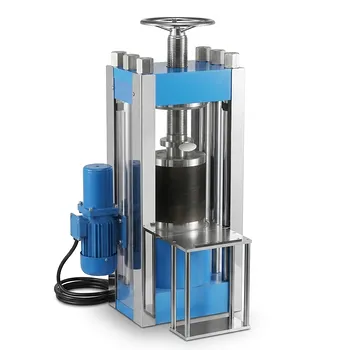
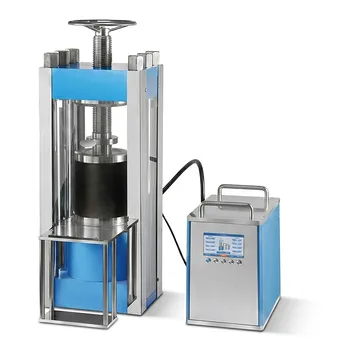
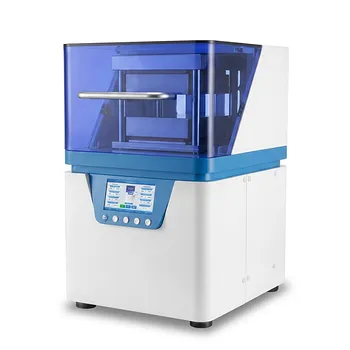
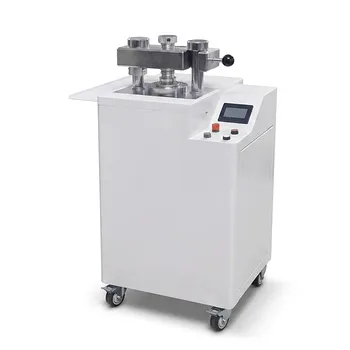
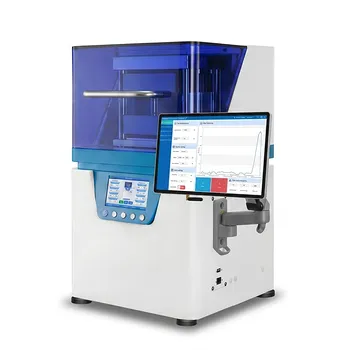
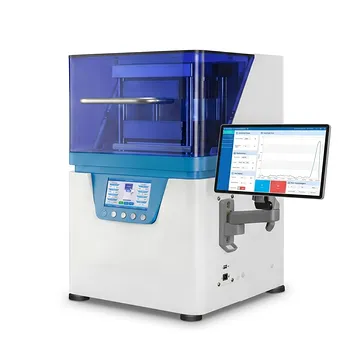
A Split manual press is a compact, high-precision machine engineered specifically for small-scale production, research, and development. Its defining feature is a modular design where the mold cavity can be separated, allowing for effortless cleaning and maintenance that traditional fixed presses cannot offer.
The Split manual press solves a specific laboratory challenge: it delivers the high precision required for experimental materials without the footprint, cost, or complexity of industrial machinery.
The Core Design Philosophy
The "Split" Advantage
The primary innovation of this device is found in its name. Unlike traditional presses with integrated cavities, the mold cavity in this unit is detachable.
This allows operators to easily separate components for thorough cleaning. This is critical when working with sensitive materials where cross-contamination must be avoided.
Compact and Space-Saving
Laboratories often struggle with limited workspace. The Split manual press is designed with a minimal footprint, making it ideal for crowded research environments.
It provides industrial-grade compression capabilities without dominating valuable bench space.
Simplified Manual Operation
The machine utilizes simple manual controls, eliminating the need for complex digital interfaces or extensive operator training.
This user-friendly approach ensures that researchers can focus on their experiments rather than learning to operate heavy machinery.
Applications and Precision
Versatility in Material Creation
This press is not limited to a single output type. It enables the production of materials in various sizes, shapes, and compositions.
This flexibility is essential for R&D, where experimental parameters change frequently.
High-Precision Output
Despite its small size and manual operation, the device delivers high precision.
It ensures consistent quality and dimensions, which is a strict requirement for fields such as superconductors, powder ceramics, new power sources, and building materials.
Cost-Effective Experimentation
For small manufacturing facilities or research institutions, large industrial presses are often cost-prohibitive.
The Split manual press offers a low-cost alternative for creating experimental samples, removing financial barriers to entry for advanced material research.
Understanding the Trade-offs
Production Volume Limitations
This device is optimized for small-scale production and sampling.
It is not designed for high-volume mass production. If your project requires thousands of units per hour, an automated industrial press is a better fit.
Manual Effort Required
While the controls are simple, the operation is manual.
This offers excellent tactile control for delicate experiments but lacks the automation and speed of hydraulic or electric motor-driven systems used in heavy manufacturing.
Making the Right Choice for Your Goal
If you are evaluating whether a Split manual press fits your current needs, consider the following scenarios:
- If your primary focus is experimental R&D: This is the ideal choice for testing new material compositions like ceramics or superconductors where precision and cleanliness are paramount.
- If your primary focus is keeping costs low: This machine provides the most cost-effective route to producing high-quality samples without investing in heavy infrastructure.
- If your primary focus is high-volume manufacturing: You should look for automated industrial presses, as the manual nature of this device will become a bottleneck.
The Split manual press is the definitive tool for converting raw concepts into tangible, precise samples within a compact laboratory setting.
Summary Table:
| Feature | Description |
|---|---|
| Core Innovation | Split/detachable mold cavity for easy cleaning and maintenance |
| Operation Type | Manual tactile control; no complex digital interface required |
| Best Used For | Small-scale production, R&D, and experimental sampling |
| Key Industries | Ceramics, superconductors, and new energy materials |
| Main Advantage | Prevention of cross-contamination and compact footprint |
Elevate Your Material Research with KINTEK
Precision and purity are the foundations of successful research. As a leader in laboratory pressing technology, KINTEK offers a comprehensive range of solutions including manual, automatic, heated, and multifunctional models. Whether you need specialized glovebox-compatible presses or advanced isostatic solutions (CIP/WIP) for battery research, our equipment is engineered to deliver consistent, high-quality results.
Don't let cross-contamination or equipment complexity stall your innovation. Contact KINTEK today to find the perfect press for your lab and see how our expertise in laboratory pressing can accelerate your development process.
Related Products
- Split Automatic Heated Hydraulic Press Machine with Heated Plates
- Split Warm Isostatic Lab Press 200 Ton Powder Compaction Chamber for Battery Research and Material Science
- Split Hot Isostatic Pressing Machine 150 Ton Laboratory Heated Isostatic Press
- Electric Split Lab Cold Isostatic Pressing CIP Machine
- Laboratory Hydraulic Split Electric Lab Pellet Press
People Also Ask
- What are the requirements for electrode pressing with high-viscosity ionic liquids like EMIM TFSI? Optimize Performance
- How does a laboratory heated hydraulic press facilitate PBN sample prep for WAXS? Achieve Precise X-Ray Scattering
- What are the industrial applications of heated hydraulic presses? Master Heat & Force for Precision Manufacturing
- Why is a laboratory hydraulic press with heating plates required for PLA/TEC films? Achieve Precise Sample Integrity
- Function of a Laboratory Hydraulic Press with Heated Platens in SSE? Enhance Battery Density & Conductivity