
The laboratory hydraulic press serves as the fundamental bridge between loose precursor materials and a functional electrochemical device. In the assembly of all-solid-state batteries using $Li_6PS_5Br$ (electrolyte) and $Li_2S$ (cathode) powders, its function is to transform discrete particles into a dense, continuous medium. By applying extreme, uniform pressure, the press eliminates microscopic voids and forces solid particles into intimate contact, creating the physical pathways strictly necessary for lithium-ion transport.
The Core Reality: Unlike liquid electrolytes that naturally fill gaps, solid-state materials require mechanical force to create continuity. The hydraulic press is not just a shaping tool; it is the primary instrument for minimizing interfacial impedance, ensuring that the resistance between solid layers is low enough for the battery to function.
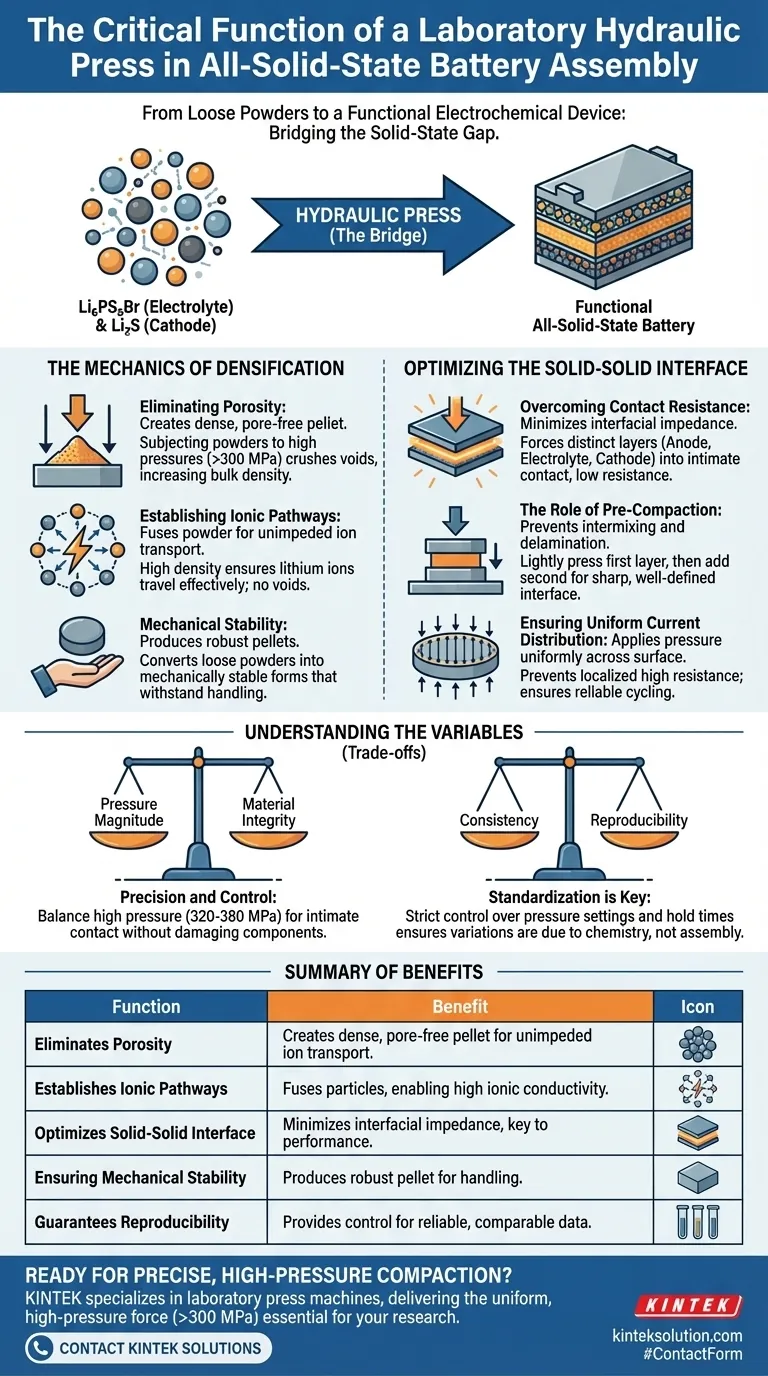
The Mechanics of Densification
Eliminating Porosity
The immediate physical task of the press is to subject the $Li_6PS_5Br$ and composite cathode powders to high pressures (often exceeding 300 MPa).
This force creates a dense, pore-free pellet. By mechanically crushing the voids between particles, the press significantly increases the material's bulk density.
Establishing Ionic Pathways
High density is a prerequisite for ionic conductivity.
If voids remain in the electrolyte layer, lithium ions cannot travel effectively, leading to poor performance. The press ensures that individual powder particles are fused into a cohesive solid, allowing ions to move freely through the bulk material.
Mechanical Stability
Beyond electrochemical needs, the press provides structural integrity.
It converts loose powders into mechanically stable pellets that can withstand handling and subsequent processing steps without crumbling.
Optimizing the Solid-Solid Interface
Overcoming Contact Resistance
The most critical challenge in solid-state batteries is the solid-solid interface.
The hydraulic press applies pressure across the cell stack—anode, electrolyte, and cathode—to force these distinct layers together. This physical intimacy minimizes contact resistance, which is often the performance-limiting factor in these cells.
The Role of Pre-Compaction
Assembling a cell often requires a multi-step pressing strategy.
References indicate that a pre-compaction step is vital when building bilayer structures (e.g., electrolyte plus cathode). By lightly pressing the first layer to create a flat substrate before adding the second, you prevent intermixing and delamination, ensuring a sharp, well-defined interface.
Ensuring Uniform Current Distribution
The press must apply pressure uniformly across the entire surface area.
Uniform pressure results in uniform contact. If the pressure is uneven, the battery will suffer from localized areas of high resistance, leading to inefficient ion transport and unreliable cycling data.
Understanding the Variables (Trade-offs)
Pressure Magnitude vs. Material Integrity
While high pressure is necessary, it must be precise and controlled.
References suggest pressures around 320–380 MPa are often required to achieve intimate contact. However, the pressure must be optimized to maximize density without damaging the cell components or causing excessive deformation of the anode material.
Consistency equals Reproducibility
The hydraulic press is the "control variable" for experimental reliability.
If the forming pressure varies between samples, the interfacial quality will fluctuate. This introduces noise into electrochemical data (such as impedance spectra), making it impossible to accurately evaluate the intrinsic properties of the $Li_6PS_5Br$ or $Li_2S$ materials.
Making the Right Choice for Your Goal
To maximize the utility of your laboratory press in this application, consider the following specific objectives:
- If your primary focus is Ion Transport Efficiency: Prioritize sufficiently high pressure (e.g., >300 MPa) to eliminate all voids within the electrolyte layer, as this is the physical basis for high ionic conductivity.
- If your primary focus is Structural Integrity: Utilize a two-step pre-compaction method to ensure flat, stable interfaces between the electrolyte and the cathode layers to prevent delamination.
- If your primary focus is Data Reliability: Enforce strict standardization of pressure settings and hold times to ensure that variations in performance are due to material chemistry, not assembly inconsistencies.
Ultimately, the hydraulic press is the tool that dictates the interfacial quality of your cell, directly determining whether your materials will perform as a high-efficiency battery or a high-resistance resistor.
Summary Table:
| Function | Benefit in Battery Assembly |
|---|---|
| Eliminates Porosity | Creates a dense, pore-free pellet for unimpeded ion transport. |
| Establishes Ionic Pathways | Fuses powder particles into a cohesive solid, enabling high ionic conductivity. |
| Optimizes Solid-Solid Interface | Minimizes interfacial impedance, the key performance-limiting factor. |
| Ensures Mechanical Stability | Produces a robust pellet that can withstand handling and processing. |
| Guarantees Reproducibility | Provides the control variable for reliable, comparable experimental data. |
Ready to achieve precise, high-pressure compaction for your solid-state battery research?
KINTEK specializes in laboratory press machines, including automatic and heated lab presses, designed to meet the exacting demands of advanced materials development. Our hydraulic presses deliver the uniform, high-pressure force (exceeding 300 MPa) required to create the dense, low-impedance interfaces essential for functional all-solid-state batteries.
Contact us today using the form below to discuss how our solutions can enhance the reliability and performance of your research.
Visual Guide
Related Products
- Laboratory Hydraulic Press Lab Pellet Press Machine for Glove Box
- Laboratory Hydraulic Press 2T Lab Pellet Press for KBR FTIR
- 24T 30T 60T Heated Hydraulic Lab Press Machine with Hot Plates for Laboratory
- Laboratory Hydraulic Press Lab Pellet Press Button Battery Press
- Laboratory Hydraulic Pellet Press for XRF KBR FTIR Lab Press
People Also Ask
- How does a laboratory hydraulic press contribute to the preparation of Li3-3xScxSb samples? Optimize Ionic Conductivity
- What is the function of a laboratory hydraulic press in FT-IR of curcumin-coated MWCNTs? Achieve Optical Clarity.
- Why is a laboratory hydraulic press required for compression molding boron-siloxane? Solve High-Loading Density Challenges
- What role does a laboratory hydraulic press play in the preparation of piezoelectric ceramic discs for DC-PG? | KINTEK
- What role does a laboratory hydraulic press play in reaction pellets? Optimizing Lunar Soil and Metal Fuel Density



















