
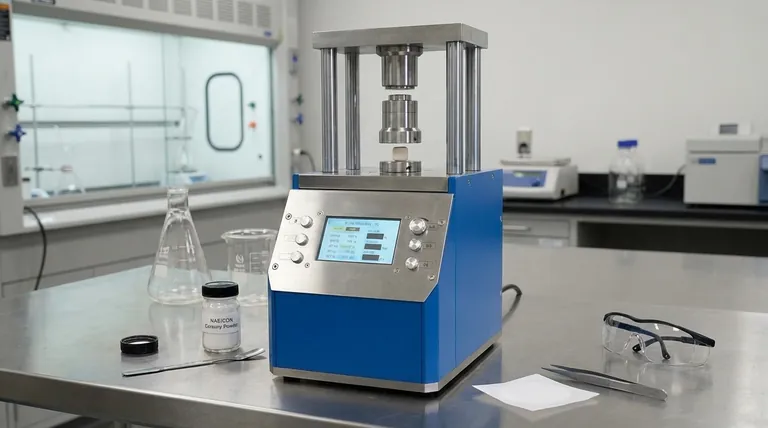
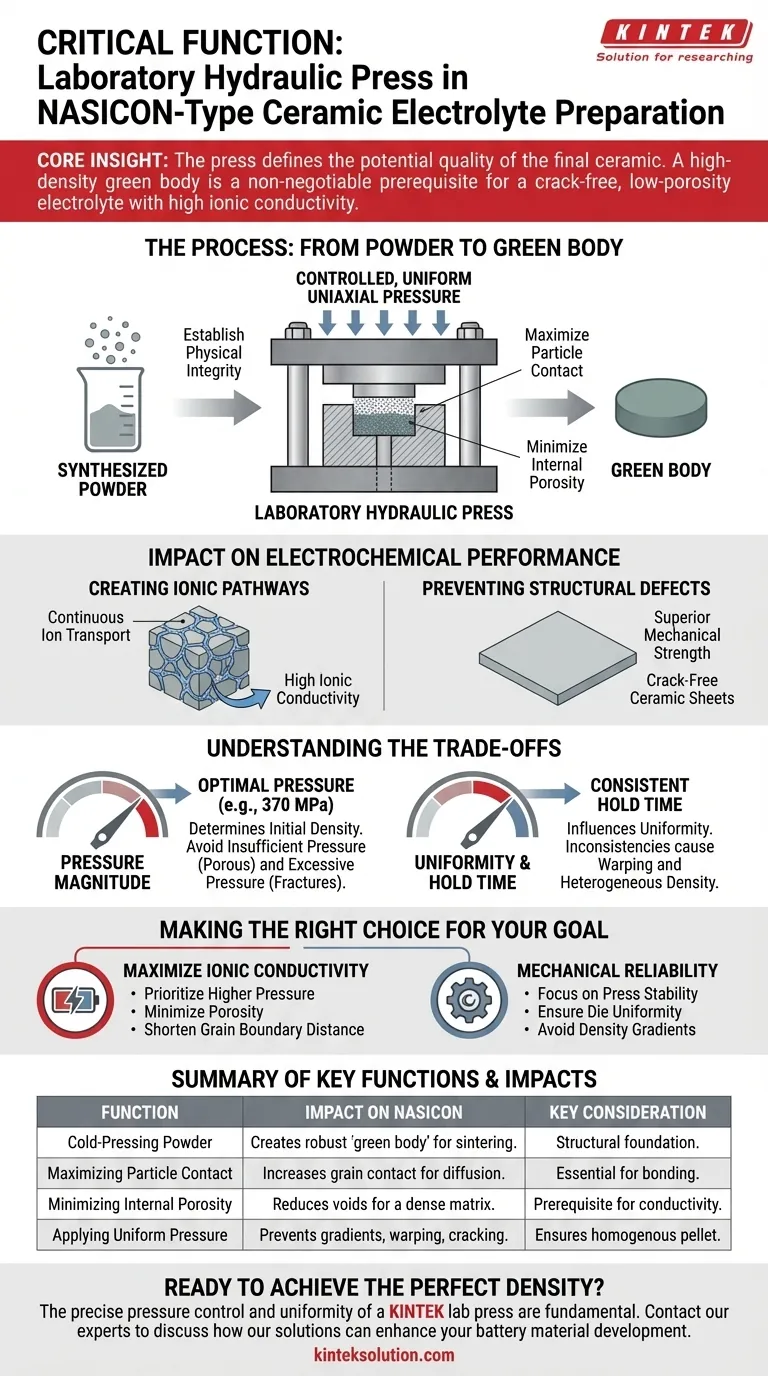
The primary function of a laboratory hydraulic press in the preparation of NASICON-type electrolytes is to cold-press synthesized powder into a high-density "green body" prior to sintering. By applying controlled, uniform uniaxial pressure, the press forces loose powder particles into close physical contact, minimizing internal porosity and establishing the structural foundation required for the subsequent high-temperature densification phase.
Core Insight The hydraulic press does not merely shape the material; it defines the potential quality of the final ceramic. A high-density green body is a non-negotiable prerequisite for achieving a crack-free, low-porosity electrolyte with the high ionic conductivity necessary for superior battery performance.
The Role of the Green Body
Establishing Physical Integrity
In the fabrication process, the hydraulic press transforms loose, synthesized electrolyte powder into a solid pellet, technically known as a "green body."
This compaction creates a mechanically robust form that can withstand handling before the final firing stage. Without this initial consolidation, the material would lack the cohesion necessary to undergo the solid-state reactions required in the next steps.
Maximizing Particle Contact
The application of significant pressure ensures that powder particles are packed tightly together.
This tight packing drastically increases the contact area between individual grains. This proximity is essential for promoting the thorough diffusion and bonding that must occur during high-temperature sintering.
Minimizing Internal Porosity
One of the most critical tasks of the press is the reduction of void space within the material.
By forcing particles into the spaces that would otherwise remain empty, the press creates a dense matrix. Minimizing these voids at the "green" stage is the only way to ensure the final ceramic sheet is dense and defect-free.
Impact on Electrochemical Performance
Creating Ionic Pathways
The density achieved during pressing directly correlates to the material's ability to conduct ions.
High-pressure compaction facilitates the formation of continuous, efficient pathways for ion transport (such as sodium or lithium ions). This continuous network is fundamental to achieving high ionic conductivity in the final NASICON electrolyte.
Preventing Structural Defects
A well-pressed green body leads to a final product with superior mechanical strength.
If the initial packing is loose or uneven, the final sintered ceramic is prone to cracking and structural failure. A laboratory press ensures the uniformity required to produce crack-free ceramic sheets that can survive operation within a battery cell.
Understanding the Trade-offs
The Importance of Pressure Magnitude
While pressure is vital, the specific magnitude applied (often up to 370 MPa in similar ceramic processes) determines the initial density.
Insufficient pressure will result in a porous green body that cannot be fixed by sintering, leading to poor conductivity. However, the process relies on finding the optimal pressure to maximize density without introducing stress fractures.
Uniformity and Hold Time
It is not enough to simply apply force; the pressure must be uniform, and the hold time must be sufficient.
References indicate that the duration of the pressure hold directly influences the uniformity of the green body. Inconsistencies at this stage can lead to warping or heterogeneous density in the final sintered pellet, compromising the electrolyte's reliability.
Making the Right Choice for Your Goal
To maximize the effectiveness of your laboratory hydraulic press in NASICON preparation, consider your primary research objectives:
- If your primary focus is maximizing Ionic Conductivity: Prioritize higher pressure settings to minimize internal porosity and shorten the distance between grain boundaries for easier ion hopping.
- If your primary focus is Mechanical Reliability: Focus on the stability of the press and the uniformity of the die to ensure the green pellet is free of density gradients that could cause cracking during sintering.
The laboratory hydraulic press acts as the gatekeeper of quality, setting the physical limits for the electrolyte's final electrochemical potential.
Summary Table:
| Function | Impact on NASICON Electrolyte | Key Consideration |
|---|---|---|
| Cold-Pressing Powder | Creates a mechanically robust "green body" for sintering. | Forms the structural foundation for the entire process. |
| Maximizing Particle Contact | Increases contact area between grains for efficient diffusion. | Essential for promoting bonding during sintering. |
| Minimizing Internal Porosity | Reduces voids to create a dense matrix. | A non-negotiable prerequisite for high ionic conductivity. |
| Applying Uniform Pressure | Prevents density gradients, warping, and cracking. | Ensures a homogenous and reliable final ceramic pellet. |
Ready to achieve the perfect density for your solid-state electrolyte research?
The precise pressure control and uniformity provided by a KINTEK lab press are fundamental to replicating the high-quality results discussed in this article. Whether you are developing NASICON-type, LLZO, or other ceramic electrolytes, our automatic lab presses, isostatic presses, and heated lab presses are engineered to deliver the reliable, high-density green bodies your research demands.
Contact our experts today to discuss how our laboratory press solutions can enhance your battery material development.
Get in Touch for a Consultation
Visual Guide
References
- Zehui Zhao, Peng Tan. Quasi/All Solid‐State Electrolytes for Lithium–Carbon Dioxide Batteries. DOI: 10.1002/cnl2.70026
This article is also based on technical information from Kintek Solution Knowledge Base .
Related Products
- Laboratory Hydraulic Press Lab Pellet Press Machine for Glove Box
- Laboratory Hydraulic Press 2T Lab Pellet Press for KBR FTIR
- 24T 30T 60T Heated Hydraulic Lab Press Machine with Hot Plates for Laboratory
- Laboratory Hydraulic Press Lab Pellet Press Button Battery Press
- Laboratory Hydraulic Pellet Press for XRF KBR FTIR Lab Press
People Also Ask
- How does a laboratory hydraulic press contribute to the preparation of Li3-3xScxSb samples? Optimize Ionic Conductivity
- What is the function of a laboratory hydraulic press in FT-IR of curcumin-coated MWCNTs? Achieve Optical Clarity.
- Why is a laboratory hydraulic press required for compression molding boron-siloxane? Solve High-Loading Density Challenges
- What role does a laboratory hydraulic press play in the preparation of piezoelectric ceramic discs for DC-PG? | KINTEK
- What role does a laboratory hydraulic press play in reaction pellets? Optimizing Lunar Soil and Metal Fuel Density



















