
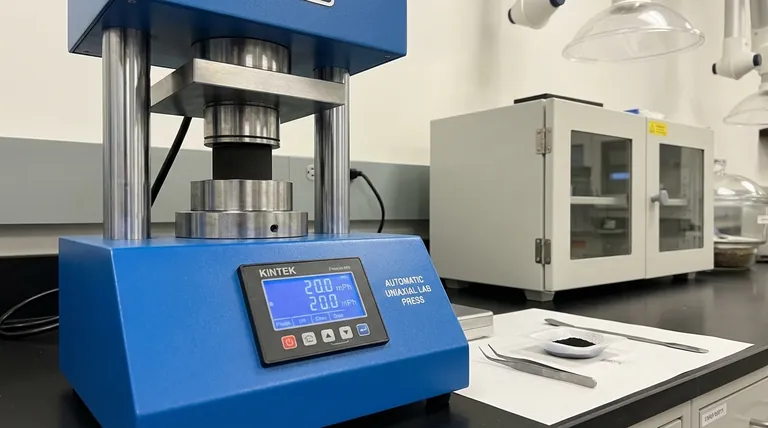
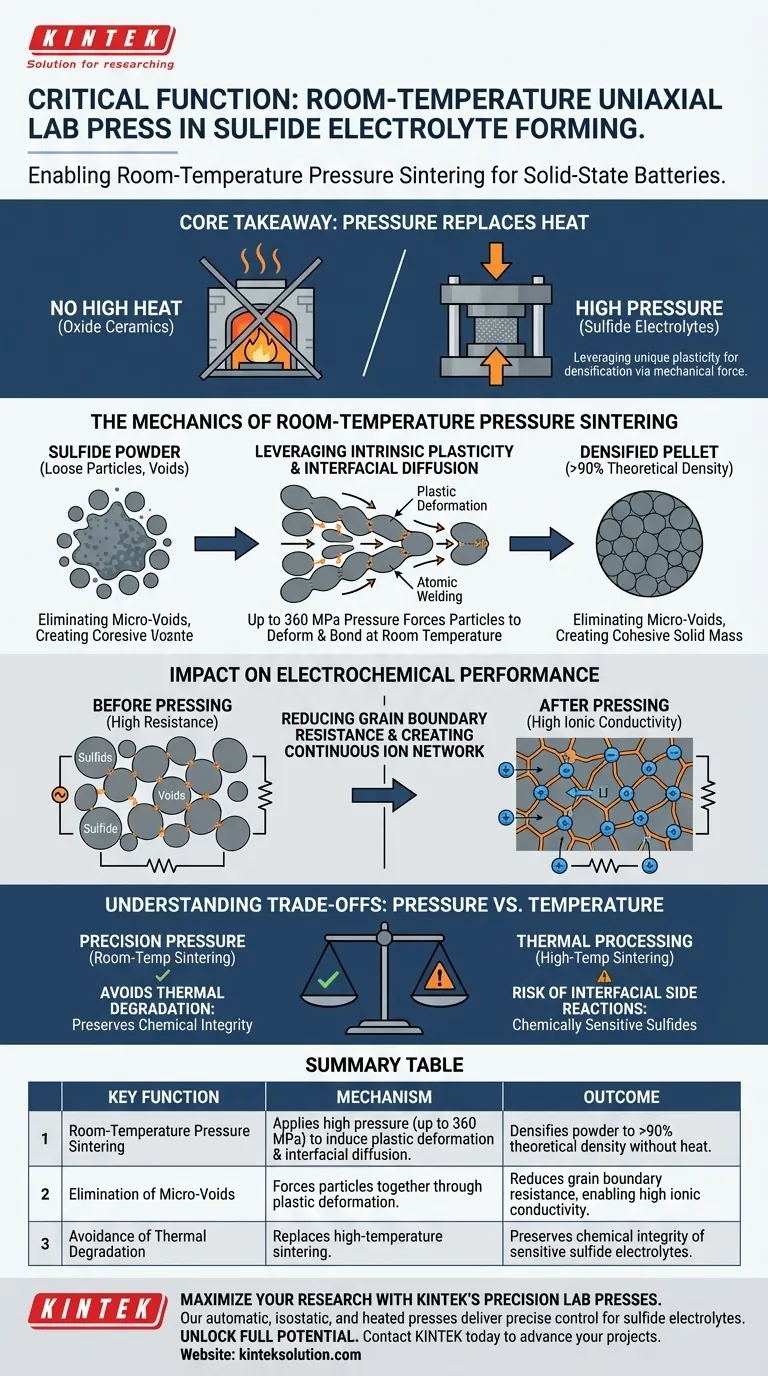
The critical function of a room-temperature uniaxial lab press in the forming of sulfide solid-state electrolytes is to facilitate "room-temperature pressure sintering." By applying high, precise pressure (up to 360 MPa), the press forces the sulfide powder to undergo plastic deformation and interfacial diffusion, creating a dense pellet exceeding 90% theoretical density without the application of heat.
Core Takeaway Unlike oxide ceramics that require high heat to fuse, sulfide electrolytes possess unique plasticity that allows them to be densified solely through mechanical force. The uniaxial press leverages this property to eliminate voids and lower grain boundary resistance, achieving high ionic conductivity while avoiding the chemical degradation associated with high-temperature thermal sintering.
The Mechanics of Room-Temperature Pressure Sintering
Leveraging Intrinsic Plasticity
The effectiveness of a uniaxial press in this context relies on the specific material properties of sulfide electrolytes.
Unlike brittle ceramic materials, sulfides exhibit excellent intrinsic plasticity and ductility. When subjected to uniaxial pressure, the particles do not merely rearrange; they physically deform to fill the spaces between them.
Facilitating Interfacial Diffusion
The pressure applied by the lab press drives a mechanism known as interfacial diffusion at the contact points between particles.
This process essentially "welds" the particles together at the atomic level. It transforms a loose powder into a cohesive solid mass at room temperature, a feat that typically requires intense heat for other material classes.
Eliminating Micro-Voids
The primary goal of this mechanical densification is the reduction of porosity.
By compacting the material to over 90% of its theoretical density, the press effectively eliminates inter-particle voids. This is critical because voids act as barriers to ion transport, drastically reducing the performance of the electrolyte.
The Impact on Electrochemical Performance
Reducing Grain Boundary Resistance
The most significant outcome of using a uniaxial press is the reduction of grain boundary resistance.
In solid-state batteries, the interface between particles (the grain boundary) is often where resistance is highest. By forcing tight interfacial contact through plastic deformation, the press minimizes this resistance, directly enabling high ionic conductivity.
Creating a Continuous Ion Network
For the battery to function, lithium ions must move freely through the pellet.
The densification process establishes a continuous lithium-ion conduction network. This ensures that the electrolyte pellet is not just a collection of particles, but a unified pathway for energy transfer.
Understanding the Trade-offs: Pressure vs. Temperature
Avoiding Thermal Degradation
The distinct advantage of using a room-temperature press for sulfides is the avoidance of thermal processing.
High-temperature sintering, while common for oxides, can trigger interfacial side reactions in chemically sensitive sulfides. By relying on pressure rather than heat, the lab press preserves the chemical integrity of the electrolyte.
The Necessity of Precision
While heat is removed from the equation, the requirement for precise pressure control becomes paramount.
Insufficient pressure will fail to induce the necessary plastic deformation, leaving voids that cripple conductivity. Conversely, uncontrolled pressure application could lead to macroscopic defects or density gradients within the pellet.
Making the Right Choice for Your Goal
To maximize the potential of sulfide electrolytes, you must view the press not just as a shaping tool, but as a critical processing reactor.
- If your primary focus is Maximizing Ionic Conductivity: Prioritize pressures (e.g., up to 360 MPa) that push the material beyond simple compaction and into the realm of plastic deformation to minimize grain boundary resistance.
- If your primary focus is Chemical Stability: Utilize the press to achieve full density at room temperature, ensuring you eliminate the need for thermal sintering steps that could degrade the sulfide structure.
The uniaxial press effectively replaces the furnace in sulfide processing, turning mechanical force into electrochemical efficiency.
Summary Table:
| Key Function | Mechanism | Outcome |
|---|---|---|
| Room-Temperature Pressure Sintering | Applies high pressure (up to 360 MPa) to induce plastic deformation and interfacial diffusion. | Densifies powder to >90% theoretical density without heat. |
| Elimination of Micro-Voids | Forces particles together through plastic deformation. | Reduces grain boundary resistance, enabling high ionic conductivity. |
| Avoidance of Thermal Degradation | Replaces high-temperature sintering. | Preserves chemical integrity of sensitive sulfide electrolytes. |
Maximize the performance of your solid-state battery research with KINTEK's precision lab presses.
Our automatic lab presses, isostatic presses, and heated lab presses are engineered to deliver the precise, high-pressure control required for room-temperature sintering of sulfide electrolytes. By eliminating the need for heat, you can achieve dense, highly conductive pellets while preserving material stability.
KINTEK specializes in serving the precise needs of laboratory research and development. Let our expertise in pressure application help you unlock the full potential of your materials.
Contact KINTEK today to discuss how our lab press solutions can advance your solid-state battery projects.
Visual Guide
Related Products
- Automatic High Temperature Heated Hydraulic Press Machine with Heated Plates for Lab
- 24T 30T 60T Heated Hydraulic Lab Press Machine with Hot Plates for Laboratory
- Cylindrical Lab Electric Heating Press Mold for Laboratory Use
- Manual Heated Hydraulic Lab Press with Integrated Hot Plates Hydraulic Press Machine
- Automatic Laboratory Hydraulic Press Lab Pellet Press Machine
People Also Ask
- Function of a Laboratory Hydraulic Press with Heated Platens in SSE? Enhance Battery Density & Conductivity
- What are the requirements for electrode pressing with high-viscosity ionic liquids like EMIM TFSI? Optimize Performance
- How does a laboratory heated hydraulic press facilitate PBN sample prep for WAXS? Achieve Precise X-Ray Scattering
- What are the industrial applications of heated hydraulic presses? Master Heat & Force for Precision Manufacturing
- Why is a laboratory hydraulic press with heating plates required for PLA/TEC films? Achieve Precise Sample Integrity



















