
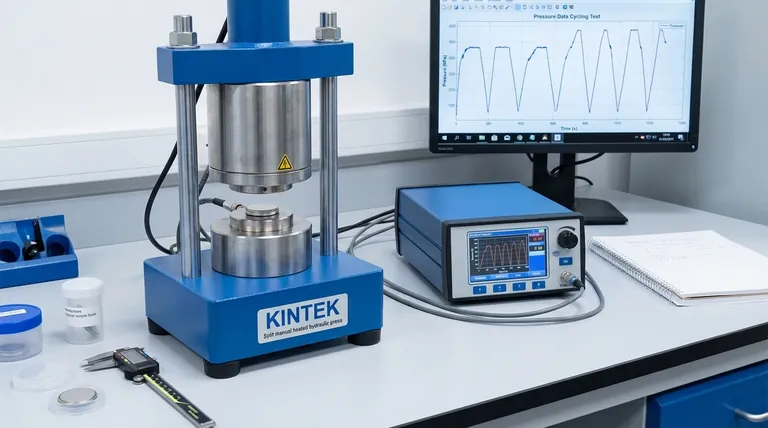
Precision pressure management is the operational backbone of reliable solid-state battery (SSB) research. It serves a dual purpose: physically maintaining the intimate contact required for ionic transport and providing the data necessary to correlate mechanical stress with electrochemical failure. Without a precise system to apply and monitor this force, it is impossible to distinguish between material failure and simple mechanical delamination.
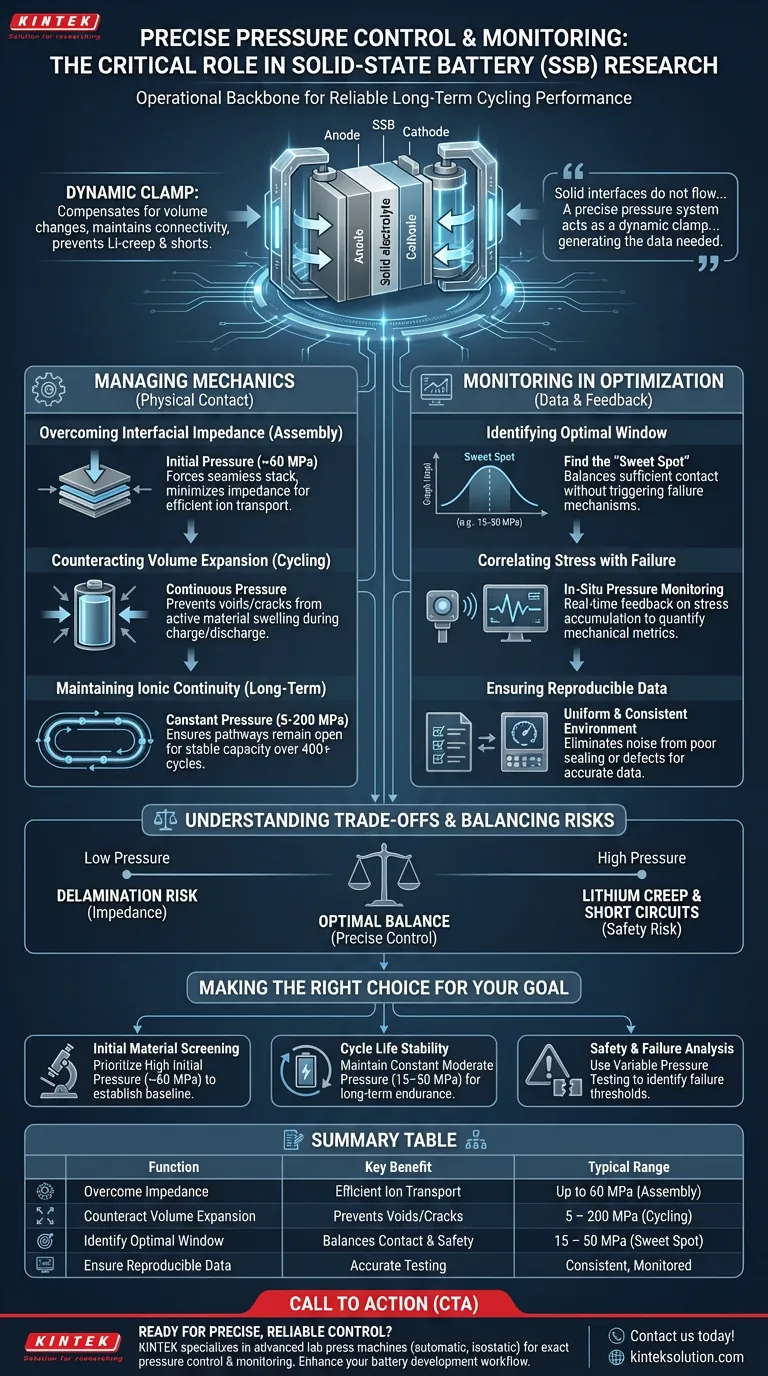
The fundamental challenge in solid-state batteries is that solid interfaces do not flow to fill gaps like liquid electrolytes. A precise pressure system acts as a dynamic clamp, compensating for volume changes to maintain connectivity while generating the data needed to prevent pressure-induced lithium creep and short circuits.
Managing the Mechanics of Solid Interfaces
Overcoming Interfacial Impedance
In all-solid-state batteries, the movement of lithium ions depends entirely on physical contact between layers. A precise control system applies an initial pressure, often as high as 60 MPa, during assembly to force the electrodes and solid electrolyte into a seamless stack. This minimizes interfacial impedance, a prerequisite for enabling efficient ion transport.
Counteracting Volume Expansion
Active materials, particularly in anode-free designs or cathodes like Nb2O5, undergo significant volume changes during cycling. Without external pressure, the expansion and contraction caused by lithium deposition and stripping lead to physical separation. A continuous pressure system effectively counteracts this stress, preventing the formation of voids and cracks that sever ionic pathways.
Maintaining Ionic Continuity
Long-term cycling requires the battery to survive hundreds of charge-discharge events. By maintaining a constant external pressure—ranging widely from low levels like 5 MPa to high loads of 200 MPa depending on the chemistry—the system ensures ionic pathways remain unobstructed. This compensation for interfacial stress relaxation is critical for achieving stable capacity retention over 400+ cycles.
The Role of Monitoring in Optimization
Identifying the Optimal Pressure Window
Pressure is not a "more is better" variable; it requires a specific operating window. Precise monitoring allows researchers to test various levels (e.g., 5 MPa, 25 MPa, 75 MPa) to find the "sweet spot." The goal is to apply enough force to ensure contact but not so much that it triggers failure mechanisms.
Correlating Stress with Failure
Advanced testing molds with in-situ pressure monitoring provide real-time feedback on stress accumulation. This data helps researchers evaluate how specific interlayers, such as elastic carbon felt or silicone, buffer against expansion. It transforms mechanical stress from an unknown variable into a quantifiable metric.
Ensuring Reproducible Data
Fluctuations in contact pressure are a primary source of noise in electrochemical testing. A calibrated system ensures that the mechanical environment is uniform and consistent across every test. This eliminates variables related to poor sealing or electrolyte leakage, ensuring that the resulting data reflects the true chemistry of the battery, not assembly defects.
Understanding the Trade-offs
The Risk of Pressure-Induced Short Circuits
While pressure prevents delamination, excessive force introduces its own risks. High pressure can force lithium metal to deform and penetrate the solid electrolyte. This phenomenon, known as lithium creep, accelerates dendrite growth and leads to immediate short circuits.
Balancing Contact vs. Safety
Researchers must navigate a trade-off between impedance and safety. Lower pressures (e.g., 5 MPa) may be sufficient to maintain contact without inducing creep. A system that lacks precision may inadvertently overshoot this limit, causing false negatives in battery longevity tests.
Making the Right Choice for Your Goal
To maximize the value of your pressure control system, align your settings with your specific research objectives:
- If your primary focus is Initial Material Screening: Prioritize high initial assembly pressure (approx. 60 MPa) to minimize impedance and establish the baseline performance of the material interfaces.
- If your primary focus is Cycle Life Stability: Maintain a constant, moderate pressure (e.g., 15–50 MPa) to compensate for volume expansion and prevent delamination over hundreds of cycles.
- If your primary focus is Safety and Failure Analysis: Use variable pressure testing to identify the exact threshold where mechanical load triggers lithium creep and short circuits.
By treating mechanical pressure as a precise, controllable variable rather than a static condition, you unlock the ability to engineer solid-state batteries that are both high-performing and mechanically robust.
Summary Table:
| Pressure Function | Key Benefit | Typical Range |
|---|---|---|
| Overcome Interfacial Impedance | Ensures efficient ion transport | Up to 60 MPa (assembly) |
| Counteract Volume Expansion | Prevents voids and cracks from cycling | 5 - 200 MPa (cycling) |
| Identify Optimal Pressure Window | Balances contact and safety to avoid lithium creep | 15 - 50 MPa (sweet spot) |
| Ensure Reproducible Data | Eliminates mechanical variables for accurate testing | Consistent, monitored pressure |
Ready to achieve precise, reliable pressure control for your solid-state battery research?
KINTEK specializes in advanced lab press machines, including automatic and isostatic presses, designed to deliver the exact pressure control and monitoring your laboratory needs. Our equipment helps you maintain critical ionic contact, prevent delamination, and gather accurate data for long-term cycling studies—ensuring your research on materials like lithium metal anodes and solid electrolytes is both efficient and reproducible.
Contact us today to discuss how our lab press solutions can enhance your battery development workflow. Get in touch via our contact form to learn more!
Visual Guide
Related Products
- Warm Isostatic Press for Solid State Battery Research Warm Isostatic Press
- Electric Lab Cold Isostatic Press CIP Machine
- Automatic Lab Cold Isostatic Pressing CIP Machine
- Manual Cold Isostatic Pressing CIP Machine Pellet Press
- Lab Isostatic Pressing Molds for Isostatic Molding
People Also Ask
- Why must composite cathodes be sealed in vacuum lamination bags for WIP? Ensure Battery Stability and Density
- How do sacrificial volume materials (SVM) maintain microchannels in isostatic pressing? Ensure Structural Integrity
- What is the function of elastic molds in warm isostatic pressing? Achieve Uniform Density in Composite Particles
- What is the mechanism of a Warm Isostatic Press (WIP) on cheese? Master Cold Pasteurization for Superior Safety
- What is the role of the flexible material in warm isostatic pressing? Key to Uniform Density & Precision



















