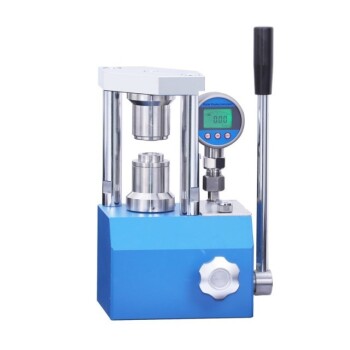
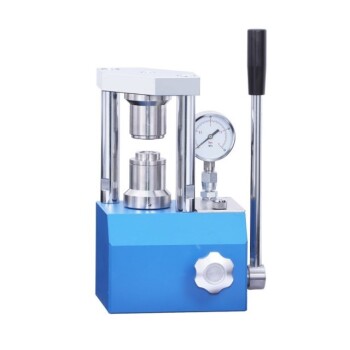
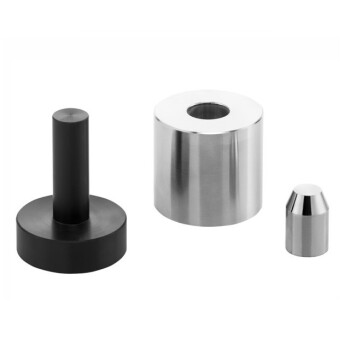
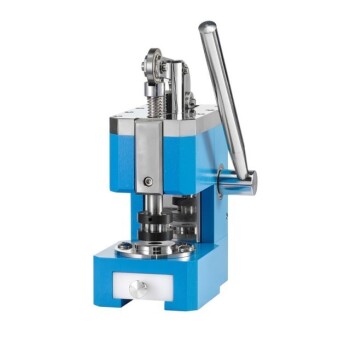
The primary function of a coin cell crimper or lab press is to apply precise, uniform mechanical pressure to hermetically seal battery components within their casing. This process tightly compacts internal layers—such as the cathode, anode, and separator—while effectively preventing electrolyte leakage and the ingress of external contaminants.
Core Takeaway While often viewed as a simple assembly tool, the crimper is actually a critical instrument for ensuring data integrity. By guaranteeing consistent internal contact pressure and a perfect seal, it minimizes interface resistance and eliminates environmental variables that would otherwise corrupt electrochemical test results.
Ensuring Electrochemical Stability
The Hermetic Seal
The most immediate function of the press is to create an airtight closure that isolates sensitive internal materials from the external environment. This prevents the ingress of outside air and moisture, which can cause detrimental side reactions.
Protecting High-Voltage Systems
Proper sealing is particularly vital for high-voltage systems, such as Lithium Nickel Manganese Oxide (LNMO) batteries operating at 4.7 V. In these scenarios, even trace amounts of external moisture can accelerate electrolyte decomposition, severely degrading cycle stability.
Preventing Leakage
By applying consistent pressure, the press ensures the liquid electrolyte is fully contained within the cell casing. Preventing electrolyte evaporation is essential for maintaining safety and ensuring the battery performs reliably during long-term cycling tests.
Optimizing Internal Mechanics
Minimizing Interface Resistance
Beyond sealing, the lab press performs a critical mechanical function: compaction. It applies uniform force to the component stack, ensuring intimate physical contact between the electrodes and the separator.
Enhancing Conductivity
This tight compaction drastically reduces interfacial resistance. Without this pressure, gaps between layers would impede electron and ion flow, leading to poor performance and inaccurate data regarding the material's true potential.
Standardizing Experimental Conditions
For research involving subtle metrics—such as Charge Transfer Resistance (Rct) or Solid Electrolyte Interface (SEI) studies—encapsulation pressure must be identical across all samples. A precision press standardizes this variable, ensuring that fluctuations in data are caused by material properties rather than inconsistent assembly techniques.
Understanding the Trade-offs
The Risk of Improper Pressure
While pressure is necessary, it must be carefully controlled to avoid damaging the cell. The equipment is designed to find the specific mechanical "sweet spot" for the materials being tested.
Consequences of Extremes
Insufficient pressure leads to poor contact and high impedance, rendering test results unusable. Conversely, excessive pressure can crush the porous separator or deform the electrodes, causing internal shorts or structural failure before testing even begins.
Making the Right Choice for Your Goal
To ensure your battery assembly supports your specific research objectives, consider the following:
- If your primary focus is Long-Term Cycling: Prioritize the hermetic seal quality to prevent electrolyte evaporation and moisture ingress over time.
- If your primary focus is Impedance (EIS) Studies: Prioritize precision pressure control to minimize contact resistance noise and eliminate experimental error.
Reliable electrochemical data begins with a standardized, precision-sealed assembly.
Summary Table:
| Feature | Function in Battery Assembly | Impact on Research |
|---|---|---|
| Hermetic Sealing | Isolates internal components from air/moisture | Prevents electrolyte decomposition and side reactions |
| Mechanical Compaction | Ensures intimate contact between electrodes and separator | Minimizes interfacial resistance for accurate conductivity data |
| Pressure Standardization | Applies consistent force across all test samples | Eliminates assembly variables in SEI and Rct studies |
| Leakage Prevention | Contains liquid electrolyte within the casing | Ensures safety and reliability during long-term cycling tests |
Elevate Your Battery Research with KINTEK Precision Solutions
In the pursuit of breakthrough electrochemical performance, the quality of your cell assembly is just as critical as your material chemistry. KINTEK specializes in comprehensive laboratory pressing solutions designed to eliminate experimental variables and ensure data integrity.
Whether you are conducting high-voltage LNMO studies or intricate Impedance (EIS) research, our diverse range of equipment—including manual, automatic, heated, multifunctional, and glovebox-compatible models, as well as cold and warm isostatic presses—provides the exact pressure control your battery research demands.
Ready to achieve superior sealing and standardized results?
Contact KINTEK today to find the perfect press for your lab.
Related Products
- Lab Button Battery Disassembly and Sealing Mold
- Button Battery Sealing Machine for Button Batteries
- Manual Button Battery Sealing Machine for Battery Sealing
- Lab Button Battery Tablet Press Sealing Mold
- Button Battery Sealing Press Machine for Lab
People Also Ask
- How does a sealed battery mold facilitate the assembly and testing of asymmetric supercapacitors using VO2?
- What is the function of specialized battery molds and sealing consumables? Optimize Your In-situ XRD Testing Today
- How does the geometry of laboratory molds influence mycelium-based composites? Optimize Density and Strength
- Why are specialized battery test molds used? Ensure Peak Performance for All-Solid-State Sodium Batteries (ASSIBs)
- What role do battery testing molds play in electrolyte performance? Exploring Pressure vs. Viscoelasticity