
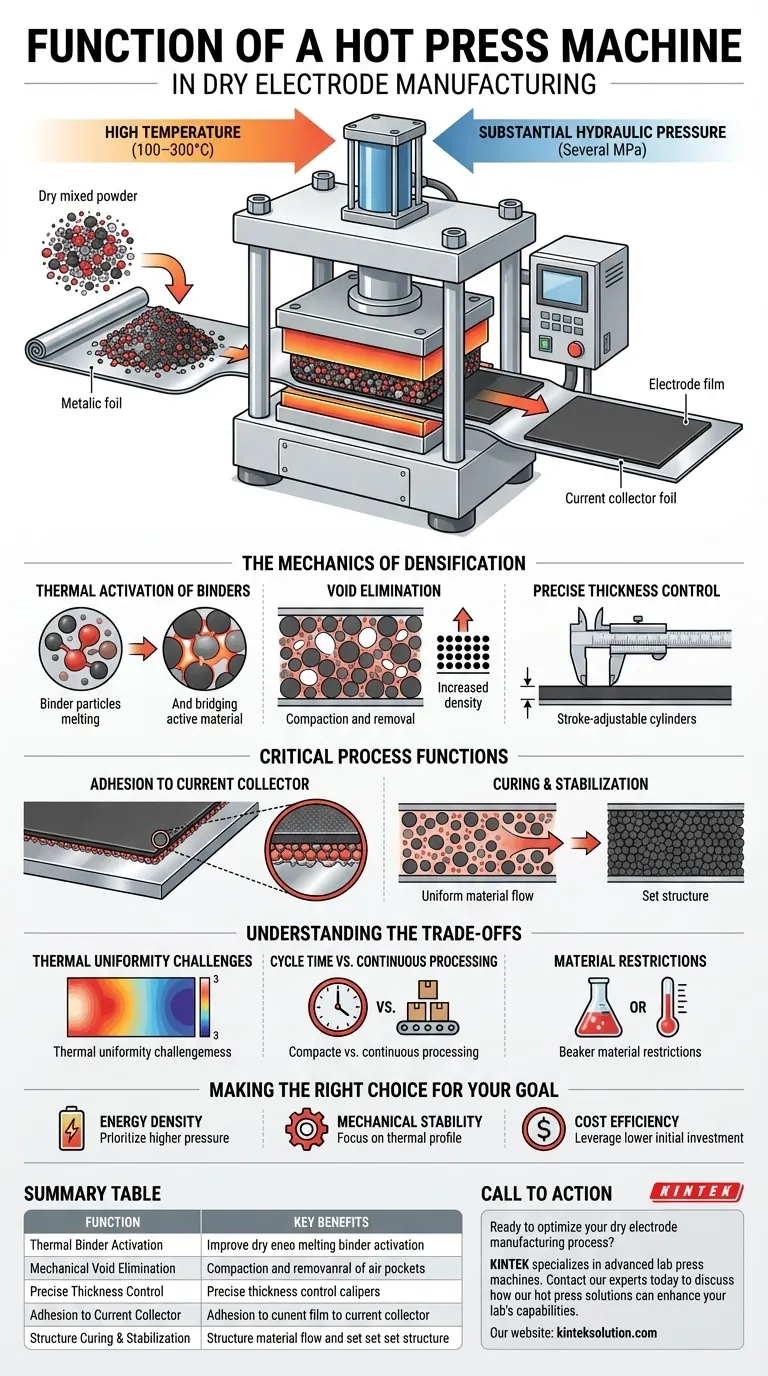
A hot press machine functions as the central consolidation unit in dry electrode manufacturing, transforming loose powder into a functional battery component. It applies simultaneous high temperature (typically 100–300°C) and substantial hydraulic pressure (several MPa) to a dry mixture of active materials, conductive agents, and binders. This process thermally activates the binder to bond the particles while mechanically compressing the structure to eliminate microscopic voids.
The hot press replaces the drying ovens of traditional wet coating by using thermal activation rather than solvent evaporation. It is the definitive step that turns a fragile powder mixture into a dense, cohesive, and electrically conductive film adhered to the current collector.
The Mechanics of Densification
Thermal Activation of Binders
The primary role of the temperature component is to soften the thermoplastic binder within the dry powder mix. Unlike wet processes that rely on solvent evaporation to leave a binder network behind, the hot press melts the binder just enough to make it pliable. This allows the binder to flow and create strong cohesive bridges between the active material particles.
Void Elimination
Simultaneously, the hydraulic pressure acts to compact the material. This physical force squeezes out air pockets and voids that exist between the loose powder particles. The result is a significant increase in compaction density, which is directly correlated to the energy density of the final battery cell.
Precise Thickness Control
Modern hot press machines utilize stroke-adjustable cylinders and high-precision frames to determine the final thickness of the electrode. By controlling the gap and pressure, manufacturers ensure the electrode film meets exact dimensional specifications, which is critical for the final cell assembly.
Critical Process Functions
Adhesion to the Current Collector
Beyond shaping the film itself, the hot press ensures the electrode material bonds firmly to the current collector (the metal foil). The combination of heat and pressure cures the interface between the powder and the foil. This creates a permanent mechanical and electrical connection, preventing delamination during battery operation.
Curing and Stabilization
In processes like dry spray deposition, the hot press acts as a curing step. It consolidates deposited particles that may not have been fibrillated (a web-like structure created by shear force). This "sets" the structure, ensuring the electrode remains mechanically stable and creates a uniform material flow.
Understanding the Trade-offs
Thermal Uniformity Challenges
While hot pressing offers superior density, it requires absolute temperature uniformity across the heating plates. Even minor temperature gradients can lead to inconsistent binder activation, resulting in localized weak spots or variations in conductivity across the electrode surface.
Cycle Time vs. Continuous Processing
Hot pressing is often a discontinuous or semi-continuous process (using platforms or strokes) compared to purely rotary roll-to-roll methods. While it offers lower initial equipment investment than isostatic pressing, balancing the dwell time required for proper heat transfer with high-volume production speeds remains a specific engineering challenge.
Material Restrictions
The process relies heavily on the properties of the binder. The operating temperature of the press must be perfectly matched to the melting point and flow characteristics of the thermoplastic binder used. If the temperature is too low, bonding fails; if too high, the binder may degrade or the active material may oxidize.
Making the Right Choice for Your Goal
To optimize the hot press process for your specific electrode requirements, consider the following:
- If your primary focus is Energy Density: Prioritize higher pressure settings and vacuum environments to maximize void elimination and active material packing.
- If your primary focus is Mechanical Stability: Focus on the thermal profile to ensure the binder is fully activated and flows uniformly for maximum cohesion.
- If your primary focus is Cost Efficiency: Leverage the lower initial investment of hot pressing compared to isostatic systems, but implement rigorous IT integration for precise quality management to prevent waste.
The hot press is not just a compaction tool; it is the thermal reactor that dictates the structural integrity and ultimate performance of a solvent-free electrode.
Summary Table:
| Function | Key Benefit |
|---|---|
| Thermal Binder Activation | Melts binder to create strong cohesive bonds between particles. |
| Mechanical Void Elimination | Applies high pressure to remove air pockets, increasing energy density. |
| Precise Thickness Control | Ensures the electrode film meets exact dimensional specifications. |
| Adhesion to Current Collector | Bonds the electrode material firmly to the metal foil, preventing delamination. |
| Structure Curing & Stabilization | Sets the electrode structure, ensuring mechanical stability and uniformity. |
Ready to optimize your dry electrode manufacturing process?
KINTEK specializes in advanced lab press machines, including automatic, heated, and isostatic presses, designed to meet the precise thermal and pressure demands of battery research and development. Our equipment helps you achieve superior electrode density, stability, and performance.
Contact our experts today to discuss how our hot press solutions can enhance your lab's capabilities and accelerate your battery innovation.
Visual Guide
Related Products
- Automatic Heated Hydraulic Press Machine with Hot Plates for Laboratory
- Automatic High Temperature Heated Hydraulic Press Machine with Heated Plates for Lab
- Laboratory Manual Heated Hydraulic Press Machine with Hot Plates
- Heated Hydraulic Press Machine with Heated Plates for Vacuum Box Laboratory Hot Press
- Automatic Heated Hydraulic Press Machine with Heated Plates for Laboratory
People Also Ask
- Function of a Laboratory Hydraulic Press with Heated Platens in SSE? Enhance Battery Density & Conductivity
- Why is a laboratory hydraulic press with heating plates required for PLA/TEC films? Achieve Precise Sample Integrity
- What are the requirements for electrode pressing with high-viscosity ionic liquids like EMIM TFSI? Optimize Performance
- How does a laboratory heated hydraulic press facilitate PBN sample prep for WAXS? Achieve Precise X-Ray Scattering
- What are the industrial applications of heated hydraulic presses? Master Heat & Force for Precision Manufacturing



















