
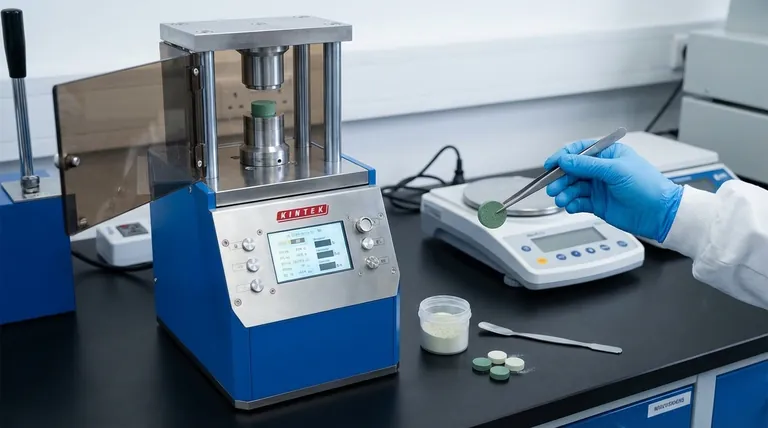
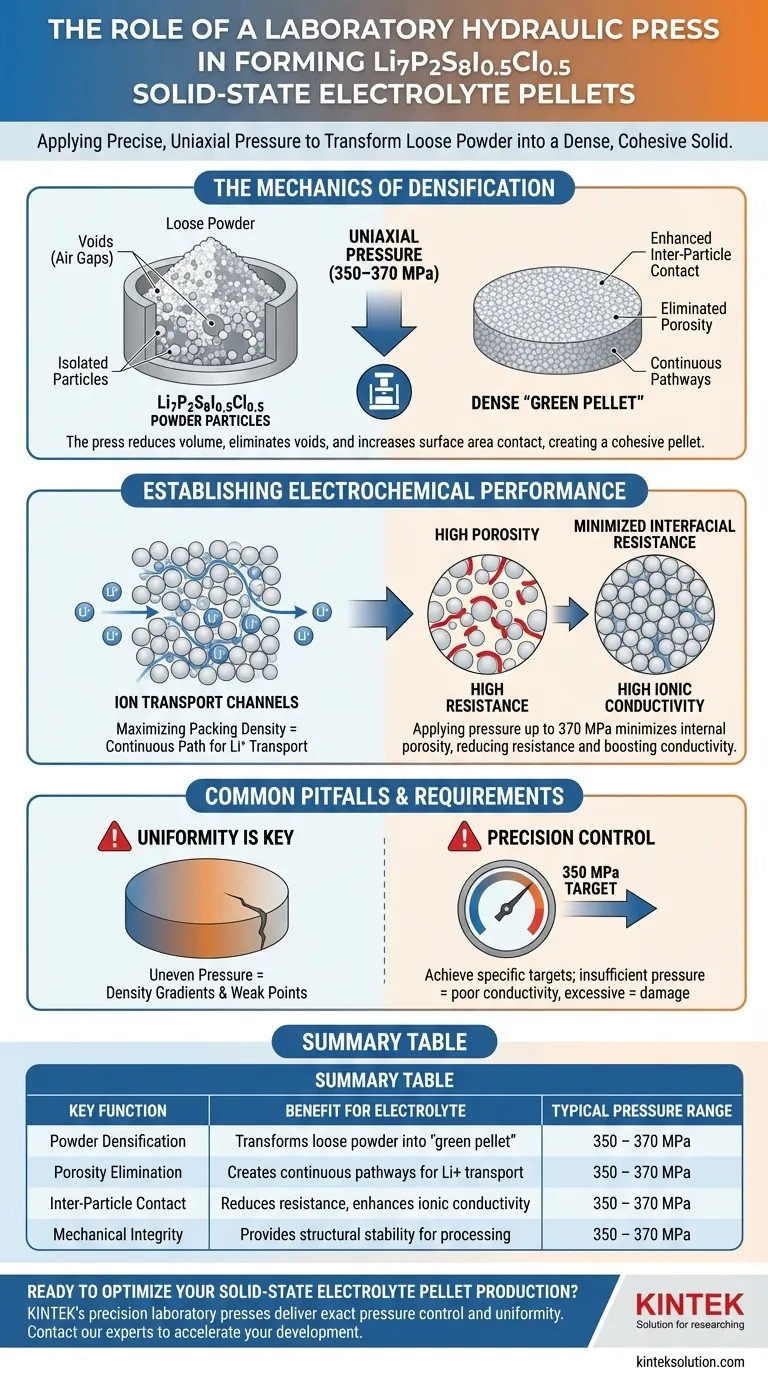
The primary function of a laboratory hydraulic press in this context is to apply precise, uniaxial pressure to transform loose Li7P2S8I0.5Cl0.5 powder into a dense, cohesive solid. By exerting significant force—often between 350 and 370 MPa—the press compacts the material into a "green pellet," establishing the fundamental physical structure necessary for the electrolyte to function.
The Core Takeaway: The hydraulic press acts as a bridge between raw material and functional component; its role is not merely shaping the powder, but eliminating porosity to create continuous pathways for lithium-ion transport.
The Mechanics of Densification
Compacting Loose Powder
The immediate physical task of the press is to reduce the volume of the bulk powder. The machine applies force to the Li7P2S8I0.5Cl0.5 particles, forcing them to rearrange and pack tightly together. This action significantly reduces the voids (air gaps) that naturally exist between loose particles.
Enhancing Inter-Particle Contact
As voids are eliminated, the surface area of contact between individual particles increases drastically. This physical intimacy is critical; without high pressure, particles would remain isolated, creating a discontinuous structure that blocks ion movement.
Creating the "Green Pellet"
The result of this cold-pressing stage is a circular "green pellet." This pellet possesses sufficient mechanical strength to be handled and processed further. It serves as the foundational form for the electrolyte, whether it is used directly or subjected to subsequent steps like sintering or annealing.
Establishing Electrochemical Performance
Building Ion Transport Channels
The densification achieved by the press is directly responsible for creating efficient lithium-ion transport channels. By maximizing the packing density, the press ensures that lithium ions have a continuous, uninterrupted path to travel through the material.
Minimizing Interfacial Resistance
High porosity leads to high resistance at the boundaries between particles. By applying pressure up to 370 MPa, the press minimizes this internal porosity. This reduction in resistance is the key factor in obtaining an electrolyte with high ionic conductivity.
Common Pitfalls and Requirements
The Necessity of Uniformity
It is not enough to simply apply force; the pressure must be uniform and uniaxial. Uneven pressure distribution leads to density gradients within the pellet, which can cause localized areas of high resistance or mechanical weak points.
Precision Control
The press must be capable of stable, controllable output. Achieving specific pressure targets (e.g., 350 MPa) is essential because insufficient pressure results in a porous, conductive-poor pellet, while excessive or uncontrolled pressure could damage the structural integrity of the formed disc.
Making the Right Choice for Your Goal
To maximize the efficacy of your solid-state electrolyte fabrication, focus on how the press parameters align with your performance metrics.
- If your primary focus is Ionic Conductivity: Prioritize a press capable of sustaining high pressures (350+ MPa) to maximize densification and minimize internal voids.
- If your primary focus is Mechanical Integrity: Ensure the press delivers exceptionally uniform uniaxial pressure to prevent density gradients that lead to cracks or crumbling.
Ultmately, the hydraulic press transforms the potential chemistry of the powder into the kinetic reality of a high-performance battery component.
Summary Table:
| Key Function | Benefit for Li7P2S8I0.5Cl0.5 Electrolyte | Typical Pressure Range |
|---|---|---|
| Powder Densification | Transforms loose powder into a cohesive "green pellet" | 350 - 370 MPa |
| Porosity Elimination | Creates continuous pathways for lithium-ion transport | 350 - 370 MPa |
| Inter-Particle Contact | Reduces interfacial resistance, enhancing ionic conductivity | 350 - 370 MPa |
| Mechanical Integrity | Provides structural stability for handling and further processing | 350 - 370 MPa |
Ready to Optimize Your Solid-State Electrolyte Pellet Production?
KINTEK's precision laboratory presses are engineered to deliver the exact pressure control and uniformity required for high-performance Li7P2S8I0.5Cl0.5 electrolyte fabrication. Our automatic lab presses, isostatic presses, and heated lab presses ensure:
- Consistent 350+ MPa pressure for maximum densification and ionic conductivity
- Superior uniformity to prevent density gradients and structural weaknesses
- Repeatable results for reliable battery component manufacturing
Transform your solid-state battery research with press technology designed for electrolyte success. Contact our experts today to discuss how KINTEK's lab press solutions can accelerate your development timeline and improve your electrochemical performance metrics.
Visual Guide
Related Products
- Automatic Laboratory Hydraulic Press for XRF and KBR Pellet Pressing
- Manual Laboratory Hydraulic Press Lab Pellet Press
- Automatic Laboratory Hydraulic Press Lab Pellet Press Machine
- Laboratory Hydraulic Pellet Press for XRF KBR FTIR Lab Press
- Manual Laboratory Hydraulic Pellet Press Lab Hydraulic Press
People Also Ask
- Why is pressing powder into a pellet critical before sintering? Ensure Dense, Conductive Solid-State Electrolytes
- What is the role of a laboratory pressure machine and KBr in FTIR? Master Sample Preparation for Flame Retardants
- What are the advantages of using a laboratory automatic hydraulic press for HEA green compact forming?
- What are the advantages of using a lab automatic hydraulic press for HEA green body molding? Ensure Material Integrity
- What are the advantages of using an automatic laboratory hydraulic press? Enhance Precision in Sample Preparation



















