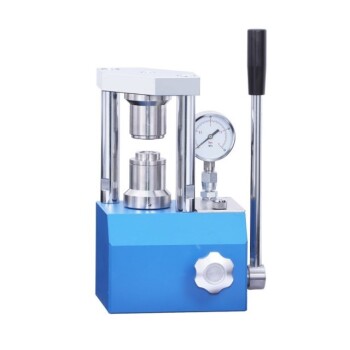
A laboratory manual fastening die system acts as a critical mechanical stabilizer for solid-state batteries by applying a continuous, calibrated physical force. Its primary function is to exert constant stack pressure—typically around 5 MPa—to force the battery components into a unified structural state. This ensures tight conformal contact between the lithium metal anode and the solid electrolyte, which is a prerequisite for the battery to function electrically.
Core Takeaway Solid-state interfaces are rigid and prone to separation; the fastening die system bridges these gaps through mechanical loading. By maintaining continuous pressure, it compensates for volume expansion during cycling, minimizes interface impedance, and prevents the contact failures that lead to uneven current distribution and battery death.
The Mechanics of Interface Stability
Creating Conformal Contact
In solid-state batteries, the electrolyte does not flow to fill gaps like a liquid would. A fastening die system uses a mechanical loading mechanism to solve this by applying constant axial pressure.
This pressure forces the solid electrolyte particles and electrodes together, eliminating microscopic voids. The result is tight conformal contact, ensuring that ions can move freely between layers without encountering physical barriers.
Compensating for Volume Fluctuations
Battery materials, particularly lithium metal anodes, change volume significantly during charging and discharging. Without external constraint, these shifts would cause layers to delaminate or separate.
The fastening die system counters this by maintaining its pressure load despite these physical changes. It acts as a mechanical buffer, preserving the interface integrity even as the internal architecture expands and contracts.
Impact on Electrochemical Performance
Reducing Interface Impedance
The stability provided by the die system directly correlates to electrical efficiency. By eliminating interface gaps, the system drastically reduces contact resistance (impedance).
Low impedance is vital for performance. It ensures that energy is transferred efficiently rather than being lost as heat at the junction between the anode and electrolyte.
Preventing Uneven Current Distribution
When contact between layers is inconsistent, electrical current tends to concentrate in the few spots where contact remains good. This creates "hot spots" of high current density.
By applying uniform pressure, the die system ensures current is distributed evenly across the entire active area. This is particularly critical in anode-free architectures, as it promotes smooth lithium metal deposition and prevents premature failure.
Operational Constraints and Trade-offs
The Dependency on External Pressure
While the die system solves the interface issue, it introduces a reliance on heavy external hardware. The battery chemistry often cannot function independently without this significant mechanical load (e.g., 5 MPa).
This adds complexity to the testing setup. If the manual fastening is not secured with high precision, the pressure may not remain constant over long cycles, negating the benefits.
Uniformity vs. Point Pressure
The goal is uniform axial pressure, but mechanical systems can sometimes apply force unevenly if the fixtures are not perfectly aligned.
Uneven pressure can be worse than low pressure. It can mechanically stress specific points of the electrolyte, potentially leading to cracking or short circuits rather than preventing them.
Making the Right Choice for Your Goal
To maximize the effectiveness of a manual fastening die system, align your setup with your specific testing objectives:
- If your primary focus is Reducing Impedance: Prioritize a setup capable of delivering higher pressure ranges (approx. 5 MPa) to maximize conformal contact and minimize resistance.
- If your primary focus is Long-Term Cycling: Ensure the fastening mechanism has a robust locking feature that will not loosen over time due to the repetitive volume expansion of the anode.
Effective solid-state battery testing is not just about chemistry; it is about maintaining the mechanical integrity required for that chemistry to exist.
Summary Table:
| Feature | Function in Solid-State Battery Stability |
|---|---|
| Mechanical Loading | Applies constant axial pressure (e.g., 5 MPa) to eliminate microscopic voids |
| Conformal Contact | Bridges gaps between rigid electrodes and electrolytes for ion movement |
| Volume Compensation | Acts as a buffer against expansion/contraction during charge cycles |
| Impedance Reduction | Minimizes contact resistance to prevent energy loss as heat |
| Current Distribution | Ensures uniform current flow to prevent hot spots and uneven lithium deposition |
Elevate Your Solid-State Battery Research with KINTEK
Precision at the interface is the difference between breakthrough results and battery failure. KINTEK specializes in comprehensive laboratory pressing solutions designed specifically for the rigorous demands of material science.
Whether you require manual, automatic, heated, or glovebox-compatible models, our equipment provides the calibrated, uniform pressure necessary to maintain interface stability and minimize impedance in solid-state cells. From multifunctional dies to cold and warm isostatic presses, we empower researchers to achieve tight conformal contact and reliable cycling data.
Ready to optimize your battery testing setup? Contact our laboratory specialists today to find the perfect pressing solution for your research goals.
References
- Mouhamad Diallo, Gerbrand Ceder. Mitigating Battery Cell Failure: Role of Ag‐Nanoparticle Fillers in Solid Electrolyte Dendrite Suppression. DOI: 10.1002/aenm.202405700
This article is also based on technical information from Kintek Solution Knowledge Base .
Related Products
People Also Ask
- Why is a laboratory hydraulic press or battery sealing machine essential? Ensure Coin Cell Data Integrity
- How do laboratory battery sealing machines ensure performance consistency? Master Your Lithium and LFP Battery Assembly
- Why is stable pressure control necessary when assembling SC-NCM83/PLM-3/Li batteries? Optimize Solid-State Interfaces
- How does the mechanical pressure provided by a laboratory crimper affect the performance of assembled 2032-type coin cells?
- What role does a laboratory press perform for CR2032 coin cell assembly? Ensure Precision in Battery Research