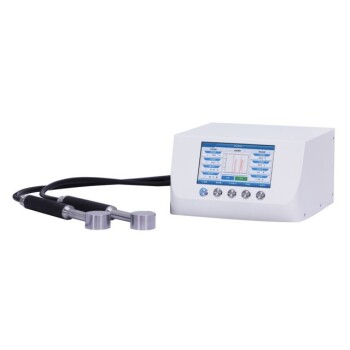
The primary function of a laboratory oven in the gravimetric analysis of sludge is to establish a precise dry mass baseline. By maintaining a stable thermal environment at 105°C, the oven evaporates moisture from the sample until it reaches a constant weight. This process isolates the solid material, enabling the accurate calculation of dry matter content.
In gravimetric analysis, the laboratory oven acts as a standardization tool. By removing moisture to determine the exact dry matter content, it provides the fundamental baseline required to calculate accurate organic and nitrogen extraction rates.
The Role of Thermal Stability in Analysis
To analyze sludge components accurately, you must eliminate the variable of water. The laboratory oven accomplishes this through precise temperature control.
Standardizing Temperature
The oven provides a stable thermal environment, specifically set at 105°C. This temperature is critical because it is high enough to ensure water evaporation but controlled enough to preserve the integrity of the remaining solids.
Achieving Constant Weight
The objective is not simply to heat the sample, but to heat it until it stops losing mass. This state, known as constant weight, confirms that moisture evaporation is complete. This ensures that the final measurement reflects only the solid components of the sludge.
The Foundation for Data Accuracy
The data derived from the oven is not the final result, but the prerequisite for all subsequent calculations.
Determining Dry Matter Content
Once the moisture is removed, the remaining mass represents the dry matter content. This value serves as the immutable baseline for the analysis. Without this step, the water content would skew mass measurements, rendering specific component analysis impossible.
Calculating Extraction Ratios
Accurate extraction rates depend entirely on this dry mass figure. Whether you are analyzing organic content or nitrogen levels, the ratios must be calculated against a standardized solid mass. The oven ensures that these extraction ratios are chemically significant and comparable across different samples.
Understanding the Trade-offs
While the laboratory oven is essential for accuracy, the gravimetric method has inherent operational characteristics that must be managed.
Time Intensity
This is a thermogravimetric reference method, which prioritizes accuracy over speed. Achieving complete evaporation often requires an extended period, potentially taking up to 24 hours. It is not suitable for rapid, real-time analysis.
Dependency on Stability
The accuracy of the moisture calculation is strictly tied to the oven's ability to hold a constant environment. Any fluctuation in temperature can lead to incomplete evaporation, resulting in erroneous dry matter calculations and flawed downstream extraction data.
Ensuring Analytical Precision
To derive valid insights from sludge analysis, you must apply the gravimetric data correctly based on your specific objectives.
- If your primary focus is determining extraction efficiency: Use the dry matter content as the absolute denominator to calculate organic and nitrogen extraction rates.
- If your primary focus is method calibration: Ensure the sample remains in the oven until strictly constant weight is achieved to create reliable reference data for other prediction models.
The laboratory oven transforms a variable, moisture-heavy sludge sample into a standardized data point, forming the backbone of reliable quantitative analysis.
Summary Table:
| Feature | Function in Gravimetric Analysis | Impact on Results |
|---|---|---|
| Temperature Control | Sustains 105°C for moisture evaporation | Preserves solid integrity without burning |
| Constant Weight | Verification of complete water removal | Ensures solid mass is the only variable |
| Baseline Setup | Establishes dry matter content denominator | Crucial for organic and nitrogen extraction ratios |
| Methodology | Acts as thermogravimetric reference | High accuracy for method calibration |
Elevate Your Analytical Accuracy with KINTEK
Precise gravimetric analysis starts with thermal stability. KINTEK specializes in comprehensive laboratory pressing and heating solutions, providing the high-performance tools needed to achieve constant weight and reliable dry mass baselines. Whether you are conducting battery research or environmental sludge analysis, our equipment—from manual and automatic presses to specialized laboratory ovens—ensures your data is chemically significant.
Ready to optimize your lab's extraction efficiency? Contact our experts today to find the perfect solution for your research requirements.
References
- Ēriks Skripsts, Linda Mežule. Organic mass and protein extraction from secondary sewage sludge via multi-step physical alkali- and acid-based treatment. DOI: 10.3389/fceng.2024.1346736
This article is also based on technical information from Kintek Solution Knowledge Base .
Related Products
- Cylindrical Lab Electric Heating Press Mold for Laboratory Use
- Lab Double Plate Heating Mold for Laboratory Use
- Laboratory Split Manual Heated Hydraulic Press Machine with Hot Plates
- Automatic Heated Hydraulic Press Machine with Hot Plates for Laboratory
- Laboratory Manual Heated Hydraulic Press Machine with Hot Plates
People Also Ask
- How does a laboratory electric heated press ensure sample quality? Optimize SiR-EPDM vulcanization and molding.
- What role does a laboratory electric heated press play in polymer composite fabrication? Key for Standardized Specimens
- What role does a laboratory electric heating press play in NBR molding? Master Vulcanization & Material Density
- Why is a laboratory electric heating press required for PP/EPDM molding? Achieve Superior Specimen Integrity
- What is the purpose of incorporating cartridge heaters into a lab press mold for MLCC block compression? Optimize Results