
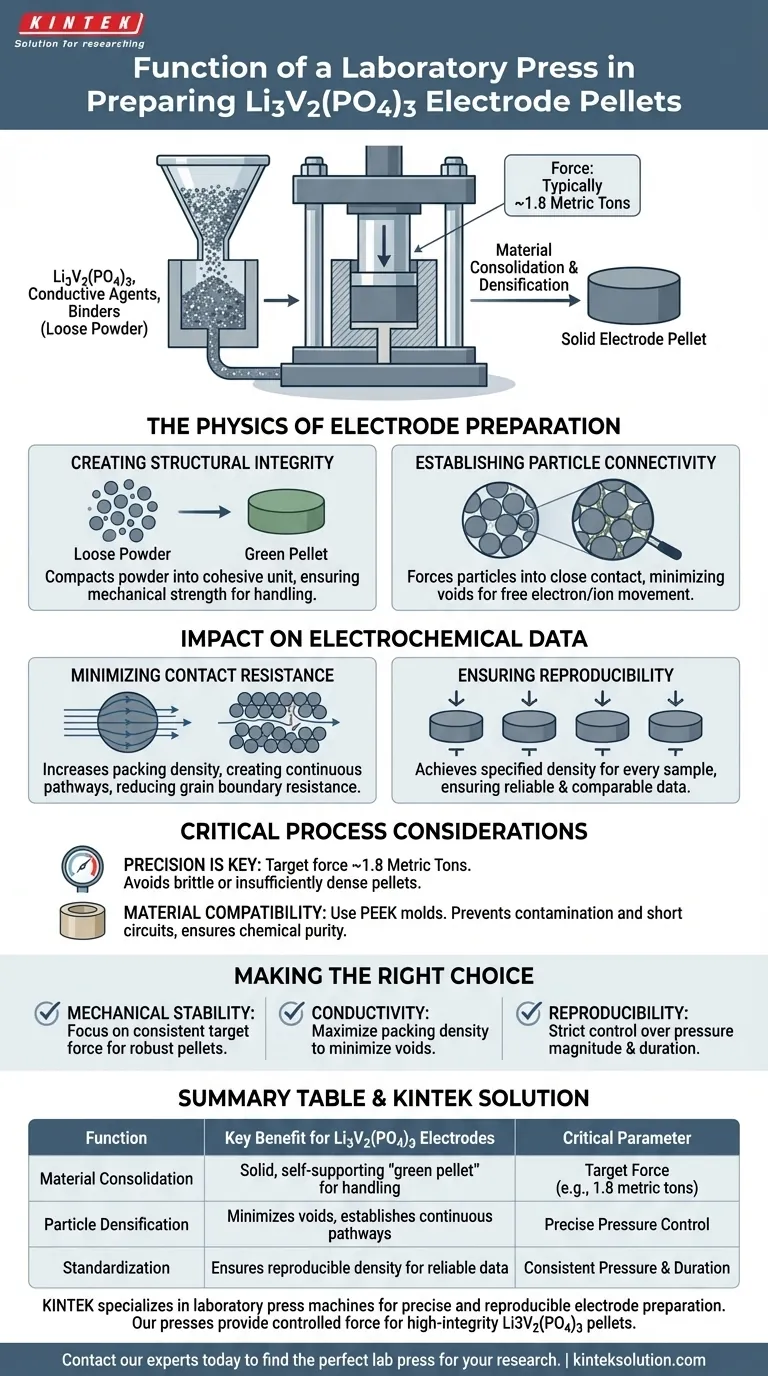
The primary function of a laboratory press in this context is material consolidation and densification. It transforms a loose, uniform mixture of Li3V2(PO4)3 active material, conductive agents, and binders into a solid, self-supporting pellet. By applying precise force (typically around 1.8 metric tons for electrode applications), the press ensures the mechanical integrity required for the pellet to be handled and assembled into a test cell.
The press does more than just shape the material; it enforces intimate physical contact between particles. This step is the gateway to accurate testing, as it minimizes internal voids to create the continuous conductive pathways necessary for stable electrochemical performance.
The Physics of Electrode Preparation
Creating Structural Integrity
Before an electrode can be tested, it must exist as a cohesive unit. The laboratory press compacts the loose powder mixture into what is often called a "green pellet."
This consolidation provides sufficient mechanical strength to make the electrode self-supporting. Without this step, the material would remain a loose powder, making it impossible to assemble into a coin cell or testing rig without falling apart.
Establishing Particle Connectivity
For Li3V2(PO4)3 to function as an electrode, electrons and ions must move freely through the structure. The press forces the active material, conductive additives, and binder into close proximity.
This intimate physical contact is critical. It reduces the empty spaces (voids) between particles that would otherwise act as barriers to transmission.
Impact on Electrochemical Data
Minimizing Contact Resistance
A loosely packed electrode suffers from high grain boundary resistance. By applying controlled pressure, the press increases the packing density of the composite material.
This densification creates continuous pathways for charge transfer. It ensures that the resistance measured during testing reflects the intrinsic properties of the material, rather than artifacts caused by poor particle contact.
Ensuring Reproducibility
Scientific data is only valuable if it is consistent. The laboratory press allows you to achieve a specified density for every sample you fabricate.
This standardization removes variables related to fabrication. It ensures that the electrochemical data you collect—such as capacity and cycling stability—is reliable and comparable across different batches.
Critical Process Considerations
The Necessity of Precision
Applying pressure is not a "more is better" scenario; it requires precision. The pressure must be high enough to consolidate the powder and reduce voids, but controlled enough to maintain the structural integrity of the active material.
In specific electrode preparations, a force of 1.8 metric tons is often cited as the target standard. Deviating significantly from the required pressure can lead to pellets that are either too brittle or insufficiently dense.
Material Compatibility and Contamination
The interaction between the pellet and the pressing die is also a factor. Using appropriate molds, such as those made from PEEK (polyetheretherketone), can prevent issues during compaction.
PEEK offers high mechanical strength to withstand pressure while providing electrical insulation. This prevents short circuits or electrochemical reactions between the sample and the mold, preserving the chemical purity of your Li3V2(PO4)3 sample.
Making the Right Choice for Your Goal
To ensure your electrochemical testing yields valid results, consider these specific focus areas during fabrication:
- If your primary focus is mechanical stability: Ensure your press can consistently apply the target force (e.g., 1.8 metric tons) to produce robust, self-supporting pellets that survive handling.
- If your primary focus is conductivity measurements: Prioritize maximizing packing density to minimize interstitial voids and reduce grain boundary resistance.
- If your primary focus is data reproducibility: strict control over the pressure duration and magnitude is required to ensure every pellet creates a standardized testing environment.
The laboratory press is not merely a shaping tool; it is the instrument that bridges the gap between raw powder and a functional, testable electrochemical component.
Summary Table:
| Function | Key Benefit for Li3V2(PO4)3 Electrodes | Critical Parameter |
|---|---|---|
| Material Consolidation | Creates a solid, self-supporting "green pellet" for handling. | Target Force (e.g., 1.8 metric tons) |
| Particle Densification | Minimizes voids to establish continuous pathways for ion/electron flow. | Precise Pressure Control |
| Standardization | Ensures reproducible pellet density for reliable, comparable test data. | Consistent Pressure & Duration |
Ready to achieve precise and reproducible results in your battery material research?
KINTEK specializes in laboratory press machines, including automatic and heated lab presses, designed to meet the exacting demands of electrode preparation for laboratories like yours. Our presses provide the controlled force and consistency you need to fabricate high-integrity Li3V2(PO4)3 pellets, minimizing experimental variables and ensuring your electrochemical data is accurate.
Contact our experts today to find the perfect lab press for your specific application and enhance the reliability of your research.
Visual Guide
Related Products
- Manual Laboratory Hydraulic Pellet Press Lab Hydraulic Press
- Laboratory Hydraulic Press 2T Lab Pellet Press for KBR FTIR
- Lab XRF Boric Acid Powder Pellet Pressing Mold for Laboratory Use
- Laboratory Hydraulic Press Lab Pellet Press Button Battery Press
- Automatic Laboratory Hydraulic Press Lab Pellet Press Machine
People Also Ask
- What is the primary purpose of manual lab hydraulic pellet presses? Achieve High-Precision Sample Preparation for Spectroscopy
- What is the primary purpose of a manual lab hydraulic pellet press? Ensure Accurate Sample Prep for XRF and FTIR
- What is the purpose of initial axial molding using a lab hydraulic press? Optimizing Electrolyte Green Bodies
- What role does a lab hydraulic press play in researching squishy granular matter? Expert Insights into Material Physics
- What is the primary function of a laboratory hydraulic press in evaluating the ionic conductivity of Li6PS5X (LMSX)?



















