
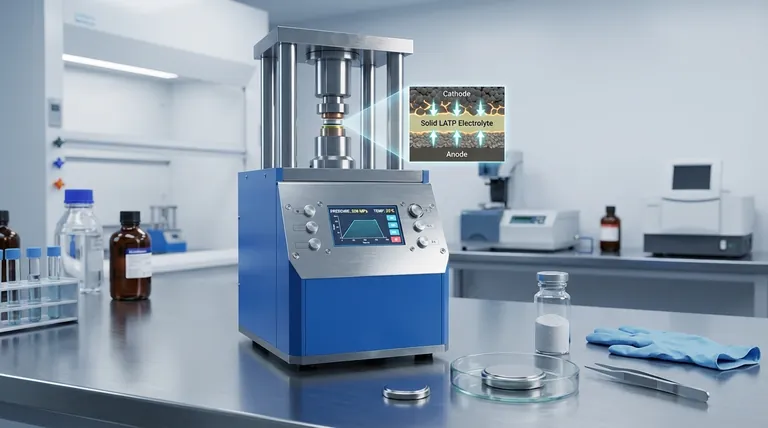
The primary function of a laboratory press in this context is to apply precise, uniform pressure to overcome the inherent physical limitations of solid materials. Specifically, it forces the LATP composite electrolyte and electrodes into intimate physical contact to minimize voids and significantly reduce solid-solid interfacial impedance. Without this mechanical intervention, the lack of seamless contact prevents efficient lithium-ion transport, rendering the battery incapable of stable cycling or high-rate performance.
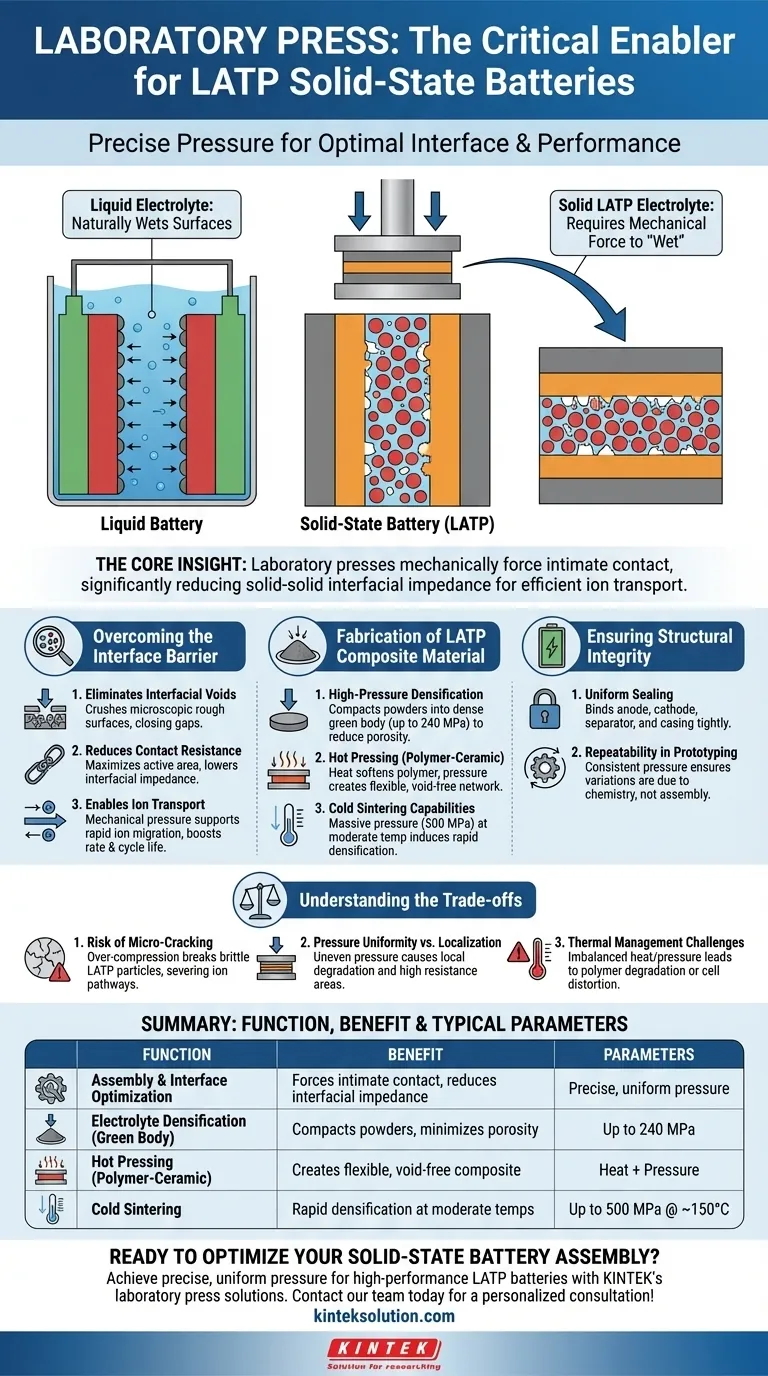
The Core Insight: In liquid batteries, the electrolyte naturally wets the electrode surface; in all-solid-state batteries, this "wetting" must be mechanically forced. A laboratory press is not merely an assembly tool, but a critical electrochemical enabler that lowers internal resistance by physically merging distinct solid layers into a cohesive, ion-conductive stack.
Overcoming the Solid-Solid Interface Barrier
Eliminating Interfacial Voids
Solid material surfaces are microscopically rough, creating gaps when stacked together. A laboratory press applies controlled pressure to crush these irregularities. This action eliminates void spaces between the LATP electrolyte, the cathode, and the anode.
Reducing Contact Resistance
The elimination of voids is directly linked to electrochemical performance. By maximizing the active contact area, the press significantly lowers the interfacial impedance. This provides unobstructed pathways for lithium ions to move between layers.
Enabling Ion Transport
Low impedance is a prerequisite for battery function. The mechanical pressure ensures that the physical contact is sufficient to support rapid ion migration. This directly dictates the battery's rate performance and long-term cycle life.
Fabrication of the LATP Composite Material
High-Pressure Densification
Before the battery is assembled, the press is often used to form the electrolyte itself. It compacts mixed powders into a dense pellet, known as a green body, using pressures up to 240 MPa. This reduces porosity and prepares the material for efficient sintering.
Hot Pressing Polymer-Ceramic Composites
When the LATP is mixed with a polymer matrix, a heated laboratory press is essential. The heat softens the polymer, while the pressure forces it to flow around the ceramic LATP particles. This creates a flexible, void-free network with high ionic conductivity.
Cold Sintering Capabilities
For specific composites like LATP-Li₃InCl₆, specialized presses facilitate "cold sintering." By applying massive pressure (up to 500 MPa) at moderate temperatures (150°C) with a solvent, the press induces plastic deformation and rapid densification in a short time frame.
Ensuring Structural Integrity
Uniform Sealing
Beyond electrochemical needs, the press provides the mechanical force required to seal the cell components. It ensures the anode, cathode, separator, and casing are bound tightly.
Repeatability in Prototyping
Developing a reliable battery requires consistent variables. A laboratory press provides precise, repeatable pressure settings. This ensures that performance variations are due to material chemistry, not inconsistent assembly techniques.
Understanding the Trade-offs
The Risk of Micro-Cracking
While high pressure is necessary for contact, excessive force can be detrimental. Over-compressing brittle ceramic particles like LATP can cause micro-cracks within the electrolyte layer. These cracks can sever ion pathways or create short circuits.
Pressure Uniformity vs. Localization
If the press platens are not perfectly parallel, pressure distribution will be uneven. High-pressure "hotspots" can degrade materials locally, while low-pressure areas will suffer from high resistance. Uniformity is just as critical as the magnitude of force applied.
Thermal Management Challenges
In heated pressing, the synergy between heat and pressure must be carefully balanced. If the temperature is too high relative to the pressure, polymers may degrade or flow excessively, distorting the cell geometry.
Making the Right Choice for Your Goal
To maximize the utility of your laboratory press for LATP batteries, align your process with your specific development stage:
- If your primary focus is Electrolyte Synthesis: Prioritize high-pressure capabilities (200+ MPa) and heated platens to minimize porosity and ensure high density in green bodies or polymer composites.
- If your primary focus is Full Cell Assembly: Focus on precision control and uniformity to optimize the electrolyte-electrode interface without damaging the brittle LATP ceramic layer.
Success in solid-state battery assembly relies less on the chemistry itself and more on the mechanical precision used to unite that chemistry into a functioning system.
Summary Table:
| Function | Key Benefit | Typical Pressure/Temperature |
|---|---|---|
| Assembly & Interface Optimization | Forces intimate contact, reduces interfacial impedance | Precise, uniform pressure |
| Electrolyte Densification (Green Body) | Compacts powders, minimizes porosity | Up to 240 MPa |
| Hot Pressing (Polymer-Ceramic) | Creates flexible, void-free composite | Heat + Pressure |
| Cold Sintering | Rapid densification at moderate temperatures | Up to 500 MPa @ ~150°C |
Ready to Optimize Your Solid-State Battery Assembly?
Achieving the precise, uniform pressure required for high-performance LATP-based batteries is critical. KINTEK specializes in laboratory press machines—including automatic, isostatic, and heated lab presses—designed to meet the exacting demands of battery research and development.
Our presses provide the control and consistency you need to:
- Minimize interfacial impedance by ensuring perfect solid-solid contact.
- Eliminate voids without causing micro-cracks in brittle ceramics.
- Accelerate your prototyping with repeatable, reliable results.
Let's discuss how our expertise can enhance your lab's capabilities. Contact our team today for a personalized consultation!
Visual Guide
References
- Yuyue Guo, Xiaodong Wu. Lithium aluminum titanium phosphate (LATP) composite solid-state electrolytes: progress and prospects for all-solid-state batteries. DOI: 10.1039/d5nr03393d
This article is also based on technical information from Kintek Solution Knowledge Base .
Related Products
- Laboratory Hydraulic Press Lab Pellet Press Button Battery Press
- Laboratory Hydraulic Press 2T Lab Pellet Press for KBR FTIR
- Laboratory Hydraulic Press Lab Pellet Press Machine for Glove Box
- Laboratory Split Manual Heated Hydraulic Press Machine with Hot Plates
- Laboratory Hydraulic Pellet Press for XRF KBR FTIR Lab Press
People Also Ask
- How is a laboratory hydraulic press used for HAP composite gels? Master Mineral Substrate Standardization
- What role does a laboratory hydraulic press play in the preparation of piezoelectric ceramic discs for DC-PG? | KINTEK
- What role does a laboratory hydraulic press play in reaction pellets? Optimizing Lunar Soil and Metal Fuel Density
- What role does a laboratory hydraulic press play in the assembly of all-solid-state battery test cells? Expert Guide
- Why is a laboratory hydraulic press required for PBAT and PLA sample preparation? Achieve Flawless Characterization



















