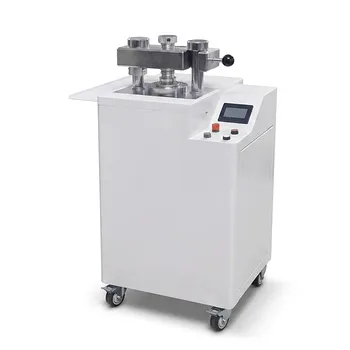
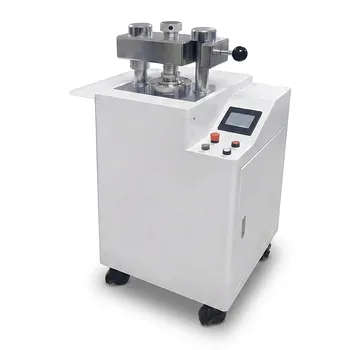
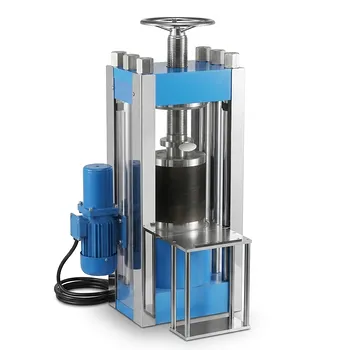
The primary function of a pellet press in FTIR analysis is to mechanically transform a raw, powdered sample into a solid, optical-quality disc. By applying significant pressure to a pellet die containing a mixture of the sample and a binder (typically Potassium Bromide, KBr), the press compacts the material into a thin, uniform, and translucent pellet. This transformation is essential to allow the infrared instrument's beam to pass through the material with minimal scattering, enabling precise molecular analysis.
Without a pellet press, powdered samples scatter infrared light, leading to noisy or unusable data. The press eliminates these irregularities by fusing the sample and binder into a homogeneous medium, ensuring the clarity and consistent geometry required for accurate spectral transmission.
Why Compression is Critical for Spectroscopy
Achieving Optical Transparency
The goal of FTIR is to measure how a sample absorbs infrared light. Loose powders are opaque and scatter light.
The pellet press applies enough force (often between 5 to 10 tons) to induce plastic flow in the salt crystals used as a binder. This flow embeds the sample particles within a fused salt matrix, creating a translucent "window" that the infrared beam can penetrate effectively.
Ensuring Uniform Geometry
For accurate quantitative analysis, the path length of the light through the sample must be consistent.
A pellet press, used in conjunction with a quality die, produces a cylinder with flat ends and uniform thickness. This geometric precision ensures that the infrared light interacts with the material evenly, preventing the distortions associated with irregular sample shapes.
The Operational Process
Preparation and Homogeneity
Before the press is involved, the sample is mixed with a binder like KBr and finely ground.
The press cannot fix a poorly mixed sample. The mixture must be homogeneous to ensure the resulting pellet represents the material accurately without "hot spots" of pure sample or pure binder.
Compacting the Matrix
The mixture is loaded into a durable pellet die, which is then placed into the press.
The press drives a ram against the die, compressing the powder. This reduces the void space between particles to near zero, resulting in a solid, clear pellet ready for the FTIR sample holder.
Common Pitfalls to Avoid
Moisture Contamination
The most common failure in pressing pellets is cloudiness caused by moisture.
Because KBr is hygroscopic (it absorbs water from the air), the components must be kept dry before pressing. If the mixture is damp, the press will create a cloudy pellet that introduces water peaks into your spectrum, obscuring the data you actually need.
Insufficient Pressure or Duration
Applying pressure too quickly or not holding it long enough can result in a fragile or opaque pellet.
The salt crystals require time and sustained force to flow and fuse completely. If the pellet crumbles upon removal or remains opaque white rather than translucent, the pressing conditions likely need adjustment.
Optimizing Your Results
To ensure the highest quality spectral data, tailor your pressing technique to your specific analytical needs:
- If your primary focus is quantitative analysis: strictly control the mass of the sample and the pressure applied to ensure every pellet has the exact same thickness and path length.
- If your primary focus is signal clarity: Prioritize fine grinding and a low sample-to-binder ratio (mostly KBr) to minimize light scattering and maximize transparency.
The pellet press serves as the critical bridge between a raw, unreadable powder and a precise, high-fidelity spectral fingerprint.
Summary Table:
| Feature | Function in FTIR Analysis |
|---|---|
| Material Transformation | Converts loose powder and KBr binder into a solid, translucent disc. |
| Optical Clarity | Eliminates light scattering by inducing plastic flow to create a fused salt matrix. |
| Geometric Precision | Ensures uniform thickness and flat surfaces for a consistent light path length. |
| Data Quality | Reduces spectral noise and prevents distortions for accurate quantitative results. |
| Compaction Force | Typically applies 5–10 tons of pressure to remove void spaces between particles. |
Elevate Your Spectroscopic Accuracy with KINTEK
Precise FTIR results start with a perfect pellet. KINTEK specializes in comprehensive laboratory pressing solutions designed to meet the rigorous demands of material science and battery research. Whether you require manual, automatic, heated, multifunctional, or glovebox-compatible models, our equipment ensures the uniform thickness and optical transparency necessary for high-fidelity molecular analysis.
Don't let sample preparation be the weak link in your research. From cold isostatic presses to specialized FTIR dies, our expert team is ready to help you select the ideal solution for your lab’s unique needs.
Ready to optimize your sample preparation? Contact KINTEK today and achieve superior spectral clarity!
Related Products
- Automatic XRF Pellet Press for Laboratory Spectrometry Sample Preparation
- Laboratory Hydraulic Split Electric Lab Pellet Press
- Manual Laboratory Hydraulic Pellet Press Lab Hydraulic Press
- Laboratory Hydraulic Pellet Press for XRF KBR FTIR Lab Press
- Automatic Laboratory Hydraulic Press Lab Pellet Press Machine
People Also Ask
- How can contamination occur during the preparation of pressed pellets for XRF analysis? Expert Prevention Guide
- How does the sample material influence the required pressing load for making an XRF pellet? Find the Optimal Pressure
- What are the different methods for preparing a sample pellet for XRF analysis? Expert Guide to Superior XRF Results
- What are the advantages of preparing a sample as a dense pellet for XRF? Unlock High-Precision Trace Element Analysis
- What is the primary purpose of using an automatic pellet press? Achieve Precise Geopolymer Analysis Results