
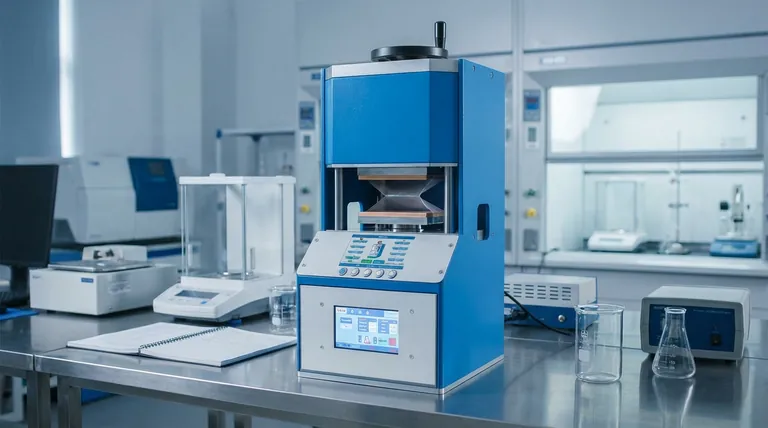
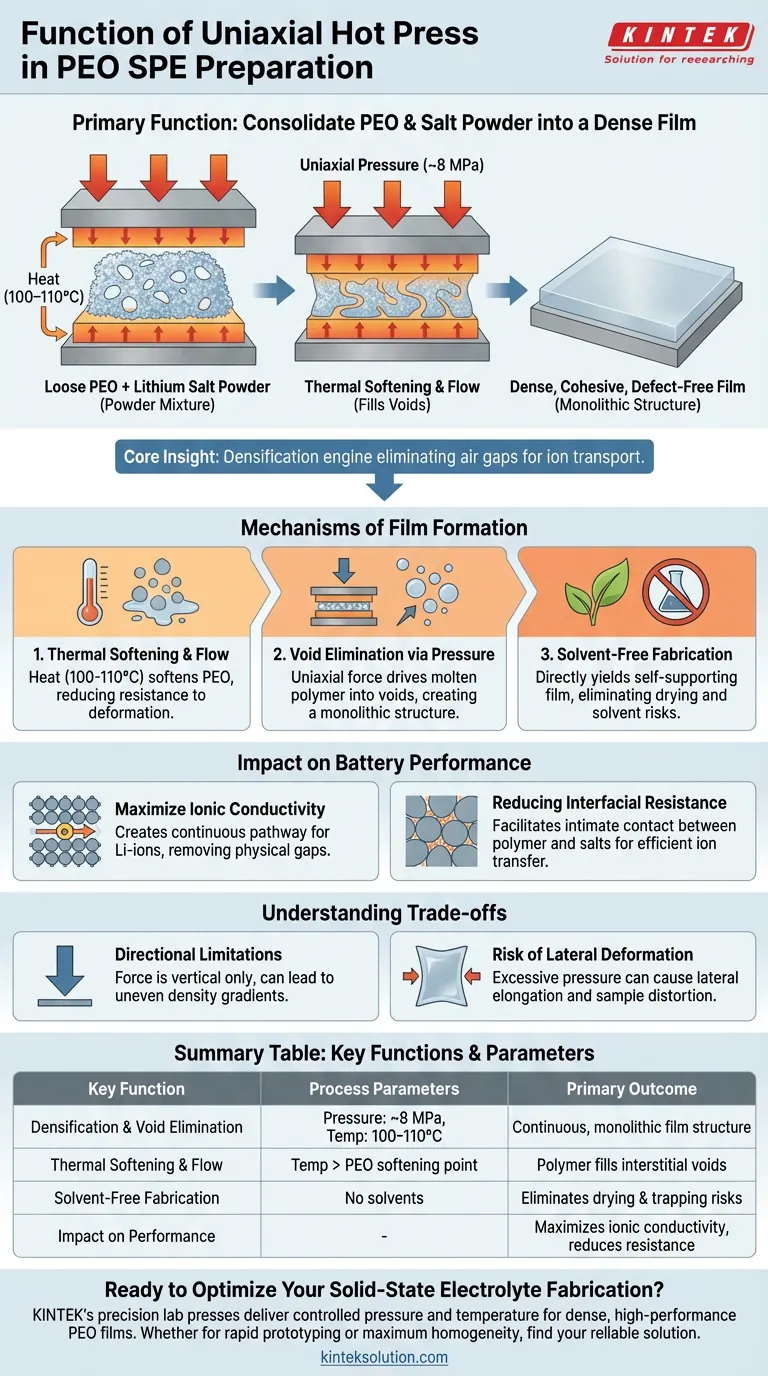
The primary function of a uniaxial hot press in this context is to consolidate a loose mixture of Polyethylene Oxide (PEO) and lithium salt powder into a dense, cohesive, and defect-free film.
By applying moderate pressure (typically around 8 MPa) at temperatures above the polymer’s softening point (approx. 100–110°C), the machine forces the softened polymer to flow and fill interstitial voids. This creates a foundation for high ionic conductivity by transforming discrete particles into a continuous, solvent-free solid electrolyte layer.
Core Insight: The hot press acts as a densification engine; it leverages the thermoplastic nature of PEO to eliminate air gaps and particle boundaries, which are the primary barriers to ion transport in solid-state batteries.
Mechanisms of Film Formation
Thermal Softening and Flow
The process begins by heating the PEO-salt mixture to a specific temperature, often between 100°C and 110°C.
At this thermal threshold, the thermoplastic polymer softens or melts, significantly reducing its resistance to deformation. This state allows the material to move and reorganize, rather than simply cracking under stress.
Void Elimination via Uniaxial Pressure
Once the polymer is softened, the press applies a vertical (uniaxial) force.
This pressure drives the molten polymer into the microscopic spaces between solid particles. This action is critical for creating a monolithic structure, effectively removing the porosity that naturally exists in a powder mixture.
Solvent-Free Fabrication
Unlike solution-casting methods, the hot press enables the creation of films without the use of liquid solvents.
This results in a "green" manufacturing process that directly yields a self-supporting film. It eliminates the need for drying steps and removes the risk of residual solvent trapping, which can degrade electrochemical performance.
Impact on Battery Performance
Maximizing Ionic Conductivity
The primary goal of the initial forming stage is to establish a continuous pathway for lithium ions.
By creating a fully dense film, the hot press ensures there are no physical gaps to interrupt ion flow. A structure free of voids and grain boundaries is essential for achieving high room-temperature ionic conductivity.
Reducing Interfacial Resistance
The pressing process facilitates intimate contact between the polymer and the lithium salts (and potentially other active materials).
This "intimate interfacial contact" significantly lowers the solid-solid interface resistance. This is a crucial step in ensuring the electrolyte can effectively transfer ions during battery operation.
Understanding the Trade-offs
Directional Limitations
Uniaxial pressing applies force in only one direction (vertical).
While effective for flat films, this can lead to uneven density gradients compared to methods like isostatic pressing, which applies pressure from all sides.
Risk of Lateral Deformation
Because the pressure is directional, the polymer film may experience lateral elongation.
If the pressure is excessive, the film can squash outwards rather than just densifying. This can result in variations in thickness or structural integrity at the edges of the sample compared to the center.
Making the Right Choice for Your Goal
The use of a uniaxial hot press is a balance between processing speed and structural uniformity.
- If your primary focus is Rapid Prototyping: A uniaxial hot press is ideal for quickly generating standardized, solvent-free films for immediate testing.
- If your primary focus is Maximum Homogeneity: Be aware that uniaxial pressure may cause lateral deformation; careful control of pressure (keeping it moderate, e.g., 8 MPa) is required to prevent sample distortion.
Summary: The uniaxial hot press serves as the critical bridge between raw powder and a functional electrolyte, utilizing heat and pressure to engineer the density required for efficient ion transport.
Summary Table:
| Key Function | Process Parameters | Primary Outcome |
|---|---|---|
| Densification & Void Elimination | Pressure: ~8 MPa Temperature: 100–110°C |
Creates a continuous, monolithic film structure |
| Thermal Softening & Flow | Temperature above PEO's softening point | Enables polymer to fill interstitial voids |
| Solvent-Free Fabrication | No solvents used in the process | Eliminates drying steps and risk of solvent trapping |
| Impact on Performance | Creates intimate interfacial contact | Maximizes ionic conductivity and reduces resistance |
Ready to optimize your solid-state electrolyte fabrication?
KINTEK's precision lab presses, including our range of automatic, heated, and isostatic presses, are engineered to deliver the controlled pressure and temperature critical for creating dense, high-performance PEO films. Whether you are focused on rapid prototyping or achieving maximum homogeneity, our equipment provides the reliability and consistency your laboratory needs.
Contact us today using the form below to discuss how our solutions can enhance your research and development process. Let's build the future of energy storage, together.
Visual Guide
References
- Benoît Denis Louis Campéon, Naoaki Yabuuchi. Virtues of Cold Isostatic Pressing for Preparation of All‐Solid‐State‐Batteries with Poly(Ethylene Oxide). DOI: 10.1002/cssc.202301054
This article is also based on technical information from Kintek Solution Knowledge Base .
Related Products
- Split Automatic Heated Hydraulic Press Machine with Heated Plates
- Laboratory Manual Heated Hydraulic Press Machine with Hot Plates
- Automatic High Temperature Heated Hydraulic Press Machine with Heated Plates for Lab
- Automatic Heated Hydraulic Press Machine with Hot Plates for Laboratory
- Manual Heated Hydraulic Lab Press with Integrated Hot Plates Hydraulic Press Machine
People Also Ask
- What are the requirements for electrode pressing with high-viscosity ionic liquids like EMIM TFSI? Optimize Performance
- How does a laboratory heated hydraulic press facilitate PBN sample prep for WAXS? Achieve Precise X-Ray Scattering
- What are the industrial applications of heated hydraulic presses? Master Heat & Force for Precision Manufacturing
- Why is a laboratory hydraulic press with heating plates required for PLA/TEC films? Achieve Precise Sample Integrity
- Function of a Laboratory Hydraulic Press with Heated Platens in SSE? Enhance Battery Density & Conductivity
















