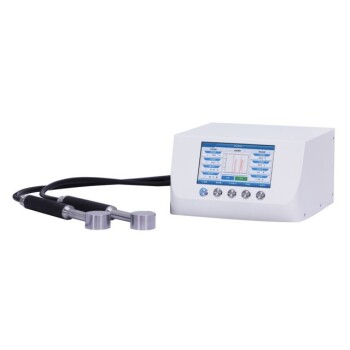
The vacuum sintering furnace functions as the critical "gatekeeper" process that bridges the gap between a porous powder compact and a transparent ceramic. It creates a high-temperature vacuum environment, typically ranging from 1450°C to 1650°C, designed to forcefully evacuate residual gases trapped between Yttria particles. This allows the material to densify sufficiently to enter the "closed-pore stage," a prerequisite condition for achieving optical transparency.
The core purpose of this equipment is not necessarily to achieve final perfection, but to reach a relative density where pores are isolated from the surface. This "closed-pore" state is the only condition under which subsequent Hot Isostatic Pressing (HIP) can successfully eliminate remaining voids to create a clear ceramic.
The Mechanics of Densification
Gas Removal and Pore Elimination
During the initial densification phase, gas molecules are often trapped within the compacted powder. The furnace's vacuum environment lowers the atmospheric pressure surrounding the material, encouraging these trapped gases to diffuse out. This evacuation is essential because trapped gas would otherwise oppose the shrinkage of the material, preventing the elimination of pores.
Inhibiting Oxidation
Yttria and its associated dopants can be sensitive to impurities at high temperatures. The vacuum atmosphere strictly controls the presence of oxygen and other reactive elements. This inhibits impurity oxidation, ensuring the chemical purity required for high-grade optical transmission.
Reaching the Closed-Pore Stage
The ultimate goal of this furnace is to sinter the material until the internal pores no longer connect to the surface. Once the material reaches this specific relative density, the gas inside the pores is cut off from the outside environment. This is the "hand-off" point where the material is ready for the final, high-pressure treatment.
Understanding the Trade-offs
The Risk of Incomplete Densification
If the vacuum sintering process is terminated too early or runs at insufficient temperatures, the material will remain in an "open-pore" state. In this state, the pressure applied during subsequent processing steps (like HIP) would simply transfer through the connected pores rather than crushing them. This results in a ceramic that remains opaque, regardless of how much pressure is applied later.
Balancing Temperature and Microstructure
While high temperatures (up to 1650°C) are necessary for densification, they must be carefully controlled. Excessive heat can lead to rapid grain growth, which may negatively affect the mechanical properties of the ceramic. The process is a balancing act: sufficient heat to close pores, but controlled enough to maintain a favorable microstructure.
Making the Right Choice for Your Goal
To maximize the effectiveness of a vacuum sintering furnace for Yttria production, consider the following based on your specific objectives:
- If your primary focus is Optical Transparency: Prioritize reaching the closed-pore stage above all else; if pores remain open, downstream HIP treatment will fail to clear the ceramic.
- If your primary focus is Material Purity: Ensure the vacuum integrity is absolute to prevent high-temperature oxidation of impurities, which creates defects that scatter light.
The vacuum sintering furnace is the essential tool that transforms a fragile powder compact into a robust, sealed pre-form capable of becoming transparent.
Summary Table:
| Feature | Function in Yttria Production | Impact on Final Ceramic |
|---|---|---|
| High-Temp Vacuum | Evacuates trapped gases between particles | Enables material shrinkage and densification |
| Atmosphere Control | Prevents impurity oxidation | Ensures chemical purity and optical clarity |
| Pore Management | Transitions material to "closed-pore" stage | Prerequisite for successful HIP processing |
| Thermal Precision | Balances heat vs. grain growth | Maintains mechanical integrity and microstructure |
Elevate Your Material Research with KINTEK
Precision is the difference between an opaque compact and a transparent ceramic. KINTEK specializes in comprehensive laboratory pressing and sintering solutions designed for high-performance battery and material research. Whether you need manual, automatic, heated, or multifunctional models—or advanced cold and warm isostatic presses—our equipment provides the controlled environment necessary to reach the critical closed-pore stage and beyond.
Ready to achieve superior optical density in your Yttria ceramics? Contact our technical experts today to find the perfect furnace or pressing solution tailored to your laboratory's needs.
References
- Danlei Yin, Dingyuan Tang. Fabrication of Highly Transparent Y2O3 Ceramics with CaO as Sintering Aid. DOI: 10.3390/ma14020444
This article is also based on technical information from Kintek Solution Knowledge Base .
Related Products
- Automatic High Temperature Heated Hydraulic Press Machine with Heated Plates for Lab
- Heated Hydraulic Press Machine With Heated Plates For Vacuum Box Laboratory Hot Press
- Heated Hydraulic Press Machine with Heated Plates for Vacuum Box Laboratory Hot Press
- Automatic Laboratory Hydraulic Press for XRF and KBR Pellet Pressing
- Split Automatic Heated Hydraulic Press Machine with Heated Plates
People Also Ask
- Function of a Laboratory Hydraulic Press with Heated Platens in SSE? Enhance Battery Density & Conductivity
- What are the requirements for electrode pressing with high-viscosity ionic liquids like EMIM TFSI? Optimize Performance
- How does a laboratory heated hydraulic press facilitate PBN sample prep for WAXS? Achieve Precise X-Ray Scattering
- What are the industrial applications of heated hydraulic presses? Master Heat & Force for Precision Manufacturing
- Why is a laboratory hydraulic press with heating plates required for PLA/TEC films? Achieve Precise Sample Integrity