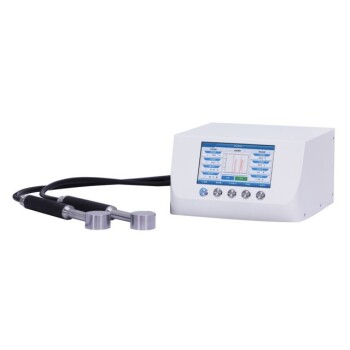
The primary function of high-precision heating equipment in this context is to accurately elevate Crystalline Organic Electrolytes (COEs) to their specific melting points, which typically range between 50°C and 100°C. By transforming the solid electrolyte into a fluid state, the equipment enables the material to deeply penetrate the complex, microscopic pore structures of cathode materials. This process, followed by controlled cooling, creates a solid, unified interface that is essential for battery performance.
High interfacial resistance is a common failure point in solid-state batteries due to poor physical contact between layers. Precision melt-casting solves this by temporarily liquefying the electrolyte to fill microscopic voids, establishing a seamless contact surface upon solidification.
Achieving the Optimal Fluid State
Targeting Moderate Melting Points
The equipment must maintain strict thermal control within a moderate window of 50°C to 100°C.
Unlike ceramics that require extreme heat, COEs rely on this specific, lower-temperature range to transition states without degrading.
Enabling Deep Pore Penetration
The core objective of liquefaction is to lower the viscosity of the electrolyte.
In its molten state, the COE flows freely, allowing it to infiltrate the tortuous pore network of the cathode.
This capability overcomes the geometric limitations of traditional solid-state manufacturing, where solid-to-solid contact is often superficial.
Establishing Intimate Interfacial Contact
The Role of Controlled Cooling
Once the molten electrolyte has fully permeated the cathode structure, the equipment facilitates a controlled cooling process.
This step is as critical as the heating phase, as it dictates how the material solidifies.
Reducing Interfacial Resistance
As the COE solidifies within the pores, it locks into place against the active particles.
This results in "intimate interfacial contact," physically bridging the gaps between components.
The direct result is a significant reduction in interfacial resistance, allowing ions to move efficiently between the cathode and the electrolyte.
Critical Considerations in Thermal Processing
Precision vs. Overheating
While the target temperature is moderate, the definition of "high-precision" implies a narrow margin for error.
Exceeding the target range could potentially degrade the organic components of the electrolyte before they solidify.
Uniformity in Solidification
The cooling phase requires uniformity to ensure the contact remains consistent throughout the battery cell.
Rapid or uneven cooling could theoretically introduce gaps or stress at the interface, negating the benefits of the melt-casting process.
Optimizing Your Melt-Casting Strategy
To leverage this process effectively, you must align your equipment capabilities with your specific performance targets.
- If your primary focus is maximizing ionic conductivity: Ensure your heating profile holds the molten state long enough for complete pore saturation before cooling begins.
- If your primary focus is material integrity: Prioritize equipment with tight thermal regulation to prevent overshooting the 50-100°C window, protecting the organic structure of the COE.
Success in this process relies not just on melting the material, but on precisely timing the transition from liquid infiltration to solid integration.
Summary Table:
| Process Phase | Temperature Range | Primary Function |
|---|---|---|
| Melt Infiltration | 50°C - 100°C | Lowers viscosity for deep penetration into cathode pores |
| Precision Heating | Strict +/- Control | Prevents thermal degradation of organic components |
| Controlled Cooling | Uniform Ramp-down | Ensures intimate interfacial contact and locks structure |
| Solidification | Ambient/Target | Reduces interfacial resistance for efficient ion transport |
Elevate Your Battery Research with KINTEK Precision
Achieving the perfect melt-cast interface requires the extreme thermal accuracy that KINTEK provides. As specialists in comprehensive laboratory pressing and heating solutions, we offer a range of manual, automatic, heated, and multifunctional models, alongside advanced cold and warm isostatic presses designed specifically for the rigors of battery research.
Don't let interfacial resistance hinder your solid-state breakthroughs. Our equipment ensures your Crystalline Organic Electrolytes (COEs) achieve optimal infiltration and structural integrity every time. Contact KINTEK today to find the high-precision heating solution tailored to your laboratory's unique requirements!
References
- Seokbum Kang, Hochun Lee. Recent Progress of the Crystalline Organic Electrolytes for Solid-State Battery Applications. DOI: 10.33961/jecst.2024.01333
This article is also based on technical information from Kintek Solution Knowledge Base .
Related Products
- Infrared Heating Quantitative Flat Plate Mold for Precise Temperature Control
- Cylindrical Lab Electric Heating Press Mold for Laboratory Use
- Automatic High Temperature Heated Hydraulic Press Machine with Heated Plates for Lab
- Lab Double Plate Heating Mold for Laboratory Use
- Automatic Laboratory Hydraulic Press for XRF and KBR Pellet Pressing
People Also Ask
- How do precision temperature-controlled heating plates function in electrolyte thermal stability storage experiments?
- What is the importance of a precision temperature-controlled heating module? Ensure Aluminum-Cadmium Thermal Stability
- How does heating platen precision affect rubber specimens? Achieve uniform density and reliable testing results.
- How are thin polymer films produced for spectroscopic analysis? Expert Guide to Heat and Low-Pressure Methods
- What accessories and field services can be used to optimize the capabilities of presses? Maximize Your Lab Performance