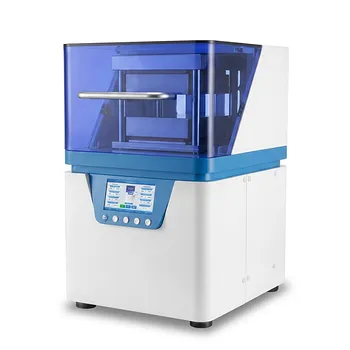
Hydraulic presses serve as dual-purpose foundational tools in materials science laboratories. Their primary functions are to simulate extreme environmental conditions for behavioral research and to precisely compact materials for analytical sample preparation.
The Core Insight: While often recognized for their brute force, the true value of a laboratory hydraulic press lies in its precision. It bridges the gap between theoretical material science and practical application by creating reproducible, high-pressure environments and uniform samples necessary for accurate spectroscopic analysis.
Simulating Extreme Environments
Replicating Natural Forces
Researchers use hydraulic presses to study how materials react when subjected to massive stress. These machines can simulate the crushing pressures found in deep-sea environments or the intense forces present within the Earth’s crust.
Investigating Material Behavior
By applying controlled high pressure, scientists can observe fundamental changes in matter. This allows for the investigation of phase transitions, structural integrity, and how materials deform or fail under stress.
Sample Preparation for Analysis
Creating Homogeneous Pellets
One of the most common daily applications of a hydraulic press is preparing samples for X-ray fluorescence spectroscopy (XRF).
Compacting Powder Mixtures
To analyze the chemical composition of a substance, loose powder must be compressed into a solid, uniform pellet. The hydraulic press applies force to create a stable disc, ensuring the distribution of components is even throughout the sample.
Ensuring Analytical Accuracy
Without the density and uniformity provided by high-pressure compaction, spectroscopic readings can be inconsistent. The press eliminates air gaps and loose particles that could skew analytical results.
Quality Control and Material Testing
Evaluating Industrial Materials
Beyond basic research, these presses are essential for testing the durability of commercial materials. They are frequently used to compact and test rubbers, plastics, and laminates to ensure they meet manufacturing standards.
Assessing Adhesion and Blocking
Presses are used to test specific performance metrics, such as blocking resistance. For example, researchers can determine how easily a printed material adheres to itself under pressure, predicting how it will behave during storage or shipping.
The Operational Trade-offs
Balancing Force and Sensitivity
While hydraulic presses generate immense force, they require careful operation. The adjustable pressure settings are critical; applying too much force too quickly can permanently damage delicate biological samples or fracture brittle ceramics before data is collected.
Maintenance vs. Durability
These machines are touted for being durable and cost-effective, but they are not maintenance-free. Seals and hydraulic fluid levels must be monitored rigorously to maintain the precision of force application over time.
Making the Right Choice for Your Goal
To maximize the utility of a hydraulic press in your lab, align its application with your specific research outcomes.
- If your primary focus is Fundamental Research: Prioritize a press with high tonnage and granular control to accurately simulate extreme environmental pressures without overshooting.
- If your primary focus is Analytical Chemistry: Focus on the press's ability to produce consistent, high-quality pellets to ensure precision in XRF and spectroscopic results.
- If your primary focus is Quality Assurance: Utilize the press to conduct repetitive stress tests on polymers and laminates to verify manufacturing consistency.
Reliable data in materials science begins with the precision of the pressure applied.
Summary Table:
| Function Category | Primary Applications | Key Benefits |
|---|---|---|
| Research & Simulation | Geologic/Deep-sea simulation, phase transitions | Precise replication of extreme environmental forces |
| Sample Preparation | XRF Pellets, powder compaction, spectroscopic discs | Ensures sample homogeneity and analytical accuracy |
| Material Testing | Durability of polymers, laminates, and rubbers | Verifies manufacturing standards and blocking resistance |
| Quality Control | Repetitive stress testing, adhesion assessment | Predicts material behavior during storage and transport |
Elevate Your Materials Research with KINTEK Precision
Ready to achieve unmatched consistency in your laboratory results? KINTEK specializes in comprehensive laboratory pressing solutions tailored to your specific research needs.
Whether you require manual, automatic, heated, or multifunctional models—including glovebox-compatible and isostatic presses (Cold/Warm)—our equipment is engineered to deliver the precision required for advanced battery research and analytical chemistry.
Contact KINTEK today to find your perfect pressing solution and ensure your laboratory has the power and control to push the boundaries of materials science.
Related Products
- Automatic Hydraulic Hot Press with Large Plate and Precision Temperature Control for Advanced Material Sample Preparation and Industrial Research
- Automatic Hydraulic Heat Press Machine with Multi Stage Programmable Control and Integrated Water Cooling Plate Size 180x180mm
- Automatic High Temperature Heated Hydraulic Press Machine with Heated Plates for Lab
- Automatic Heated Hydraulic Lab Press with Programmable Touch Screen Controls and Precision Temperature Regulation
- Manual Heated Hydraulic Lab Press with Integrated Hot Plates Hydraulic Press Machine
People Also Ask
- What are the specific features and applications of hydraulic hot press machines? Precision Solutions for Modern Labs
- How does an automatic hydraulic press operate? Achieve Precision and Consistency in Lab Pelleting
- What are the advantages and common applications of an automatic hydraulic press? Elevate Your Lab's Precision
- What is the technical significance of setting a precise dwell time? Achieve Peak Material Density and Stability
- When is an automatic hydraulic press more suitable than a manual press? Scale Your Lab with Precision & Speed