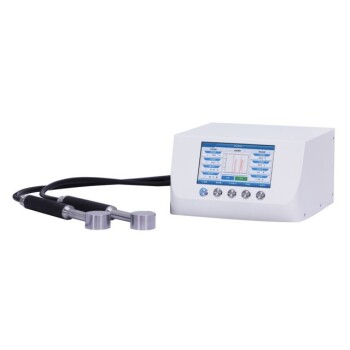
Laboratory heating equipment acts as a critical stabilization tool during the formation of organosilane layers. Its primary function is to maintain a constant temperature, typically around 50 degrees Celsius, to thermally treat surfaces that have already adsorbed organosilane molecules. This controlled heat accelerates the chemical bonding process, ensuring the coating is permanently attached rather than merely resting on the surface.
Core Takeaway While initial adsorption places silane molecules on the substrate, the application of heat is what functionally "locks" them in place. Thermal treatment drives the necessary condensation reactions and molecular cross-linking required to transform a fragile layer into a chemically stable and mechanically durable self-assembled monolayer.
The Mechanisms of Thermal Stabilization
Accelerating the Condensation Reaction
The fundamental purpose of the oven is to drive the condensation reaction.
By maintaining the environment at approximately 50 degrees Celsius, the equipment provides the energy needed for silane molecules to react efficiently with hydroxyl groups present on the substrate surface.
Promoting Molecular Cross-Linking
Beyond simple adhesion to the substrate, the layer must possess internal structural integrity.
Thermal treatment promotes molecular cross-linking between the silane molecules themselves. This creates a tightly knit network, rather than a collection of isolated molecules, significantly enhancing the layer's overall robustness.
Eliminating Reaction By-Products
Chemical reactions often leave behind unwanted residues that can weaken a coating.
The heating process assists in eliminating reaction by-products generated during the layer formation. Removing these by-products is essential for purifying the final monolayer and ensuring consistent performance.
Enhancing Layer Durability
Preventing Detachment Under Stress
A primary failure mode for organosilane layers is detachment during physical contact or wear.
The thermal process directly addresses this by increasing mechanical durability. Properly cured layers are far less likely to detach during rigorous friction testing, validating the effectiveness of the bond.
Increasing Chemical Stability
Heat treatment changes the chemical nature of the final surface.
By completing the condensation and cross-linking processes, the oven ensures the chemical stability of the self-assembled monolayers. This makes the layer more resistant to environmental degradation over time.
Critical Process Parameters
The Importance of Constant Temperature
Precision is required to achieve a uniform coating.
The equipment must be capable of maintaining a constant temperature. Fluctuations during the curing process could lead to uneven cross-linking or incomplete reactions, compromising the layer's integrity.
Adhering to Target Temperatures
The reference specifically notes a target of approximately 50 degrees Celsius.
This specific thermal window is optimized to balance reaction speed with coating quality. Deviating significantly from this temperature could either fail to drive the reaction (if too cool) or potentially damage the organic components (if too hot).
Making the Right Choice for Your Goal
To maximize the performance of your organosilane coatings, ensure your thermal treatment strategy aligns with your specific durability requirements.
- If your primary focus is mechanical durability: Ensure the heating cycle is long enough to fully maximize molecular cross-linking, preventing detachment during friction testing.
- If your primary focus is chemical purity: Verify that your equipment maintains a stable 50°C to efficiently eliminate reaction by-products without degrading the layer.
Thermal treatment is not merely a drying step; it is the chemical locking mechanism that ensures the long-term success of the monolayer.
Summary Table:
| Function | Description | Key Benefit |
|---|---|---|
| Condensation Reaction | Drives bonding between silanes and substrate | Permanent surface attachment |
| Molecular Cross-linking | Promotes internal bonding between molecules | Enhanced structural integrity |
| By-product Elimination | Removes reaction residues during heating | Higher chemical purity and stability |
| Mechanical Curing | Increases resistance to physical wear | Prevents detachment under friction |
Optimize Your Coating Precision with KINTEK
Achieving the perfect organosilane monolayer requires more than just chemistry—it requires exact thermal control. KINTEK specializes in comprehensive laboratory solutions designed for high-precision research. Whether you are performing delicate surface treatments or advanced battery research, our range of manual, automatic, heated, and multifunctional equipment provides the stability you need to ensure every layer is chemically locked and mechanically durable.
From glovebox-compatible models to isostatic presses, we empower scientists to achieve repeatable, high-performance results. Contact KINTEK today to find the perfect thermal stabilization solution for your lab!
References
- M. Cichomski, Katarzyna Lisowska. Tribological and Antimicrobial Properties of Two-Component Self-Assembled Monolayers Deposited on Ti-Incorporated Carbon Coatings. DOI: 10.3390/ma17020422
This article is also based on technical information from Kintek Solution Knowledge Base .
Related Products
- Cylindrical Lab Electric Heating Press Mold for Laboratory Use
- Laboratory Split Manual Heated Hydraulic Press Machine with Hot Plates
- Automatic Heated Hydraulic Press Machine with Hot Plates for Laboratory
- 24T 30T 60T Heated Hydraulic Lab Press Machine with Hot Plates for Laboratory
- Laboratory Manual Heated Hydraulic Press Machine with Hot Plates
People Also Ask
- How does a laboratory electric heated press ensure sample quality? Optimize SiR-EPDM vulcanization and molding.
- What role does a laboratory electric heated press play in polymer composite fabrication? Key for Standardized Specimens
- What role does a laboratory electric heating press play in NBR molding? Master Vulcanization & Material Density
- Why is a laboratory electric heating press required for PP/EPDM molding? Achieve Superior Specimen Integrity
- What is the purpose of incorporating cartridge heaters into a lab press mold for MLCC block compression? Optimize Results