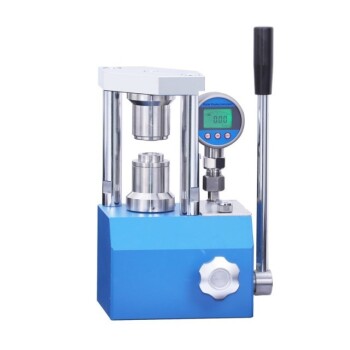
The Blank Holder's primary function is to firmly secure the aluminum foil blank against the mold surface during the deep drawing process. By applying a precise, controllable force, it prevents the material from buckling under stress while regulating the flow of metal into the die cavity to ensure a defect-free shell.
Deep drawing relies on a delicate balance of forces. The Blank Holder acts as the critical control mechanism that applies just enough pressure to suppress wrinkling without restricting material flow to the point of tearing.
The Mechanics of Material Control
Securing the Aluminum Foil
The foundational role of the Blank Holder is to clamp the aluminum foil blank securely against the mold.
This ensures the workpiece remains stationary relative to the die face before the forming begins.
Without this stabilization, the lightweight material would shift unpredictably as the punch makes contact.
Counteracting Tangential Stress
As the punch drives the material into the cavity, the aluminum undergoes significant tangential compressive stress.
If left unchecked, this stress naturally causes the thin material to buckle and fold.
The Blank Holder applies a counter-force that neutralizes this stress, keeping the flange area flat and stable.
Optimizing Forming Quality
Preventing Wrinkling
Wrinkling is a direct result of the compressive forces overwhelming the material's stiffness.
The Blank Holder mitigates this by maintaining constant, controllable pressure on the blank's surface.
This pressure forces the material to deform plastically and flow smoothly, rather than bunching up into wrinkles.
Balancing Material Flow
Beyond simply holding the material, the device acts as a precise flow regulator.
It controls the rate at which the aluminum is drawn into the cavity by the punch.
This regulation is essential for maintaining the structural integrity of ultra-thin aluminum shells.
Understanding the Trade-offs: The Pressure Window
The Risk of Excessive Force
If the blank-holding force is set too high, the friction prevents the material from flowing into the mold.
The punch will continue to pull, stretching the stationary material until it exceeds its tensile limit.
This leads to immediate tearing or fracturing of the shell wall.
The Risk of Insufficient Force
Conversely, if the pressure is too low, the holding force cannot overcome the tangential compressive stress.
The material will flow too freely and unevenly into the cavity.
This results in wrinkling along the flange or sidewalls, rendering the part geometrically inaccurate.
Achieving Precision in Lab Experiments
Success in deep drawing ultra-thin aluminum requires finding the exact "sweet spot" where pressure is high enough to flatten, but low enough to flow.
- If your primary focus is preventing wrinkles: Increase the blank-holding force incrementally to better counteract tangential compressive stress.
- If your primary focus is avoiding tears: Reduce the holding pressure to lower friction and allow easier material flow into the cavity.
Mastering the Blank Holder is the key to transforming raw aluminum foil into a flawless, high-precision component.
Summary Table:
| Function | Mechanism | Impact on Quality |
|---|---|---|
| Securing Material | Clamps foil against the mold | Prevents shifting and ensures punch alignment |
| Stress Control | Counteracts tangential stress | Suppresses buckling and folding of thin material |
| Flow Regulation | Controls draw-in rate | Prevents tearing by balancing friction and tension |
| Pressure Balance | Optimizes holding force | Eliminates wrinkles while maintaining wall integrity |
Elevate Your Battery Research with Precision Pressing Solutions
Achieving the perfect deep draw requires more than just force—it requires precision control. KINTEK specializes in comprehensive laboratory pressing solutions, offering manual, automatic, heated, multifunctional, and glovebox-compatible models, alongside advanced cold and warm isostatic presses.
Whether you are forming ultra-thin aluminum shells for battery research or developing new material prototypes, our equipment provides the exact pressure regulation needed to eliminate wrinkling and tearing. Contact KINTEK today to find the ideal press for your laboratory and ensure your research is backed by industry-leading stability and performance.
References
- Peng Zhai. Design and Manufacturing of Ultra-Thin Square Power Battery Aluminum Shell Forming Die. DOI: 10.52710/fcb.195
This article is also based on technical information from Kintek Solution Knowledge Base .
Related Products
- Lab Cylindrical Press Mold for Laboratory Use
- Lab Double Plate Heating Mold for Laboratory Use
- Lab Button Battery Disassembly and Sealing Mold
- Button Battery Sealing Machine for Button Batteries
- Manual Button Battery Sealing Machine for Battery Sealing
People Also Ask
- What is the purpose of incorporating cartridge heaters into a lab press mold for MLCC block compression? Optimize Results
- Why is precise cooling management of the lab press mold necessary? Protect Core Integrity in Thermoforming
- What is the function of a pressing tool in thermoplastic panels? Master Precision Shaping & Fusion Bonding
- Why is a high-performance laboratory molding press critical for in-situ electrolyte formation? Unlock Battery Success
- How does the geometry of laboratory molds influence mycelium-based composites? Optimize Density and Strength