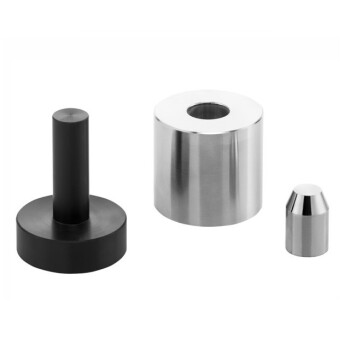
The primary function of the constant high pressure provided by laboratory press jigs is to enforce continuous "point-to-point" physical contact between solid particles that lack the wetting properties of liquid electrolytes. In the specific context of all-solid-state lithium-sulfur batteries, this pressure (typically around 20–100 MPa) acts as a mechanical buffer to counteract the massive volume expansion and contraction of sulfur active materials during charge-discharge cycles, preventing the internal components from physically disconnecting.
Core Takeaway: Solid-state batteries require external force to function because they lack liquid electrolytes to bridge gaps between particles. High pressure mechanically "fuses" the layers together, ensuring that ions can move between the cathode, anode, and electrolyte while physically constraining the electrode materials so they do not crumble during expansion.
The Critical Role of Interfacial Contact
Overcoming the Lack of Liquid Wetting
In traditional batteries, liquid electrolytes naturally permeate porous electrodes, ensuring ions can move freely. All-solid-state batteries do not have this luxury; they rely on solid-to-solid contact.
Laboratory press jigs apply constant pressure (often cited as 70 MPa) to force the active materials, conductive carbon, and solid electrolytes together. This creates tight, atomic-level interfaces necessary for ion transport.
Reducing Interfacial Resistance
Without sufficient pressure, the microscopic gaps between solid particles act as barriers to electricity. This results in high interfacial impedance (resistance).
By compacting the layers, the press jig significantly reduces this contact resistance. This ensures that the energy flows efficiently through the battery rather than being lost as heat or voltage drop at the interfaces.
Managing the Unique Physics of Sulfur
Counteracting Massive Volume Expansion
Sulfur is a unique cathode material that undergoes extreme structural changes during cycling. It can experience a volume expansion of up to 78% during lithiation (discharging).
If the battery were unconstrained, this expansion would distort the cell. The constant pressure provided by the jig acts as a containment system, mechanically restricting this expansion to maintain the cell's overall shape and integrity.
Preventing Delamination and Disconnection
The greater risk occurs when the sulfur contracts during delithiation (charging). Without external pressure, the material would shrink away from the electrolyte, creating voids.
This leads to physical disconnection or "delamination," where the electrode separates from the electrolyte. The jig maintains a squeezing force that ensures the materials stay connected even as they shrink, preventing rapid capacity decay and extending the battery's cycle life.
Understanding the Trade-offs
The Necessity of Uniformity
While high pressure is essential, it must be applied uniformly. A laboratory press ensures the force is distributed evenly across the active area.
Localized overpressure can damage the brittle solid electrolyte or cause internal short circuits. Conversely, insufficient pressure in specific spots leads to "dead zones" where no electrochemical reaction occurs.
Balancing Pressure and Material Limits
There is a limit to how much pressure is beneficial. While ranges like 60–100 MPa are common for stabilizing sulfur, excessive pressure can mechanically degrade the solid electrolyte layer.
The goal is to find the "sweet spot" where contact is maximized and lithium dendrite growth is inhibited, without crushing the electrolyte structure or requiring impractical engineering for commercial application.
Making the Right Choice for Your Goal
To maximize the utility of your electrochemical testing, align your pressure strategy with your specific research objectives:
- If your primary focus is Cycle Life Stability: Prioritize maintaining a constant, high pressure (e.g., near 60-70 MPa) to mechanically constrain the 78% volume change of sulfur and prevent delamination over time.
- If your primary focus is Initial Capacity: Focus on the uniformity of the pressure application to minimize interfacial impedance and ensure 100% active area utilization during the first cycle.
- If your primary focus is Reliability of Data: Use a high-precision fixture that actively compensates for expansion (spring-loaded or hydraulic) rather than a static clamp, to ensure the pressure remains constant as the battery "breathes."
Success in solid-state sulfur testing is not just about the chemistry; it is about mechanically engineering the environment so that the chemistry can survive the physical stress of operation.
Summary Table:
| Function | Mechanism | Impact on Battery Performance |
|---|---|---|
| Interfacial Contact | Forces "point-to-point" physical contact | Enables ion transport & overcomes lack of liquid wetting |
| Impedance Reduction | Eliminates microscopic gaps between solids | Lowers contact resistance and prevents voltage drops |
| Volume Management | Counteracts sulfur's 78% volume expansion | Prevents material delamination and physical disconnection |
| Structural Integrity | Constrains active material during cycling | Maintains cell shape and extends cycle life stability |
Maximize Your Battery Research Precision with KINTEK
Don't let interfacial resistance or material expansion compromise your electrochemical data. KINTEK specializes in comprehensive laboratory pressing solutions tailored for high-performance battery research. Our range includes:
- Manual & Automatic Presses: For precise, repeatable pressure application.
- Heated & Multifunctional Models: To simulate real-world operating environments.
- Cold & Warm Isostatic Presses: Ideal for achieving superior density in solid-state electrolytes.
- Glovebox-Compatible Designs: Ensuring moisture-free assembly for sensitive sulfur chemistries.
Whether you are stabilizing sulfur's volume changes or minimizing impedance, KINTEK provides the mechanical reliability your research demands. Contact us today to find the perfect pressing solution for your lab!
References
- Jieun Lee, Gui‐Liang Xu. Halide segregation to boost all-solid-state lithium-chalcogen batteries. DOI: 10.1126/science.adt1882
This article is also based on technical information from Kintek Solution Knowledge Base .
Related Products
- Warm Isostatic Press for Solid State Battery Research Warm Isostatic Press
- Laboratory Hydraulic Press Lab Pellet Press Button Battery Press
- Lab Infrared Press Mold for Laboratory Applications
- Button Battery Sealing Press Machine for Lab
- Lab Cylindrical Press Mold for Laboratory Use
People Also Ask
- Why must composite cathodes be sealed in vacuum lamination bags for WIP? Ensure Battery Stability and Density
- How do sacrificial volume materials (SVM) maintain microchannels in isostatic pressing? Ensure Structural Integrity
- What is the function of elastic molds in warm isostatic pressing? Achieve Uniform Density in Composite Particles
- What is the function of hydraulic pressure in warm isostatic pressing? Achieve Uniform Material Density
- How does Warm Isostatic Pressing differ from traditional pressing methods? Unlock Uniform Density for Complex Parts