
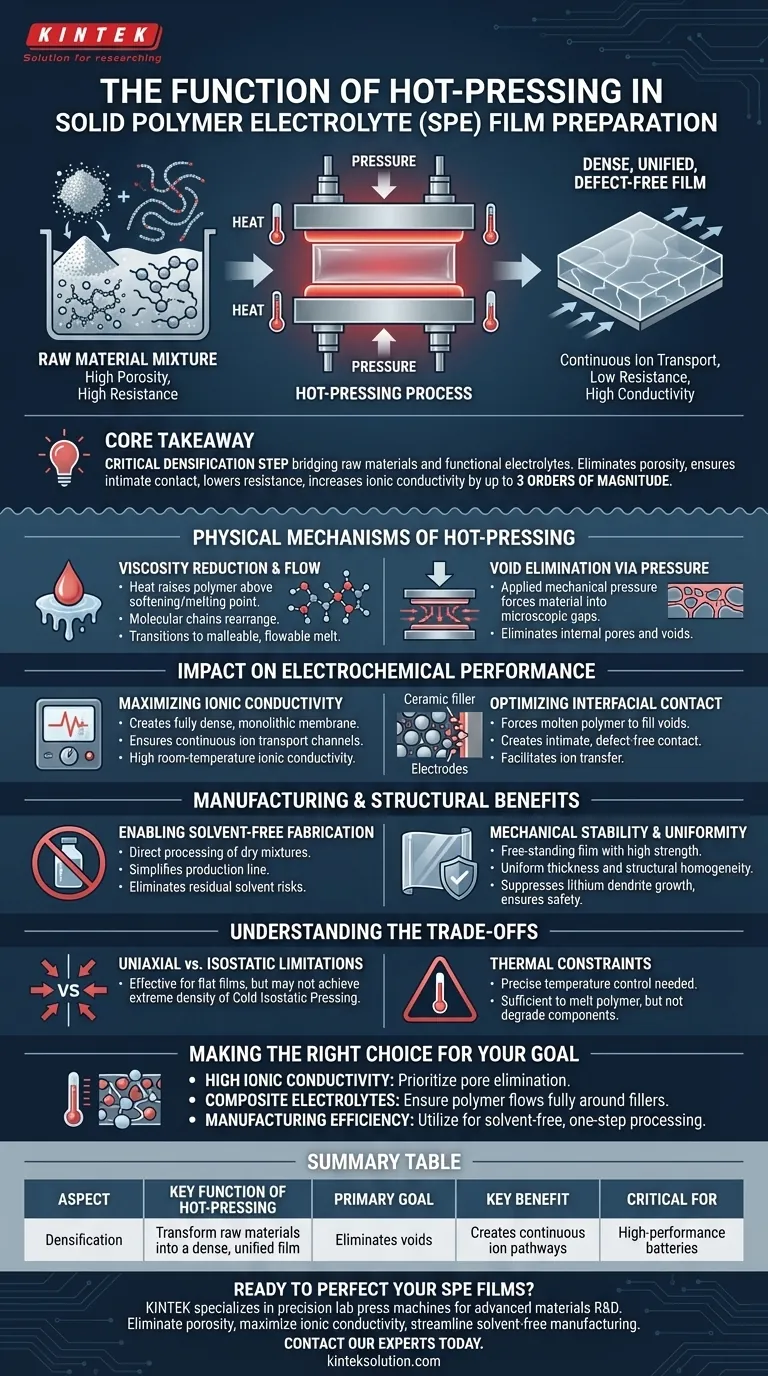
The primary function of hot-pressing in solid polymer electrolyte (SPE) preparation is to simultaneously apply heat and pressure to transform raw materials into a dense, unified, and defect-free film. By lowering the polymer's viscosity and forcing it to flow into interstitial voids, this process creates the continuous pathways necessary for efficient ion transport.
Core Takeaway Hot-pressing is the critical "densification" step that bridges the gap between raw polymer mixtures and functional electrolytes. By eliminating internal porosity and ensuring intimate contact between particles, it significantly lowers interfacial resistance and can increase ionic conductivity by up to three orders of magnitude.

The Physical Mechanisms of Hot-Pressing
Viscosity Reduction and Flow
The fundamental mechanism relies on the heated platens raising the polymer (often PEO-based) above its softening point or melting temperature. This thermal energy creates molecular chain rearrangement, drastically reducing the material's viscosity. The polymer transitions from a solid or powder state into a malleable, flowable melt.
Void Elimination via Pressure
Once the polymer is softened, the applied mechanical pressure (uniaxial) forces the material to flow into microscopic gaps. This action eliminates internal pores and voids that naturally exist between powder particles or remain after solvent evaporation in spray-coated layers.
Impact on Electrochemical Performance
Maximizing Ionic Conductivity
Porosity is the enemy of ion transport; air gaps act as insulators. Hot-pressing creates a fully dense, monolithic membrane. This densification ensures continuous ion transport channels are formed, which is essential for achieving high room-temperature ionic conductivity.
Optimizing Interfacial Contact
In composite electrolytes (containing ceramic fillers) or when bonding electrolytes to electrodes, solid-solid interface resistance is a major challenge. Hot-pressing forces the molten polymer to fill the voids between solid particles or electrode surfaces. This creates intimate, defect-free contact, facilitating easier ion transfer across boundaries.
Manufacturing and Structural Benefits
Enabling Solvent-Free Fabrication
Hot-pressing serves as a decisive shaping tool for "one-step" manufacturing. It allows for the direct processing of dry mixtures (polymer, salt, plasticizer) into finished films without the need for solvents. This simplifies the production line and eliminates the risk of residual solvent trapping.
Mechanical Stability and Uniformity
The process results in a free-standing film with high mechanical strength. Unlike non-pressed films, which may be brittle or porous, hot-pressed films possess uniform thickness and structural homogeneity. This mechanical stability is vital for suppressing lithium dendrite growth and ensuring battery safety during cycling.
Understanding the Trade-offs
Uniaxial vs. Isostatic Limitations
Hot-pressing typically applies uniaxial pressure (pressure from top and bottom). While effective for flat films, it may not achieve the extreme density possible with Cold Isostatic Pressing (CIP), which applies uniform pressure from all directions (up to 500 MPa).
Thermal Constraints
The process requires precise temperature control. The heat must be sufficient to melt the polymer matrix for flow, but not so high that it degrades the polymer chains or other sensitive components within the electrolyte mixture.
Making the Right Choice for Your Goal
To maximize the effectiveness of hot-pressing in your SPE fabrication, consider your primary objective:
- If your primary focus is High Ionic Conductivity: Prioritize pressure parameters to ensure total pore elimination; even microscopic voids will sever ion pathways and increase resistance.
- If your primary focus is Composite Electrolytes: Ensure the temperature is set high enough to allow the polymer to flow fully around the ceramic fillers, minimizing the solid-solid interfacial resistance.
- If your primary focus is Manufacturing Efficiency: Utilize hot-pressing for solvent-free protocols (dry mixing), as this combines shaping and densification into a single, rapid step.
Summary: Hot-pressing is not merely a shaping technique; it is the essential densification step that dictates the final connectivity and efficiency of the ion transport network within the electrolyte.
Summary Table:
| Aspect | Key Function of Hot-Pressing |
|---|---|
| Primary Goal | Densification: Transform raw materials into a dense, unified film |
| Mechanism | Applies heat (reduces viscosity) and pressure (eliminates voids) |
| Key Benefit | Creates continuous ion pathways, increasing ionic conductivity |
| Manufacturing | Enables solvent-free fabrication of free-standing films |
| Critical For | High-performance batteries requiring efficient ion transport |
Ready to perfect your solid polymer electrolyte films?
KINTEK specializes in precision lab press machines, including automatic and heated lab presses, designed specifically for research and development in advanced materials like SPEs. Our equipment provides the exact control over temperature and pressure you need to eliminate porosity, maximize ionic conductivity, and streamline your solvent-free manufacturing process.
Contact our experts today to discuss how our reliable and precise pressing solutions can help you achieve superior electrochemical performance and accelerate your battery development.
Visual Guide
Related Products
- Automatic High Temperature Heated Hydraulic Press Machine with Heated Plates for Lab
- Heated Hydraulic Press Machine with Heated Plates for Vacuum Box Laboratory Hot Press
- Automatic Heated Hydraulic Press Machine with Hot Plates for Laboratory
- Heated Hydraulic Press Machine With Heated Plates For Vacuum Box Laboratory Hot Press
- Laboratory Split Manual Heated Hydraulic Press Machine with Hot Plates
People Also Ask
- Function of a Laboratory Hydraulic Press with Heated Platens in SSE? Enhance Battery Density & Conductivity
- What are the requirements for electrode pressing with high-viscosity ionic liquids like EMIM TFSI? Optimize Performance
- How does a laboratory heated hydraulic press facilitate PBN sample prep for WAXS? Achieve Precise X-Ray Scattering
- What are the industrial applications of heated hydraulic presses? Master Heat & Force for Precision Manufacturing
- Why is a laboratory hydraulic press with heating plates required for PLA/TEC films? Achieve Precise Sample Integrity



















