
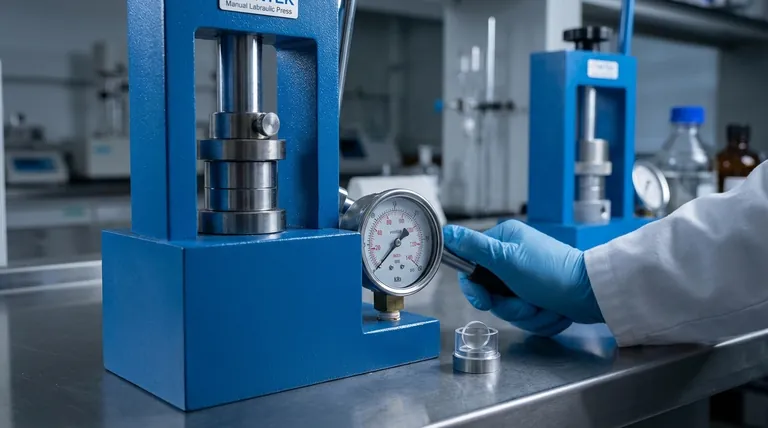
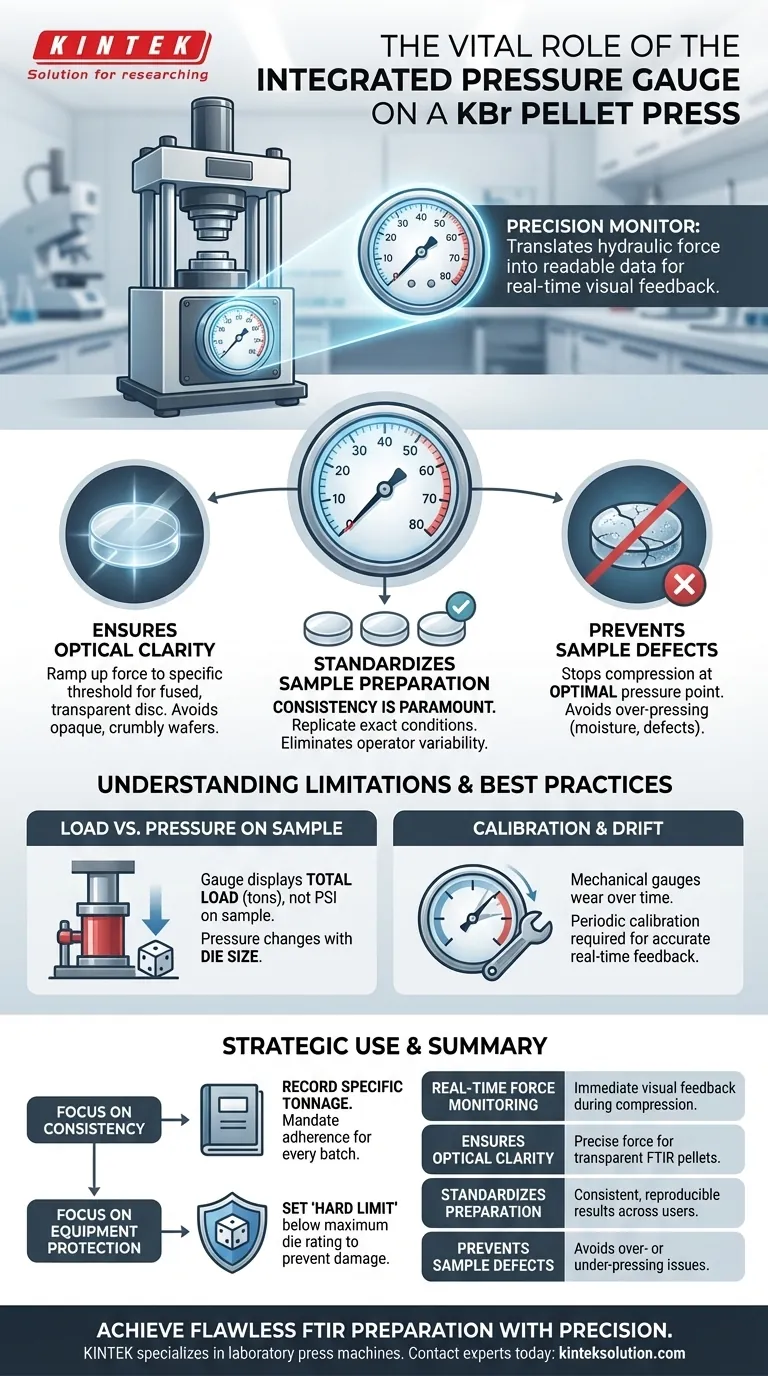
The integrated pressure gauge functions as a precision monitor, providing real-time visual feedback on the force being applied to your sample during compression. By translating hydraulic force into readable data, it enables the operator to achieve the exact load required to fuse Potassium Bromide (KBr) powder into a transparent, analytical-grade disc.
Core Takeaway: While the mechanism is simple, the pressure gauge is the driver of reproducibility. It transforms pellet preparation from a manual estimation into a controllable scientific process, ensuring every sample receives the specific force necessary for accurate FTIR spectral transmission.
Why Pressure Control is Critical for FTIR Analysis
The difference between a usable KBr pellet and a failed sample often comes down to the precision of the applied force. The gauge is your primary tool for navigating this variable.
Ensuring Optical Clarity
To function correctly in Fourier Transform Infrared (FTIR) spectroscopy, a KBr pellet must be transparent.
The pressure gauge allows you to ramp up force until you reach the specific threshold where KBr crystals fuse and become optically clear. Without this visual guide, you risk under-pressing, resulting in an opaque, crumbly wafer that scatters light and ruins your data.
Standardizing Sample Preparation
In research and quality control, consistency is paramount.
If you prepare a sample at 8 tons of pressure today, you must be able to replicate that exact condition next week. The gauge provides a quantifiable metric, allowing you to create Standard Operating Procedures (SOPs) that eliminate operator-to-operator variability.
preventing Sample Defects
Applying too much pressure can be just as detrimental as applying too little.
Excessive force can cause "wet" pellets due to moisture absorption or create crystal lattice defects that alter the infrared spectrum. The gauge allows users to stop compression exactly at the optimal pressure point, preventing these structural anomalies.
Understanding the Limitations
While the gauge is essential, relying on it requires an understanding of its physical constraints.
Load vs. Pressure on the Sample
The gauge typically displays the total load (e.g., in tons) applied by the hydraulic ram, not necessarily the pressure per square inch on the sample itself.
You must remember that pressure changes if the die size changes. Applying 10 tons to a 13mm die creates significantly less internal pressure than applying 10 tons to a 7mm die.
Calibration and Drift
Mechanical gauges are subject to wear and can drift over time.
A reading of "10 tons" may eventually represent 9.5 or 10.5 tons as the internal springs fatigue. Periodic calibration checks are necessary to ensure the "real-time feedback" remains accurate.
Making the Right Choice for Your Goal
To get the most out of your KBr pellet press, you must use the gauge as part of a broader strategy.
- If your primary focus is Consistency: Record the specific tonnage used for every successful pellet and mandate that all team members adhere to that exact number for future batches.
- If your primary focus is Equipment Protection: Use the gauge to set a "hard limit" below the maximum rating of your die set to prevent warping or cracking expensive hardened steel components.
By treating the pressure gauge as a data input rather than just a dial, you ensure the integrity of your entire spectroscopic workflow.
Summary Table:
| Function | Key Benefit |
|---|---|
| Real-Time Force Monitoring | Provides immediate visual feedback during compression. |
| Ensures Optical Clarity | Applies precise force to create transparent pellets for FTIR. |
| Standardizes Preparation | Enables consistent, reproducible results across users and batches. |
| Prevents Sample Defects | Avoids over-pressing (moisture absorption) or under-pressing (crumbly pellets). |
Achieve flawless FTIR sample preparation with precision you can trust.
The integrated pressure gauge is the key to transforming your KBr pellet pressing from an estimation into a controlled, scientific process. For laboratories where accuracy and reproducibility are non-negotiable, the right equipment makes all the difference.
KINTEK specializes in laboratory press machines, including automatic lab presses, isostatic presses, and heated lab presses designed to meet the exacting demands of modern research. Our equipment empowers your team to produce high-quality samples with confidence.
Ready to enhance your spectroscopic workflow? Contact our experts today to find the perfect press for your laboratory's needs.
Visual Guide
Related Products
- Laboratory Hydraulic Press 2T Lab Pellet Press for KBR FTIR
- XRF KBR Plastic Ring Lab Powder Pellet Pressing Mold for FTIR
- XRF KBR Steel Ring Lab Powder Pellet Pressing Mold for FTIR
- Laboratory Hydraulic Pellet Press for XRF KBR FTIR Lab Press
- Automatic Laboratory Hydraulic Press for XRF and KBR Pellet Pressing
People Also Ask
- What is the role of a laboratory pressure machine and KBr in FTIR? Master Sample Preparation for Flame Retardants
- What is the role of a laboratory hydraulic press in high-loading NCM811 cathode prep for solid-state batteries?
- What role does a laboratory hydraulic press play in reaction pellets? Optimizing Lunar Soil and Metal Fuel Density
- Why is a laboratory hydraulic press necessary for sample preparation? Precise Pelleting for Spiro Heterocyclic Analysis
- What role does a laboratory hydraulic press play in perovskite R&D? Essential for High-Density Material Synthesis



















