
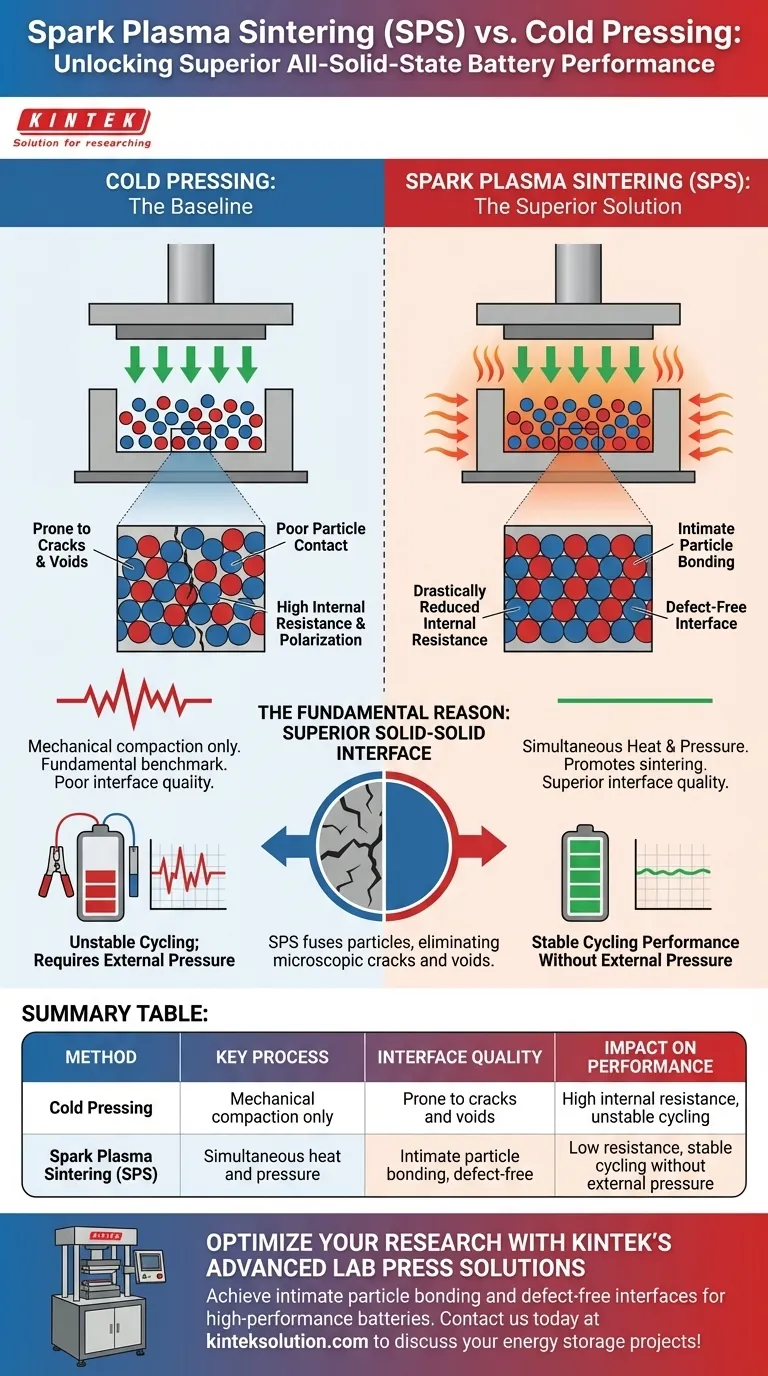
The fundamental reason for the superior performance of Spark Plasma Sintering (SPS) is the creation of a significantly higher quality solid-solid interface. While cold pressing relies solely on mechanical compaction, SPS utilizes simultaneous heating and pressure to promote strong bonding between particles. This process creates a robust internal structure that simple pressing cannot achieve.
The simultaneous application of heat and pressure in SPS fuses particles together, eliminating the microscopic cracks and voids inherent to cold pressing and drastically reducing the battery's internal resistance.
The Mechanism of Interface Improvement
Simultaneous Heat and Pressure
The defining advantage of SPS over cold pressing is the introduction of thermal energy during the compaction process.
By combining heating with pressure, SPS promotes sintering, a process where particles fuse together at the atomic level.
Eliminating Structural Defects
Samples prepared by cold pressing alone frequently suffer from structural imperfections.
Specifically, these samples often contain interface cracks and voids where particles fail to make contact.
SPS effectively eliminates these defects, resulting in a well-defined, intimate interface that is free of the gaps found in cold-pressed counterparts.
Electrochemical Performance Gains
Reducing Internal Resistance
The physical quality of the solid-solid interface has a direct impact on electrical efficiency.
The intimate bonding achieved by SPS drastically reduces the battery's internal resistance and polarization.
This reduction allows ions to flow more freely through the material, enhancing the overall efficiency of the cell.
Stability Without External Aids
A major limitation of cold-pressed batteries is the frequent need for external support to function correctly.
Because of the superior bonding, SPS-assembled batteries demonstrate stable cycling performance even without a continuous external pressure load.
This allows for more practical battery designs that do not rely on heavy, external clamping mechanisms to maintain particle contact.
Understanding the Trade-offs: The Role of Cold Pressing
Establishing a Baseline
While SPS offers superior performance, cold pressing remains a critical benchmark in battery research.
It is a fundamental powder compaction technique used to evaluate the baseline performance of materials before advanced processing.
Isolating Variables
Comparing SPS against cold pressing allows researchers to clearly assess how different forming mechanisms affect performance.
It helps highlight specific variables, such as how thick electrodes behave under different pressure and sintering conditions.
Understanding the limitations of cold pressing—such as poor particle contact—is essential for verifying the specific improvements provided by SPS.
Making the Right Choice for Your Project
The choice between these assembly methods depends on whether you are establishing a baseline or optimizing for maximum efficiency.
- If your primary focus is high-performance cycling: Utilize Spark Plasma Sintering (SPS) to ensure low resistance and stable operation without the need for external pressure.
- If your primary focus is material benchmarking: Use cold pressing to establish a control sample and clearly identify the impact of interface defects on your material.
By leveraging the thermal and mechanical advantages of SPS, you transform a collection of particles into a cohesive, high-efficiency energy storage unit.
Summary Table:
| Method | Key Process | Interface Quality | Impact on Performance |
|---|---|---|---|
| Cold Pressing | Mechanical compaction only | Prone to cracks and voids | High internal resistance, unstable cycling |
| Spark Plasma Sintering (SPS) | Simultaneous heat and pressure | Intimate particle bonding, defect-free | Low resistance, stable cycling without external pressure |
Ready to optimize your all-solid-state battery research with superior sintering technology?
KINTEK specializes in advanced lab press machines, including automatic and heated lab presses ideal for Spark Plasma Sintering (SPS) applications. Our equipment helps you achieve the intimate particle bonding and defect-free interfaces necessary for high-performance batteries, reducing internal resistance and enabling stable cycling without external aids.
Contact us today to discuss how our lab press solutions can enhance your energy storage projects. Get in touch now!
Visual Guide
Related Products
- Automatic High Temperature Heated Hydraulic Press Machine with Heated Plates for Lab
- Split Automatic Heated Hydraulic Press Machine with Heated Plates
People Also Ask
- Function of a Laboratory Hydraulic Press with Heated Platens in SSE? Enhance Battery Density & Conductivity
- What are the requirements for electrode pressing with high-viscosity ionic liquids like EMIM TFSI? Optimize Performance
- How does a laboratory heated hydraulic press facilitate PBN sample prep for WAXS? Achieve Precise X-Ray Scattering
- What are the industrial applications of heated hydraulic presses? Master Heat & Force for Precision Manufacturing
- Why is a laboratory hydraulic press with heating plates required for PLA/TEC films? Achieve Precise Sample Integrity

