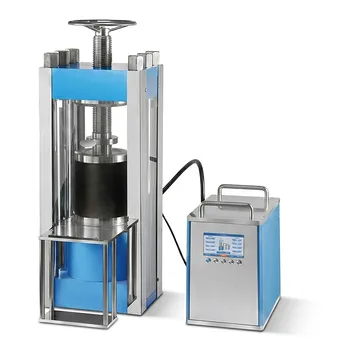
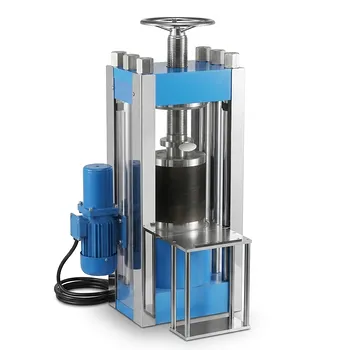
The general operating procedure for a laboratory hot press follows a strict sequence of verification, programming, execution, and safe retrieval to ensure consistent sample quality. This process begins with checking utilities like hydraulic oil and cooling water, followed by inputting precise temperature and pressure parameters into the control system. The cycle concludes only after the equipment has automatically cooled the sample to a safe handling temperature, ensuring operator safety and protecting the platens.
Success with a laboratory hot press relies on more than just applying heat and force; it depends on the precise synchronization of your parameters and utilities. Adhering to the "Cooling and Release" phase is just as critical for sample integrity as the active pressing stage.
Phase 1: Preparation and Configuration
Before a single sample is loaded, you must establish the machine's readiness and define the process environment.
Conducting the Pre-Operation Check
Never skip the initial inspection. You must verify the status of the hydraulic oil levels, the compressed air source, and the cooling water supply.
These utilities are the lifeblood of the machine; failing to check them can lead to stalled cycles or overheating components.
System Initialization
Turn on the main power and activate the control system. This energizes the Human-Machine Interface (HMI) and prepares the sensors for input.
Programming the Parameters
Using the HMI (touch screen or keypad), input your specific requirements for temperature, pressure, and time.
Modern systems often use PID (Proportional-Integral-Derivative) controllers. This allows you to manage the heating rate and holding time with high precision, rather than just setting a static target.
Phase 2: The Pressing Cycle
Once the machine is prepped, the focus shifts to the physical sample and the automated execution of the program.
Correct Sample Placement
Position your mold or sample centrally on the lower platen.
Central alignment is non-negotiable. Off-center loading can damage the robust frame or causing uneven pressure distribution, leading to defective samples.
Initiating the Program
Start the automated hot pressing cycle via the control panel. At this stage, you should actively monitor the readout to ensure the heating rate matches your programmed curve.
The Holding Stage
During this phase, the equipment automatically maintains the set pressure and temperature. The pressure controller works to keep the force constant, compensating for any material changes as the sample softens or cures.
Phase 3: Conclusion and Safety
The procedure is not complete until the machine returns to a neutral, safe state.
Automated Cooling and Release
Once the holding time elapses, the program initiates pressure release and the cooling cycle. Do not attempt to force the platens open manually during this stage.
Safe Sample Removal
Wait until the temperature drops to a safe level, typically below 60°C, before interacting with the sample area.
Removing a sample prematurely can cause thermal shock to the material or burn injuries to the operator.
Shutdown and Maintenance
After removing the sample, clean the platens immediately to remove any residue. Finally, turn off the power to complete the operation.
Common Operational Pitfalls
Even with a defined procedure, errors in judgment can compromise results or damage the equipment.
Ignoring the Cooling Phase
Rushing the removal process is a frequent error. Extracting materials above the recommended 60°C often leads to warping or internal stress in the sample, negating the precision of the pressing phase.
Neglecting Utility Verification
Skipping the pre-check of the air source or cooling water allows the machine to start a cycle it cannot finish safely. This often triggers emergency stops mid-cycle, wasting both the sample and valuable time.
Ensuring Consistent Results
Your approach to the hot press procedure should vary slightly depending on your specific research goals.
- If your primary focus is Repeatability: Ensure you utilize the PID control features to standardize the heating rate, not just the final target temperature.
- If your primary focus is Equipment Longevity: Prioritize the pre-operation check of hydraulic fluids and strictly adhere to the cleaning protocol after every single cycle.
Operational discipline turns a mechanical process into a reliable scientific standard.
Summary Table:
| Phase | Key Actions | Critical Requirements |
|---|---|---|
| 1. Preparation | Utility check, System Power, PID Programming | Verify hydraulic oil, cooling water, and air source |
| 2. Execution | Central Sample Loading, Cycle Initiation | Ensure central alignment to prevent frame damage |
| 3. Conclusion | Automated Cooling, Pressure Release, Cleaning | Temperature must be <60°C before sample retrieval |
Elevate Your Material Research with KINTEK Pressing Solutions
At KINTEK, we understand that precision in the lab is non-negotiable. Whether you are conducting advanced battery research or polymer testing, our comprehensive range of laboratory pressing solutions—including manual, automatic, heated, and multifunctional models, as well as cold and warm isostatic presses—is designed to deliver the consistency your data demands.
Why choose KINTEK?
- Glovebox Compatibility: Seamless integration for moisture-sensitive battery research.
- Precision Control: Advanced PID systems for exact temperature and pressure ramps.
- Durability: Robust frames built for high-throughput laboratory environments.
Contact our experts today to find the perfect hot press for your application and ensure your laboratory procedures remain world-class.
Related Products
- 24T 30T 60T Heated Hydraulic Lab Press Machine with Hot Plates for Laboratory
- Laboratory Split Manual Heated Hydraulic Press Machine with Hot Plates
- Heated Hydraulic Press Machine with Heated Plates for Vacuum Box Laboratory Hot Press
- Automatic Heated Hydraulic Press Machine with Hot Plates for Laboratory
- Automatic Large Format Laboratory Heated Hydraulic Press 400x400mm Plate Capacity
People Also Ask
- Function of a Laboratory Hydraulic Press with Heated Platens in SSE? Enhance Battery Density & Conductivity
- Why is a laboratory hydraulic press with heating plates required for PLA/TEC films? Achieve Precise Sample Integrity
- What role does a laboratory heated hydraulic press play in LTCC? Essential for High-Density Ceramic Lamination
- Why reduce load when applying composite strengthening tabs? Protect Specimen Integrity and Data Accuracy
- Why is a laboratory heated hydraulic press required? Ensure Precise Vulcanization for NBR/EPDM Nanocomposites