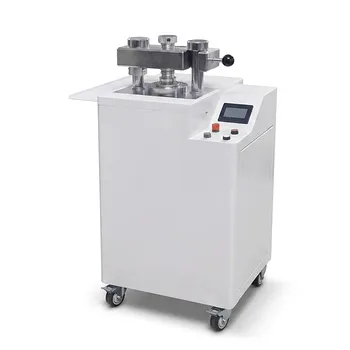
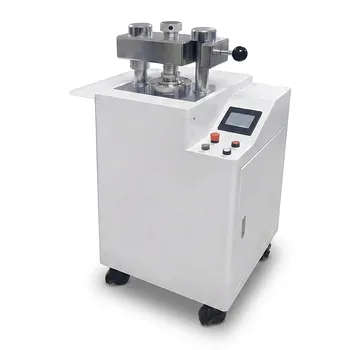
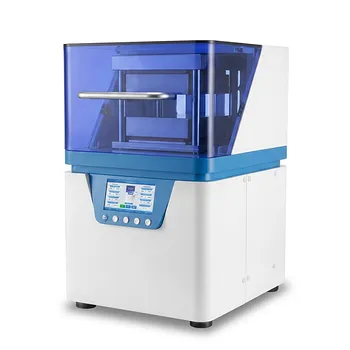
The general procedure for pellet pressing involves compressing a prepared powder mixture within a die to create a solid, compact sample. The core workflow requires mixing the powder with a binder, loading it into a die, and applying significant pressure—typically between 15 and 35 metric tons—to achieve plastic deformation and particle bonding.
Core Insight: The applied pressure is not merely for shaping; it is the critical variable determining the pellet's final density and structural integrity. Success relies on balancing mechanical force with the material's ability to deform and bond without fracturing.
Phase 1: Preparation and Setup
The quality of the final pellet is often determined before the press is even activated. Proper preparation ensures the powder can be compressed uniformly.
Material Preparation
Before pressing, the raw powder must be adequately mixed with a binder.
This additive is essential for creating cohesion between particles, ensuring the pellet holds its shape after the pressure is removed.
Equipment Verification
Perform a pre-operation check on the press machine.
Verify the status of the power supply, hydraulic oil levels, and air sources. If utilizing a hot press, ensure the cooling water system is functional and clean.
Parameter Configuration
Input the necessary processing parameters into the control system.
Standard settings include the target pressure (metric tons) and hold time. For hot pressing applications, temperature settings must also be defined.
Phase 2: The Compaction Process
This phase represents the mechanical transformation of loose powder into a solid geometric form.
Loading the Die
Place the powder mixture into the die cavity.
Ensure the sample or mold is positioned centrally on the lower platen of the press. Off-center loading can lead to uneven pressure distribution and pellet failure.
Application of Pressure
Initiate the pressing cycle to apply force to the powder.
The pressure is typically ramped up to a specified level, often between 15 to 35 metric tons depending on the material hardness and desired density.
Deformation and Bonding
As pressure increases, the material undergoes plastic deformation.
This mechanical compression forces particles together, drastically reducing porosity and gaps. The friction and deformation cause the particles to bond, creating a cohesive solid structure.
The Holding Stage
Once the target pressure is reached, the machine maintains this force for a set duration.
This "dwell time" allows the internal stresses to equilibrate and ensures uniform density throughout the pellet.
Phase 3: Release and Extraction
The final steps involve safely retrieving the consolidated part while preserving its structure.
Pressure Release
The program concludes by automatically or manually releasing the hydraulic pressure.
If heat was applied, the system will also initiate a cooling cycle to bring the sample down to a safe handling temperature (typically below 60°C).
Sample Removal
Carefully extract the pellet from the die.
This is the most delicate stage; sudden shocks or uneven force during ejection can cause the pellet to laminate or crack.
Understanding the Trade-offs
While the procedure is straightforward, several variables can negatively impact the result if not managed correctly.
Pressure Limitations
Applying insufficient pressure will result in a weak, porous pellet that crumbles easily.
Conversely, excessive pressure can cause the pellet to store too much elastic energy, leading to "capping" or transverse cracks when the pressure is released.
Uniformity Issues
Standard die pressing creates density gradients due to wall friction.
Unlike isostatic pressing, which applies pressure equally from all directions, die pressing may result in a pellet that is denser at the edges than in the center.
Making the Right Choice for Your Goal
The specific parameters you choose should align with your end-use requirements for the pellet.
- If your primary focus is high structural strength: Prioritize a higher pressure setting (closer to 35 metric tons) and ensure the binder is thoroughly distributed to maximize particle bonding.
- If your primary focus is delicate or brittle materials: Use a lower pressure setting with a longer dwell time to allow air to escape without stressing the material structure.
- If your primary focus is analysis (e.g., XRF/XRD): Ensure the surface is perfectly flat and free of contamination by thoroughly cleaning the platens and die before loading.
Mastering the pellet pressing process requires treating pressure as a precise tool for material manipulation, not just a mechanism for flattening powder.
Summary Table:
| Stage | Key Activities | Critical Parameters |
|---|---|---|
| Preparation | Mixing powder with binder, checking hydraulic levels | Binder ratio & parameter settings |
| Compaction | Central die loading, applying force | 15 - 35 metric tons of pressure |
| Holding | Maintaining pressure for dwell time | Pressure equilibration & density control |
| Extraction | Releasing pressure & cooling | Careful ejection to prevent cracking |
Elevate Your Material Research with KINTEK Pressing Solutions
Precision in pellet pressing is the foundation of accurate laboratory analysis. KINTEK specializes in comprehensive laboratory pressing solutions designed to meet the rigorous demands of battery research and material science.
Our versatile range includes:
- Manual & Automatic Presses: For flexible or high-throughput workflows.
- Heated & Multifunctional Models: Ideal for advanced thermal transformations.
- Glovebox-Compatible & Isostatic Presses: Ensuring maximum density and contamination-free processing.
Whether you are working on delicate brittle materials or high-strength solid-state batteries, KINTEK provides the mechanical reliability and uniform pressure control you need.
Ready to optimize your sample preparation? Contact our technical experts today to find the perfect press for your lab!
Related Products
- Automatic XRF Pellet Press for Laboratory Spectrometry Sample Preparation
- Laboratory Hydraulic Split Electric Lab Pellet Press
- Laboratory Hydraulic Pellet Press for XRF KBR FTIR Lab Press
- Manual Laboratory Hydraulic Pellet Press Lab Hydraulic Press
- Automatic Fluorescence Sample Preparation Press 40 Ton Lab Pellet Press for XRF Analysis
People Also Ask
- How can contamination occur during the preparation of pressed pellets for XRF analysis? Expert Prevention Guide
- How does the sample material influence the required pressing load for making an XRF pellet? Find the Optimal Pressure
- What are the different methods for preparing a sample pellet for XRF analysis? Expert Guide to Superior XRF Results
- What are the advantages of preparing a sample as a dense pellet for XRF? Unlock High-Precision Trace Element Analysis
- What is the primary purpose of using an automatic pellet press? Achieve Precise Geopolymer Analysis Results